
Dutch post-punk project Bragolin has cast a looming shadow across the international darkwave scene. For the past eight years, its music has passed from listener to listener through word of mouth and digital playlists assembled with the care once given to hand-dubbed mixtapes. With about 300,000 monthly Spotify listeners, the band now stands among the Netherlands’ most-listened-to contemporary wave exports, drawing an audience far beyond Utrecht. The band began there in 2013, when Edwin van der Velde transferred a guitar riff intended for his Dutch-language project Zwarte Poëzie onto a newly purchased Bass VI. The instrument changed the riff’s character and, with it, the course of his work. That piece became Into Those Woods, the first Bragolin song and a centerpiece of the 2018 debut, I Saw Nothing Good So I Left. The album has since been repressed six times on vinyl, while the track’s baritone hook carried it beyond ten million streams and onto darkwave dance floors around the world.
Van der Velde expanded Bragolin in 2019 through Let Out The Noise Inside, a full-album collaboration with Adam Tristar that brought more electronic production into the project. Synth player Edwin Daatselaar joined the following year, establishing the current live duo; both musicians also play in Zwarte Poëzie. Bragolin has since performed more than one hundred shows across Europe and Latin America, including appearances at Wave-Gotik-Treffen, Amphi Festival, Cold Hearted Festival, Extramuralhas, and Kalabalik. The debut has continued to find new listeners as well: seven years after its release, This Grotesque Dance took off on TikTok and is now Bragolin’s most-streamed song, with over 7 million streams on Spotify alone.
Bragolin’s third album, I Don’t Like What It Does to Me, retains the Bass VI, organ tones, and dance rhythms at the center of van der Velde’s writing while widening the arrangements with waterphone, synthetic ocean textures, seagull field recordings, strings, and a guitarless piece assembled entirely from layered Clavinets. “Visuals are what draw my attention,” van der Velde says, and references to The Lighthouse, It Follows, The Thing, and Invasion of the Body Snatchers enter these songs as stories of pursuit, artificial replication, surrender, and disappearance. Carrellee joins him on the album’s duet, Feel This Flame Unfold, extending a collaboration that will continue throughout the upcoming North American and European tours.
Post-Punk.com spoke with van der Velde about the Nirvana and Björk records that first drew him toward songwriting, growing up beyond Drenthe’s blues and metal scenes, the growth of the Dutch wave underground, and Grauzone’s international role. He also discusses the unlikely longevity of Bragolin’s earliest songs, the backlash surrounding the video for Not All Are Real, the visual rules that keep faces concealed, the band’s first North American tour, and his ambition to develop concept albums and, perhaps one day, a Bragolin film.
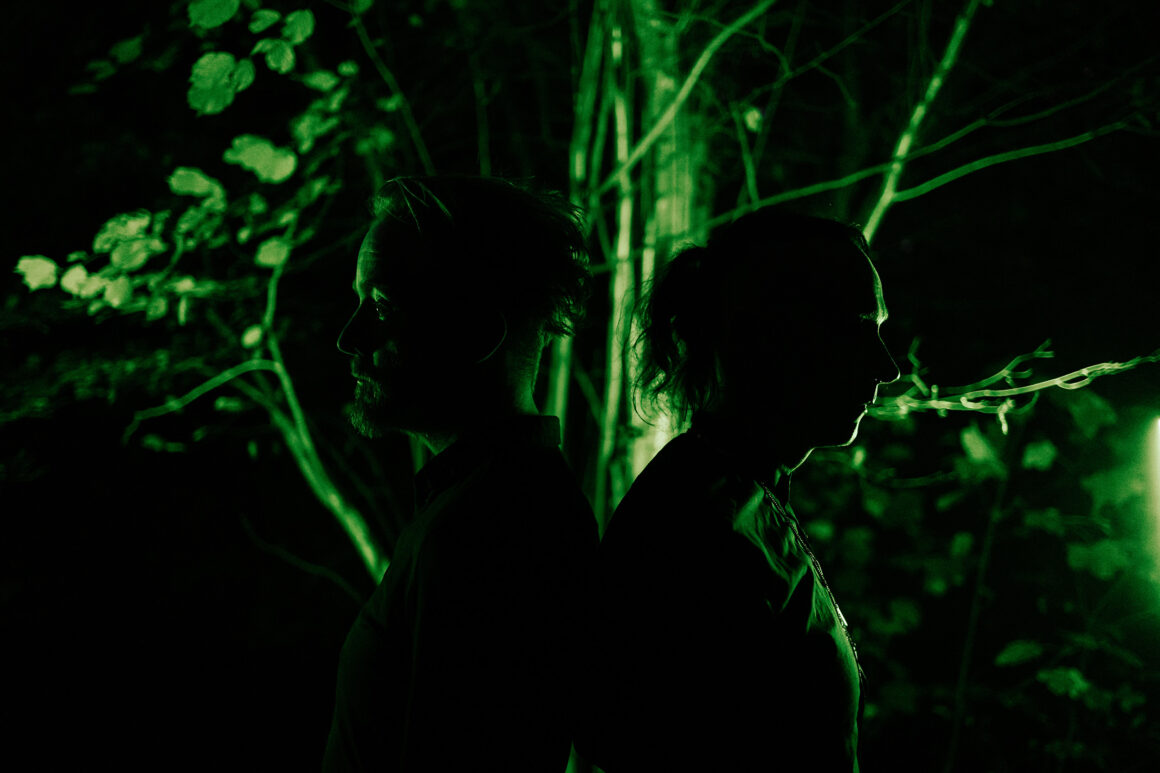
Bragolin. Photo by Lisanne Lentink
Edwin, what were the first records or artists that seized your imagination growing up, and when did listening turn into the desire to write and perform your own music?
When I was a kid, I mostly listened to local radio before I got a few pop music cassettes in the early ’90s, which were full of Eurodance. I didn’t care much about music until I discovered alternative music in my mid-teens. Nirvana and Björk were the artists who opened up that world for me. I was fascinated by what felt like the purity of Nirvana’s music, while Björk showed me how unconventional and unique an artist could be. Nevermind, Unplugged, and Post were the first three albums I owned. For most of those later teenage years, I listened almost exclusively to Nirvana. That inspired me to buy a guitar and start writing songs. You can still hear Nirvana’s influence beneath the surface in my music, in the song structures, the desire to write catchy melodies, and even in the way I often add the lyrics later in the songwriting process.
Which books and writers had the strongest effect on you during those formative years? Were there particular novels that shaped Bragolin’s fascination with isolation, dread, and the uncanny?
I’ve never been much of a reader. I have difficulty focusing on black letters on a white page. Visuals are what draw my attention. While I’m trying to translate the words into images, my mind often drifts off into its own story. I suddenly realize I’m no longer reading the text and have to go back and start again. It’s rare that I truly enjoy reading. So films have had a much bigger influence on me. It’s a shame, because all my life I’ve heard people say that books are so much more interesting than the films.
Bragolin’s music and videos seem to draw from post-apocalyptic and horror cinema, including Gothic and folk horror, science-fiction paranoia, body horror, and cosmic horror. Which films first opened those worlds to you, and what do you tend to take from them—the setting, pacing, imagery, or emotional psychology?
As a teenager, I was a big fan of the Terminator and Predator films. My dad has always loved action movies, so I grew up watching a lot of the classics with him. Later on, I discovered arthouse cinema, which gradually introduced me to folk horror. The Village (2004) and The Witch (2015) are great examples of the kind of settings and atmosphere I enjoy. I’m especially drawn to the vulnerability of the main character and the mystery and ambiguity of whatever they’re up against. I like to focus on that tension in my lyrics instead of the gore, although I enjoy those films as well.
How did growing up in the Netherlands shape your musical imagination? Are there aspects of the Dutch landscape, culture, or temperament that have found their way into Bragolin?
I don’t think growing up in the Netherlands consciously shaped Bragolin very much. I grew up in the province of Drenthe, where blues and metal were pretty much the only music scenes around. That made me realize quite early on that I had to look elsewhere to find like-minded people. Having said that, Dutch folklore is something I’d love to explore one day. I think it could make a great concept album.
How would you describe the Dutch post-punk and darkwave scene today? Does it possess a character distinct from the scenes you have encountered elsewhere in Europe and Latin America?
The Dutch wave scene has improved enormously over the last decade. It’s still a smaller and somewhat more reserved scene compared to our neighbouring countries, but it’s definitely moving in the right direction. Thanks to the hard work of promoters, musicians, and a new generation of fans, the scene has become much more hopeful than it was ten years ago. With festivals like Grauzone, Wavefest, and Momentum, we now have events of a high international standard. Artists like Adam Tristar, Raderkraft, Lifeless Past, De Ambassade, Silent Runners, Camy Huot, Pol, and many more are finding international success. A decade ago, the Dutch wave scene was mostly known internationally because Clan of Xymox came from here. Now there’s a much broader and healthier scene.
Bragolin performed at Grauzone in The Hague earlier this year. What was that experience like, and what role has Grauzone played in connecting the Dutch underground with the wider international post-punk community?
This year marked our second appearance at Grauzone. We were only announced as a last-minute replacement three days before the festival, so it was great to see such an enthusiastic response from the audience. What I enjoy most about Grauzone is seeing people from both the Dutch and international wave scene together, alongside visitors from outside the scene. Grauzone has made the genre much more accessible to people who might never have considered going to a post-punk or darkwave festival before. I think that’s played a huge role in helping the scene grow in the Netherlands and in connecting the Dutch underground with the wider international community.
Can you take us back to the creation of “Into Those Woods”? Which arrived first: the baritone melody, the repeating organ hook, the rhythm, or those images of the manor, the swing, and the mysterious book?
This is an interesting question because it was actually the very first Bragolin song I wrote. It all started with that guitar riff I originally had in mind for my other project, Zwarte Poëzie, in early 2013. In mid-2013, I bought a Bass VI, and when I tried the riff on that instrument, everything suddenly clicked. That Bass VI sound became the foundation of Bragolin when I decided to start it as a second project later that year. Because most of Zwarte Poëzie’s lyrics had been about my personal life, I wanted Bragolin to explore different themes. After watching The Evil Dead, I wrote the lyrics inspired by the film. Around that time I was also a big fan of the band The Organ and wanted to use an organ sound instead of relying mainly on synths like many darkwave bands. That became another defining element of Bragolin’s sound.
“Into Those Woods” has surpassed fourteen million streams and become a modern darkwave classic. When did you first realize the song had taken on a life beyond the debut album, and how has your relationship with it changed since 2018?
I started Bragolin without any expectations. We were just focused on making music the way we wanted to and making it as good as possible. Being in Zwarte Poëzie for eight years had taught me that success was difficult to achieve, although we did have some success with De Laatste Dagen as a minor dancefloor hit while I was working on the first Bragolin album. I assumed “Into Those Woods” might be too catchy and sound too clean for the goth scene, but fortunately I was wrong. The interesting thing is that the song’s reach kept growing year after year. Every year it felt like, “Okay, we’ve probably reached the ceiling now,” but it kept growing. What’s even more surprising is that “This Grotesque Dance” suddenly became a TikTok hit this winter, despite already being out there for seven years. Over the past year, it even surpassed “Into Those Woods” as our most streamed song. I’m very happy that our fans have embraced the new album just as much, and that Bragolin has grown beyond that one song. When we play live, it sometimes feels like we’ve already had a great show and then there’s that moment of, “Oh wait, we still have this song to come.”
When you begin writing a Bragolin song now, what form does the first idea usually take? Could you walk us through the process of developing that fragment into a finished arrangement?
For me, having a strong hook on top of a danceable beat and bassline is the foundation. I usually put on a drumbeat and play my Bass VI for hours until I find a riff that I like. I then record it and put it aside for weeks or even months. Listening back to a collection of these basic ideas later makes it easier to distinguish which ones have the most potential. After choosing the strongest one, I develop the riff into a song, often starting by humming vocal lines and eventually replacing those with rough lyrics. I then develop those lyrics into a story, which can be inspired by films I’ve recently watched. After that, I layer the song with additional instruments and sound recordings. On the latest album, I put more focus on that layering process than on the first two albums. For the next album, I would like to focus more on having strong foundations again, similar to the approach I took on the first album.
“I Run and Hide” sounds heavily guitar-driven, yet its entire instrumental body was constructed from layered Clavinets. How did you record and process those layers, and what did that self-imposed limitation allow you to discover?
After the second album, I bought a bunch of new instruments to embrace creativity. One of them was a small electric piano with different sounds built into it. For this song, I ran it through my Bass VI setup, which is why it doesn’t sound too far removed from the way the Bass VI normally sounds. Because it was a piano sound, I wanted to arrange it as if it could actually be played as a piano piece, with a low bass melody and multiple high melodies. I wanted it to feel like one instrument was playing the whole piece. It showed me that by limiting myself to one sound, I could still create a full arrangement with its own character.
I Don’t Like What It Does to Me also incorporates field recordings, synthetic ocean textures, waterphones, and other unconventional sources. Could you identify a few moments where those sounds appear and explain how you manipulated them?
For this album, I wanted it to have a more cinematic feel. One of the instruments I started using was the waterphone, which is often used in film scores and sound effects. It appears at various moments throughout the album, but it is especially noticeable at the beginning of the title track and This Presence Like a Breeze. This cinematic approach is also why I used a string section at the beginning of “Not All Are Real” to somewhat recreate the feeling of the opening of The Thing (2011), which is a prequel to the classic 1982 film. There are also two songs with ocean-inspired sounds: “Tar With Salt Foam” and “I Salute You Ancient Ocean”. For both songs, I created the sound of ocean waves with my Korg MS-20 by using synthesis rather than recordings of actual waves, while the seagulls were recorded as field recordings. I then processed and layered these sounds into the arrangements to create the atmosphere I was looking for.
Where do your lyrics usually begin—with a personal experience, an image, a line from a book, or a scene from a film? How do you turn an outside reference into something that carries your own emotional meaning?
It usually starts with a hummed vocal line, and then I look for words that fit the sounds and rhythm of that melody. From there, a few words become the basis of the lyrics. While watching films, I write down how I experience them visually and emotionally from the perspective of the protagonist. But I don’t want to create a direct interpretation of the film. It is more a starting point for my own lyrics, and often I turn it into my own story rather than sticking to the original inspiration.
Which artists working in the current post-punk, darkwave, or experimental underground are exciting you most at the moment? Are there any Dutch acts in particular that you believe deserve a much wider audience?
My listening has always been broader than just post-punk and darkwave, but from time to time I return to these genres, and there are still artists within the scene that I find very inspiring. I was pleasantly surprised by Carrellee’s music when she joined our record label, Young & Cold Records, with her self-titled 2025 album. I ended up listening to that album on repeat, which led to us getting in contact, collaborating on songs, and working together on upcoming tours. Other artists within our genre that I’ve been enjoying lately are Grundeis, The Woken Trees, The Soft Moon, Boy Harsher, Dead Man’s Bones, and Murder by Death. However, I have mainly been listening to a lot of 60s music, from Ennio Morricone and The Shadows to Nancy Sinatra and Roy Orbison. It is still often dark and melancholic music, and I think I know what elements to take from other genres and what to leave behind when creating my own music.
Bragolin’s videos have become an important extension of the songs, from the manor and woodland imagery of “Into Those Woods” to the nocturnal pursuit through streets and cornfields in “I Run and Hide.” How closely involved are you in developing those concepts, and what do you look for in a director?
I usually create at least one music video per album myself. For the others, when looking for a director or editor, the most important thing is that they understand the music, respect our visual identity, and have a fitting portfolio. With the new album, I wanted to create more original footage instead of reusing existing material as on previous albums. My role is mainly setting guidelines, such as avoiding showing faces clearly in our visual content. We call this anonymity. This connects with our album covers, which are all portraits shot from behind, and our lyrics, where we also leave room for interpretation rather than explaining everything too clearly. I Run and Hide was made by two very talented film students, Maria Gaedcke and Jonathan Eder. It was our first time working with a larger production. My idea was to combine the inspiration for the song, the film It Follows (2014), with the new album cover’s figure in the nightgown, while taking the opposite approach to the film by not showing the antagonist explicitly. The video for “Feel This Flame Unfold” was created by State of Poison, who had caught our attention with several great animated productions. Animation offered a chance to explore another style, and I’m really happy with how all the videos turned out.
For “Not All Are Real,” you connected The Thing and Invasion of the Body Snatchers with contemporary anxiety about artificial replication, using intentionally unnatural AI-generated imagery. What creative and ethical boundaries did you establish for that video, and did the response to it alter your view of the technology?
Even though it received quite a lot of negative responses, I still think the concept I wanted to create was only possible in this way. The video is about artificial replication, so using AI-generated imagery became part of the concept itself rather than just a production tool. Filming people in public without their consent would have raised ethical concerns. Emptying the streets of major cities around the world to create a film set and hiring hundreds of actors simply isn’t realistic within the budget of an independent band. Animation, on the other hand, wouldn’t have captured the unsettling feeling of cloned humans that I was looking for. The only real alternative would have been to abandon the concept and make a completely different video. I also found it interesting that we’d previously used existing footage in our videos, which raises ethical questions of its own, yet that never received the same criticism. That said, the reaction was enough for me to decide: never again.
Bragolin will embark on its first North American tour this fall. What are you most looking forward to experiencing on this run, and when you look beyond it, where would you like to take Bragolin next—musically, visually, and geographically?
We have had a following in North America for a long time, and the requests for us to come over have gone unanswered for many years. I’m mainly looking forward to finally meeting those fans who have been following us from the beginning and hopefully giving them the show they’ve been waiting for. Looking beyond this tour, I’d like Bragolin to remain a constant by continuing to make albums for many years to come. I’d also love to explore the possibility of creating concept albums, which is an element from the past I’d like to bring back to the present, and combine that with even more visual storytelling, perhaps one day creating our own dedicated film. Geographically, there are still plenty of places we haven’t visited. In early 2027, we’re planning a West Coast tour and a return to Latin America.§
Listen to I Don’t Like What It Does To Me below and order the album here.
I Don’t Like What It Does To Me by Bragolin
Looking towards the horizon, Edwin Van der Velde hopes to expand Bragolin through future concept albums and, eventually, a film devoted to the project’s visual world. Yet, the immediate priority is Bragolin’s first North American tour. Van der Velde and synth player Edwin Daatselaar will take the band on the road alongside Carrellee for the thirty-date North American Hope Tour, beginning September 3 at X-Ray Arcade in the Milwaukee area. Bragolin has maintained a substantial North American audience for years, yet these will be the duo’s first performances on the continent. The route continues through the Midwest, Ontario and Quebec, the Northeast, the South, and Texas before ending October 11 in Tulsa. Bragolin then returns to Europe for dates beginning October 31 in Utrecht and running through December 19 in Brussels, followed by São Paulo and Santiago in February 2027. A separate West Coast tour is also being planned for early 2027, though its dates have yet to be announced.
The schedule reflects the unusual way Bragolin’s audience has grown. Into Those Woods accumulated listeners steadily until it passed ten million streams, while This Grotesque Dance found a new audience through TikTok seven years after its release and eventually became Bragolin’s most-streamed song. Those songs reached North America well before the band could follow them. After years of requests from listeners across the continent, van der Velde and Daatselaar will finally meet that audience in person this fall.
Bragolin Worldwide Tour Dates:
Europe — August 2026
August 15 — Münster, Germany — Tanz der Vampire Dark Summer Festival
North American Hope Tour — Fall 2026 with Carrellee
September 3 — Milwaukee, WI — X-Ray Arcade
September 4 — Madison, WI — Memorial Union Terrace
September 5 — Minneapolis, MN — Mortimer’s
September 6 — Davenport, IA — Raccoon Motel
September 9 — Grand Rapids, MI — The Pyramid Scheme
September 10 — Detroit, MI — Small’s
September 11 — Windsor, ON — Meteor
September 12 — Montreal, QC — P’tit Ours
September 13 — Ottawa, ON — Dominion Tavern
September 15 — Rochester, NY — Record Archive
September 16 — Providence, RI — The Parlour
September 17 — New Paltz, NY — Scry Chapelle
September 18 — New York City, NY — Market Hotel
September 19 — Philadelphia, PA — Nikki Lopez
September 20 — Baltimore, MD — Metro Baltimore
September 22 — Cincinnati, OH — Northside Tavern
September 24 — Chicago, IL — Cold Waves Festival
September 25 — Indianapolis, IN — The 808
September 26 — Columbus, OH — The Summit Music Hall
September 27 — Pittsburgh, PA — Poetry Lounge
September 30 — Richmond, VA — Fallout
October 1 — Raleigh, NC — Chapel of Bones
October 2 — Asheville, NC — Static Age Records
October 3 — Atlanta, GA — The Masquerade
October 4 — New Orleans, LA — The Crypt
October 7 — Houston, TX — Black Magic Social Club
October 8 — Austin, TX — Elysium
October 9 — San Antonio, TX — Paper Tiger
October 10 — Denton, TX — Rubber Gloves
October 11 — Tulsa, OK — The Whittier
Europe — Autumn and Winter 2026
October 31 — Utrecht, Netherlands — ACU
November 6 — Venlo, Netherlands — Grenswerk
November 7 — Arnhem, Netherlands — Willemeen
November 12 — Glasgow, UK — Ivory Blacks
November 14 — Manchester, UK — Kable
November 15 — London, UK — Barfly
November 19 — Berlin, Germany — Urban Spree
November 21 — Weißenhäuser Strand, Germany — Plage Noire Festival
November 25 — Graz, Austria — PPC
November 26 — Budapest, Hungary — Robot
November 28 — Augsburg, Germany — Rockfabrik
November 29 — Cologne, Germany — Blue Shell
December 1 — Karlsruhe, Germany — Stadtmitte
December 3 — Rüsselsheim, Germany — Das Rind
December 5 — Bremen, Germany — Lila Eule
December 6 — Bielefeld, Germany — Movie
December 8 — Prague, Czech Republic — Café V lese
December 9 — Brno, Czech Republic — ArtBar Druhý Pád
December 11 — Barcelona, Spain — Sala Wolf
December 12 — Madrid, Spain — Sala Nazca
December 17 — Paris, France — Le Chinois
December 19 — Brussels, Belgium — mOtown Concerts
Latin America — 2027
February 6 — São Paulo, Brazil — Madame
February 7 — Santiago, Chile — Club Freedom
Tickets and further information are available through Bragolin’s official website.
Follow Bragolin:
Instagram
Facebook
YouTube
TikTok
Spotify
Bandcamp
The post “What Lies Beyond The End? — An Interview With Dutch Darkwavers Bragolin Ahead of Their First North American Tour appeared first on Post-Punk.com.