

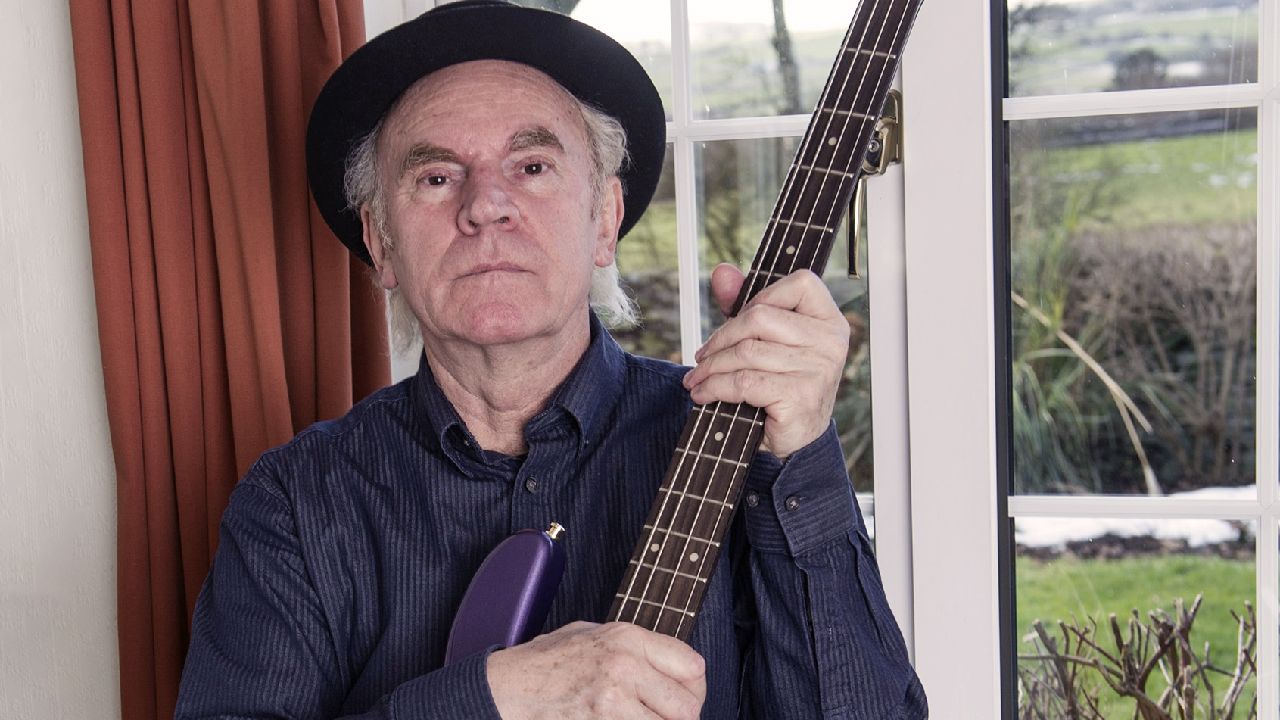
Ashley Hutchings co-founded three leading groups of Britain’s folk-rock movement – Fairport Convention, Steeleye Span and The Albion Band. In 2022 he released his 100th album, and although health issues forced him off the road in 2025, his achievements remain admired among other artists. In 2016 Hutchings told Prog about the energy that drove him to keep creating.
‘‘If you like, I’m semi‑retired,” Ashley Hutchings tells Prog. He’s gigging with his admirable current record, From Psychedelia To Sonnets, from church halls to festivals; prepares for the Cropredy Convention’s Fringe Festival; continues his catalogue reissue programme. and works on yet another album. Imagine what he was like when he was full-time.
At 71, the man who did more than almost anyone to lay the foundations of modern-day folk music may say he’s slowing down. But his unquenchable instinct to continue exploring the nooks and crannies of real music still fuels him, just as it did when he heard Heartbreak Hotel, released in the week he turned 11.
Or, indeed, when he helped to make perhaps modern folk’s finest hour, Fairport Convention’s 1969 masterpiece Liege & Lief; or when he recorded with his cherished 2004-2010 project the Rainbow Chasers; or won his MBE for services to music in 2015.
In the broadest sense of the word ‘progressive,’ Hutchings is an unassuming overlord, who gets as much pleasure from seeing his son, Blair Dunlop, making great strides in his own career in roots music as he has from any of his own formidable achievements. On his new website – a comprehensive and entertaining companion to his 50-year career – Hutchings is described by his late former Fairport bandmate Sandy Denny as “stern but always kind, strict but generous, wise… a bit like God”.
At Cropredy and subsequent shows, Hutchings will recreate From Psychedelia, a delightful melange of readings and songs, with accompaniment by Becky Mills and Ruth Angell. It’s the live embodiment of his book Words Words Words, and he’s having a great time performing it. “It’s the kind of thing that I love to do now, because it’s not like lugging amplifiers about and organising a band,” he says. “I’ve been a bandleader ever since I was at school. I’ve never not had a band since I was 15. So there’s a spring in my step.
“I did one of these shows a few months ago and Robert Plant walked in, sat at the back, and loved it. My sound man said that you could see his brain ticking away, thinking, ‘I should do this.’ So hey, I’m at the forefront again. That’s what I like.”
The Psychedelia project is also fuelled by Hutchings’ determination to realise some long‑time goals. “Two and a half years ago, I was hit by a series of disturbing illnesses and ailments,” he says. “The worst was that I had to travel to gigs horizontally. I couldn’t sit down properly. But the good thing was that I realised, ‘Uh-oh, I’m now old. What do I want to do before I go?’
“So I made a list. There were about six things on it, and I’ve ticked off five of them. One was the book, which is my selection of my best song lyrics, poetry and album sleeve notes. Then getting [1987 landmark release] Gloucester Docks out again, because I love that album – I think it’s possibly my best, and it had just not been available. So we did, and it got some great reviews.”
Psychedelia and its live counterpart delve back long before psychedelia itself, with recurring autobiographical themes of rock’n’roll. “The first thing that ever made any impression on me was hearing Elvis Presley on Radio Luxembourg – that classic ‘under the bedclothes’ thing,” Hutchings says. “I was very lucky; living in London, I went to loads of shows. Eddie Cochran was one of my favourites, and I saw him at the Astoria, Finsbury Park, in 1960, just before he died.
“I saw the Everly Brothers with just Phil, when Don was ill, and Phil only knew the harmonies, and it was wonderful. And the package gigs, The Ronettes with the Rolling Stones, all that kind of stuff. The Beatles with Brian Matthew on Saturday Club, we heard them and it blew our minds.” Even then, the route towards folk was circuitous. “I got very deeply into the blues, formed a blues band and saw loads of great people like Howlin’ Wolf, Jimmy Reed, Sonny Boy Williamson,” he explains. “Then I got into Bob Dylan and folk.”
The year was 1966. “We settled on starting to think about forming Fairport,” he recalls. “I met Simon Nicol, and really got into American singer-songwriters – met Joni Mitchell, met Leonard Cohen, one-to-one, and was very influenced by them, and then we were up and running.”
Suddenly Sandy Denny’s not the clumsy person of a few seconds ago, but an angel with a voice to match
It took Fairport quite some time to become themselves, as Hutchings freely admits. “When we started in ’67, we were kind of copying the Americans. It’s a wonder we had the success we did. But John Peel got behind us, and a lot of other people, and then by the second album – third album, certainly – we were starting to get folkier. It certainly wasn’t a question of ‘Sandy Denny joined the band and suddenly we were folky.’ or even Dave Swarbrick.
“Richard Thompson, Simon and myself, and initially Judy Dyble, always went to folk clubs – it was part of the DNA. But it dawned on us when we got to ’69 that we couldn’t carry on being American-influenced. By then I’d met The Byrds and talked to Gram Parsons in Rome, when he’d just joined them, and The Band, and then the penny dropped with all of us: ‘We’ve got to do our own version of rocking up the historical music,’ and we never looked back. ’69 was the big year.”
Fairport Convention: Richard Thompson, Sandy Denny, Simon Nicol Martin Lamble and Hutchings (Image credit: Gems/Redferns)
Denny is often painted as a tragic figure, after her demise at the age of just 31, but Hutchings remembers her with humour and affection. “I have very fond memories of Sandy, as do all my Fairport friends. When her name is mentioned, I think of two enduring pictures. One is Sandy trying to tell a joke onstage and getting the punchline wrong, then tripping over a microphone lead. The second is of her steadying herself and starting to sing – and suddenly she’s not the clumsy person of a few seconds ago, but an angel with a voice to match.”
I hope people will say is I was an important cog in the progression of traditional music in this country
Like so many modernisers, Hutchings and his fellows took plenty of flak from the traditionalists. “We were barracked,” he agrees. “Not so much Fairport – Steeleye were barracked more, because there were a lot of people from the folk scene [involved] – Martin Carthy, Maddy Prior. But Fairport did divide people. When we were creating Liege & Lief we thought, ‘This is the greatest thing ever; this is exactly the right thing!’ And incidentally, all these years later, I still think that. But then we started to get reviews for it and they were very mixed. We were shocked.
“Then I left and formed Steeleye, and people were taking us to task: ‘Why are you doing this?’ It was a shock to me, and to everyone else, when I left Fairport; and a shock to many when I left Steeleye, but Steeleye were quite a Celtic band.
We didn’t use the word ‘Celtic’ in those days – we played lots of Irish tunes and Scottish ballads, and I was falling in love with England. I’d got the Morris bug. I was still in Steeleye, but I’d discovered Morris music and loved it – it was so English for me. So I wanted to form The Albion Band.”
By the late 1970s, Hutchings and the Albions were branching into work at the National Theatre and becoming what we would now call ‘multimedia.’ That encouraged his first one-man show, about folk revivalist Cecil Sharp. “I was looking in my diaries a few years ago and I could not comprehend how much work I managed to do,” he muses. “Between the late 70s and late 80s, I didn’t stop.”
When asked if he feels a sense of responsibility for the re-establishment of traditional music, like a torchbearer, he answers softly: “Yes, I do. I don’t talk about it much at all, but I do feel that.”
And as for his legacy? “What I hope people will say is that he was an important cog in the progression of traditional music in this country. And I think I’d like them also to say, ‘My God, he did all these things. Now he’s dead, I realise he wrote poetry, and he made all these fantastic albums that didn’t sell many copies that are now coming out again…’”