

Becoming a new person
Leaving just a trace behind
What Nationalists want to avoid
That is what I do now
Roman Wilhelm began making music in 1991 with the sort of recording setup that encourages either ingenuity or surrender: two ghetto blasters, a teenage bedroom, and no obvious reason to believe anyone beyond its walls would ever hear the results. Born in 1976 in a small West German town, Wilhelm had recorded his first song by the time he was fifteen. A demo tape eventually found its way to a local goth DJ, who invited him to perform at a small dark-music festival. There remained the practical matter of instrumentation. Wilhelm did not own a synthesizer, so he brought his Italian accordion.
That solution says quite a bit about the sensibility behind roman946, Wilhelm’s long-running musical project, where the machinery of post-punk and electronic music has always been susceptible to interruption by something tactile, eccentric, or stubbornly homemade. The accordion was hardly an adolescent anomaly. During his years studying graphic design in Halle (Saale), Wilhelm began collaborating with aspiring filmmakers, composing music for images before gradually moving toward a broader conception of performance. After relocating to Berlin in 2005, he found himself drawn into the city’s art world, playing gallery openings and treating music, at times, as an exhibit with its own spatial and conceptual logic.
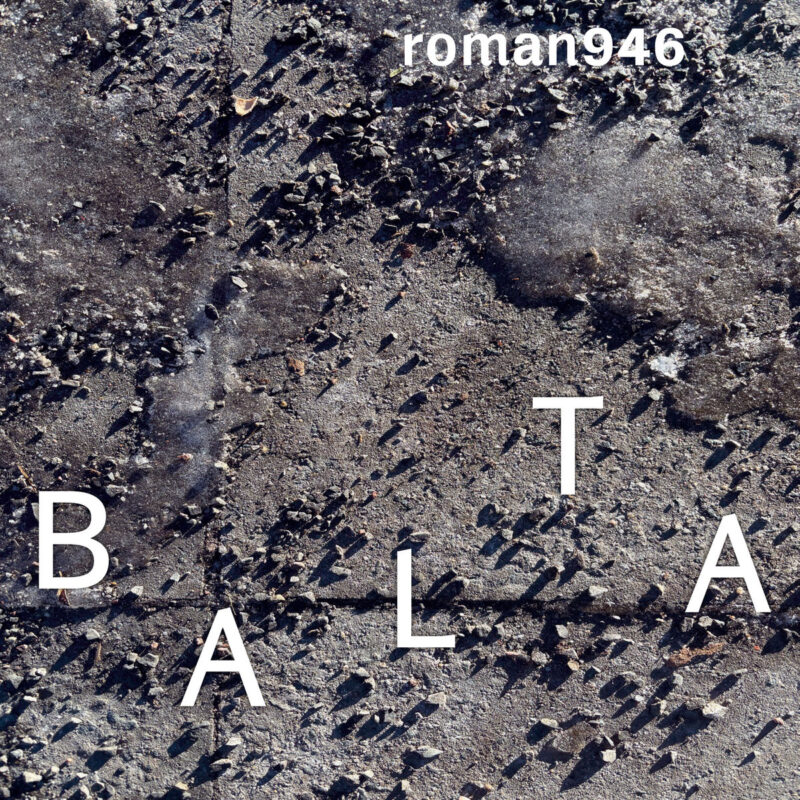
His new album, Balta, gathers those seemingly separate histories into one body of work. Songwriting sits beside electronics; programmed structures are interrupted by acoustic instruments; post-punk economy brushes against folk music and experimental composition. Wilhelm cites Onuka, Laurie Anderson, Lou Reed, The Legendary Pink Dots, and And Also The Trees among his inspirations, a list broad enough to suggest that taxonomy has never been his preferred occupation.
The album’s geography is equally expansive. Balta looks toward Germany and Eastern Europe at a moment when political anxiety has become increasingly difficult to leave outside the rehearsal room. Wilhelm addresses the rise of the political right in Germany, intolerance, artistic freedom, gender stereotypes, and the unease surrounding developments farther east, drawing much of the material from events he has witnessed and conversations with people whose lives intersect with these pressures.
His working life gives those concerns an unusual proximity. Wilhelm divides his professional time between the German Institute of Economic Research and the Berlin University of the Arts, moving between debates over social policy and questions about artistic independence. Those worlds find their way into songs such as BBC and into the wonderfully peculiar phrase Lead me to Ambivalentopia, which may be as good a name as any for the continent Wilhelm is attempting to describe.
Wilhelm speaks eloquently about his songs:
The Beach (Daina #1)
“The album begins with a Daina, a traditional Latvian genre of song and poetry consisting of four lines, often employing diminutives (Balta, balta debestiņa (little white sky), gaidu, gaidu vasariņu (waiting for the little summer), koki klusē vērojot (trees watching in silence), melnus kuģus jūriņā (black fleet in the little sea)). After the central motif, which uses cellos and guitars to evoke the motion of waves, addresses geopolitical uncertainties, the loud finale resolves the tension through absurd acts of defiance. The final line abruptly switches from English to French and Chinese.” The plodding beat and horns give this spoken word track a deep gravity, almost bordering on psychedelic.
Aufbruch
“A Jungle rhythm never fully unfolds in this song; repeatedly stutters to a halt, prompting uncoordinated flailing rather than dancing. The bass holds together elements that the piano, synths, and guitar seem unable to reconcile. Hovering over it all is the vocal, which also fails to strictly adhere to the beat. A German story of flight leads to the question of how the grandchild generation would treat refugees today; it identifies intolerant, right-wing behaviour as a negative dimension of flight. Both vocals and lyrics are indirectly influenced by Hildegard Knef and Nico Pfäffgen, particularly in the way they handle the interplay between banality and the dramatic. The song is based on an authentic poem about fleeing Silesia and the subsequent experience of social exclusion in the Federal Republic of Germany.”
BBC
“This simply structured post-punk theme, driven by a central guitar riff, centers on a person trapped in academic gender clichés.” Chimes and motorik beats bolster this track, which sounds like a lost Fad Gadget track.
I Need Nida
“A melancholic motif emerges, shaped by the imprecise playing of an analog synthesizer with faulty filters. We observe the protagonist, Katya, a dissident from Kaliningrad as she builds a new life as an artist in her adopted home of Armenia. The abrupt onset of the chorus underscores the fact that homesickness knows no borders. The song was inspired by a text message from the real-life Katya (I asked her where she was going, all she said is: I need Nida).”
Ambivalentopia
“Berlin-style electro-post-punk meets the stark juxtaposition of multilingual names for various border towns, some situated at the heart of current political events, others far detached from the global stage. The convergence of multiple languages seems to obscure the message, yet invites the listener to seek it out in the spaces in between: the dream of a world where one is no longer limited to simply choosing one out of several names.” This track has a heavily Kraftwerk-inspired chant and backbeat that will get stuck in your head.
Exchange; KWC
“Being an academic exchange coordinator for Berlin University of the Arts, I deal with the questions raised in “Exchange” on a daily basis: What is openness? How does tolerance emerge? Is time abroad mostly about partying? Where do you go? Is there an atmosphere of openness? Two verses present a caricatured juxtaposition of utopia and dystopia before the language abruptly switches to Chinese in the final chorus. With its hard, driving drum’n’bass sound, “KWC” contrasts sharply with the lyrics: a belated, self-reproachful letter to a deceased friend.”
Hotel
“An old clock sets the tempo for the album’s most oppressive track; an accordion and an electric piano seem to be chasing the seconds. It tells the true story of a hotelier in a small Saxon town who aggressively tries to justify to the narrator why he did not turn away a group of fascists arriving for a conference (After all, what was he supposed to do? Hardly anyone visited them anymore, and he was left alone with the fascists in the hotel). That clock is ticking very loudly right now, too, in the run-up to the elections in Saxony-Anhalt, where right-wing populist AfD is campaigning for an abolishment of compulsory education, and for the eviction of all foreigners, whoever they may be.”
An Old Fort; Take This Town (Daina #2)
“Listeners are taken on a spoken-word tour through the overgrown ruins of Kostrzyn (Küstrin). The concluding fragment, “Daina #2,” tells the story of a refugee from Ukraine currently in Latvia (We ordered drinks, I heard her say: “If I don’t drink, I can’t sleep”. Age seventeen). The musical concept, collapses in on itself at the end.
Listen to Balta below and order the album here.
Follow roman946:
Website
Typography
Bandcamp
YouTube
Instagram
The post “Lead Me to Ambivalentopia” — Berlin Post-Punk Artist roman946 Maps a Continent in Conflict on New Album “Balta” appeared first on Post-Punk.com.