

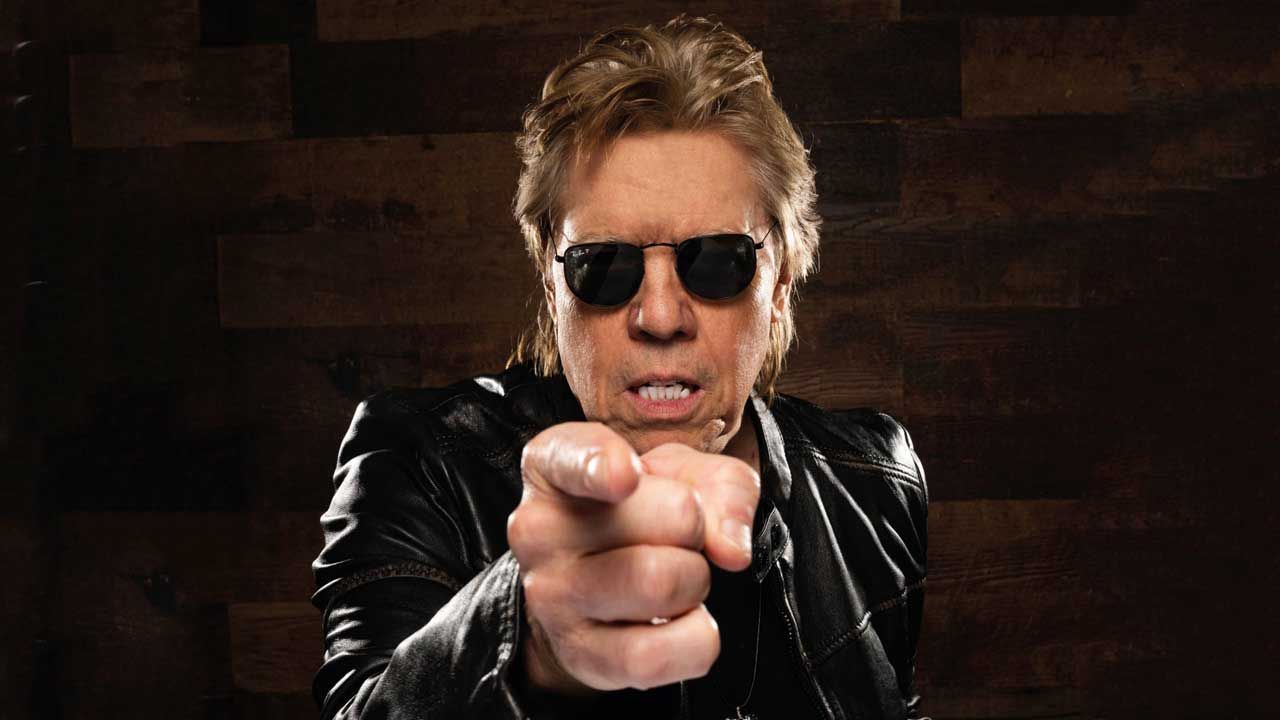
George Thorogood appears on the Zoom screen in a blank, neutral space, the background giving nothing away. The lighting is clean, the image sharp. Wearing a jacket and a big pair of shades, and with a thick head of light-brown hair, he looks every inch the high-functioning rock’n’roll lifer he has always been. He could very well be in Tysons, Virginia where he and his band the Destroyers are playing a show tomorrow night. But it’s a detail he won’t confirm.
“I like to keep one foot in the shadows,” he says, conspiratorially. Thorogood is here to talk up The Baddest Show On Earth, a live greatest hits collection that distills the best moments of a 50-plus-year touring career into a single set.
Back when you started out in those early bar gigs in Delaware, what did a great night feel like?
A great night was when nobody got hurt. That was our motive when we got into playing those barroom places. People drink a lot, they get excited, sometimes they take it too far. There’s a jealous husband or boyfriend. It could get rough. It’s better now. I like it better now.
Was there a moment early on when you realised you had something that could last?
The first time we played together. As soon as we played, the reaction was so immediate and high-energy and positive, we knew we had something right away. I said to myself: “This is who I am. This is what I am.” Before I even really got into music I was completely consumed by it. That’s all I wanted to do then, and that’s all I want now.
What for you is the hardest part of the touring life that people don’t see?
There are so many things. I could give you a migraine just listing them. Let’s put it this way: show business is not for sissies. Getting on stage and actually playing is the easiest part. It’s still difficult, but less difficult than everything else. Putting a tour together, getting a crew together, all the logistics. Just getting everybody out of the house.
Rock’n’roll is different now. People have families. They have to convince their wives or their children they have to go on the road. That’s not easy. In the 1970s we didn’t have those issues. Nobody was married, nobody had kids. People just went out and played and got high. That’s the way it was back then. Well, the world has changed. It’s become a more sophisticated thing, because, like Cyndi Lauper says, money changes everything. When the big bucks rolled in, it got more complex.
George Thorogood And The Destroyers: (l-r) Billy Blough (bass), GT, Hank ‘Hurricane’ Carter (saxophone), Jeff Simon (drums) (Image credit: Henry Diltz/Corbis via Getty Images)
You’ve stayed remarkably consistent in what you do. How did you manage that?
I was lucky. I had a particular idea of what I wanted to do, and I also knew that’s all I can do. The riffs of John Lee Hooker, Bo Diddley, Howlin’ Wolf, they came natural to me. That was my favourite kind of music anyway, so I got a break there.
What was it like when you started meeting the very people who inspired you?
I was in shock. I still am. People like Muddy Waters, John Lee Hooker, Robert Lockwood Jr… they just took us under their wing. They naturally warmed up to us. That was the biggest surprise of all. I had no expectations about it, but they went overboard to help us any way they could. Guys in Howlin’ Wolf’s band, Hound Dog Taylor’s band, they were really for us. That meant everything.
When you were promoting your 1983 single Rock And Roll Christmas, in the video you had John Lee Hooker dressed as Santa Claus. How did you persuade him to do that?
John Lee was a friend of ours. We were doing this video for MTV. And when John Lee saw some of the women in the video he said: “Okay, I’ll do it.” He became the “boogie-woogie Santa Claus” as he put it. Everything we did with John Lee was a pleasure.
Rock And Roll Christmas was your own song. So was your biggest hit, Bad To The Bone (1982). Were you under pressure to write more originals?
In the 1970s people kept telling me: “You’ve got to write your own material.” And I was going: “What if the material’s not any good? How about that?” I wasn’t going to drop One Bourbon, One Scotch, One Beer [by John Lee Hooker] or Move It On Over [Hank Williams] just because I didn’t write them. That would be crazy.
Eventually someone else would do those songs. Linda Ronstadt would do Move It On Over, and I’d be left at the dock. So I kind of had to represent the band myself, to sell those songs to a record company. I found out later that record companies make more money off originals than they do off a non-original. I didn’t know that. I just figured, look, if a song is great, it’s going to be a hit whether I do it or not.
What difference does it make who wrote it as long as people dig it? The Allman Brothers, Elvin Bishop, somebody’s going to do it. So that was a big mental struggle for me in those days.
George Thorogood in New York City, New York, October, 1984 (Image credit: David Gahr/Getty Images)
Looking back on your career, what are you most proud of?
The fact that I was able to make a living doing this. And that the songs we selected were right. I’m proud we exposed those songs. Once we made the first record [George Thorogood And The Destroyers, 1977] and it hit, then everything turned around. The record company came back and said: “Hey man, you got any more of those tunes?” So we proved ourselves in that department, and I am proud of that.
What would you have done differently?
About a thousand things. I would have tried to get a manager earlier, someone to beat the bushes and get us a record deal. That’s what managers do when an act is unknown. I had to represent the band myself, and that was a struggle. Sure, ultimately, I would have liked to get to a level like Steve Miller or Bob Seger. That didn’t happen. But I’m pleased with the level we made it to. Let’s put it this way: I clawed my way to the middle.
The 50/50 tour George Thorogood And The Destroyers did in 1981 – 50 states in 50 days – has become part of rock’n’roll folklore. What do you remember about it now?
It was an effort in lunacy. We had that tour planned, and then we got offered more shows with the Rolling Stones. [US promoter] Bill Graham wanted us to open for all the remaining dates of the Stones [Tattoo You] tour, but we couldn’t do it because we had already made that obligation. So the whole time on that 50/50 tour I was kind of kicking myself, knowing what I had passed up.
When you did get to tour with the Stones, did you spend much time with them off stage?
Mick Jagger took us out one night in Holland. We had a few beers and talked for a couple of hours – music, clothes, everything. He was a wonderful host. Very funny guy. He’s got a natural way of making you laugh. Very smart guy. I mean, he wrote Jumpin’ Jack Flash. That’s one of the greatest rock’n’roll songs ever. We send a birthday greeting to Keith every year. Sometimes we get a response, sometimes we don’t, but that’s the association, man. That’s good enough for me.
George Thorogood & Chuck Berry at the BMI Pop Awards at the Regent Beverly Wilshire Hotel in Beverly Hills, California, May 14, 2002 (Image credit: L. Cohen/WireImage)
Did Ronnie Wood offer to paint your picture?
I don’t think that’s gonna happen. I don’t think I could sit still that long.
Brian Jones was an important influence on you as well, wasn’t he?
I’ll ask you a question: what do Keith Richards, Mick Jagger and George Thorogood all have in common? We all heard a slide guitar for the first time being played by Brian Jones. He played great rhythm and slide guitar. And that’s what I do. Brian Jones turned me on to that.
I once cornered Bo Diddley, and I said: “Bo, is there anybody you know that can capture your sound?” He said: “Nobody can be like me. I’m the one and only.” I said: “I know that, but if you had to pick somebody…” And he said: “The guy that got Bo Diddley down the best was Brian Jones.”
You’ve also spent time on the road with ZZ Top. What did you take from that band?
Every year we turn around, and at some point it’s always ZZ Top and Thorogood. Promoters like that bill. We just did New Zealand and Australia with them and we’re gonna do some Stateside dates with them later in the year.
I once asked Billy Gibbons if he could give me any advice. He said: [imitates Gibbons’ deep, slow, Texan rumble] “George… I’m still looking for that lost chord.” He was talking about that one chord that takes a blues song and turns it into a rock’n’roll song. He found a way to take that basic blues thing and make it something bigger.
You played at Live Aid in Philadelphia. What do you remember about that day?
Well, it was very hot, and we’d had no sleep at all. We were in San Francisco the day before when we got the word they wanted us to do this, so we had to jump on a red-eye plane. I won’t say it was hectic, but you had to keep moving. Mr. [Bill] Graham [promoter] didn’t want anybody hanging around backstage, because there was so many acts to deal with.
We got George Siegel, who I love, to introduce us. And I got to meet Jack Nicholson. He had a sort of bowling shirt on, looked like he just walked out of a bowling alley. And he walks up to me and he says: “Georgie… [imitates Nicholson: long, long pause, big wolfish grin]… Jack.” I said: “You know who I am?” He goes: “Sure… I always follow the rough boys!” We had Albert Collins and Bo Diddley both join us on stage. I asked Bo what kind of strings he was using. He said: “I don’t know, but they’re heavy duty.”
Bo Diddley and George Thorogood onstage during the Live Aid benefit concert at Veteren’s Stadium, Philadelphia, Pennsylvania, July 13, 1985 (Image credit: Paul Natkin/Getty Images)
You’ve kept a band together for decades. What’s the secret?
Loyalty is based on finance. That doesn’t hurt. If you’re playing music, getting paid for it, and having fun, that’s rare. A lot of bands stay together because they’re successful, not because they like each other. If you can get along as well, that’s a bonus.
Come on! It’s got to be more than just the money. You and Jeff Simon (Destroyers’ drummer) have known each other since you were at school. You’ve been central to his entire working life.
Well, you might have got something there. Jeff was a few years younger than me. I went to school with his older brother. So I think he kind of looked up to me in the neighborhood. So when I said: “I want to form a band with you,” well, I think that gave him a rush.
And he had a great knowledge of music. For a young guy from about thirteen or so, he knew all about the Mothers Of Invention. He knew about the blues. He went to see Johnny Winter. He knew what was going on. So when he heard me play, he knew immediately where I was going, and he wanted to get involved with that.
What about the rest of the band? They’ve all been with you a very long time, haven’t they?
Yeah, a few years. Once you get in a groove with somebody… We’re fortunate. There’s a lot of acts that work together, and they stay together, but they really couldn’t stand each other, but they were successful. Legend has it that Lou Costello didn’t like Bud Abbott too much. Or Sonny Terry and Brownie McGee didn’t get along. But they stick it out because they’re successful.
You weren’t tempted to hire some bigger names or change the dynamic in some way?
Sure. I wanted to get Jeff Beck in. But he wasn’t available. Then I wanted to get Keith Moon, but he passed on. I went for the big time, but those cats were a little busy.
Dave Edmunds produced some of your songs. Maybe he would have made the cut?
I love Dave Edmunds. I’ve jammed with him. He got me up on stage to play with the Ringo Starr All-Stars. That was a gas. I just wish I had his chops. I mean, he’s the only guitar player in the world I knew who did that Russian song Sabre Dance [with Love Sculpture]. Now, that’s something quite extraordinary.
When Mick Taylor left the Stones, I thought Dave Edmunds could have been the man for the job. British, good knowledge of rock’n’roll, especially Chuck Berry. I was rooting for him. But I guess Ronnie Wood was the natural selection.
Your new album features live recordings from 1978 to 2024. How did you choose what songs to include?
There were certain songs we wanted to capture live that had never been on a record before. And then the record company wants to put some of our biggest songs on it to sell records. So it was kind of a fifty-fifty operation. We’re here to play what people want to hear. If they respond to Bad To The Bone, we play it. If they respond to One Bourbon, One Scotch, One Beer, then we play it. If we play a song and they don’t respond, then we don’t play it. How’s that?
Do you have any other message for your fans?
Most of what you’ve just read is true… But never let the facts interfere with a good story.
The Baddest Show On Earth: Greatest Hits Live is out now via Craft Recordings. George Thorogood and the Destroyers are currently on tour in the US – for dates and tickets, check the George Thorogood website.