
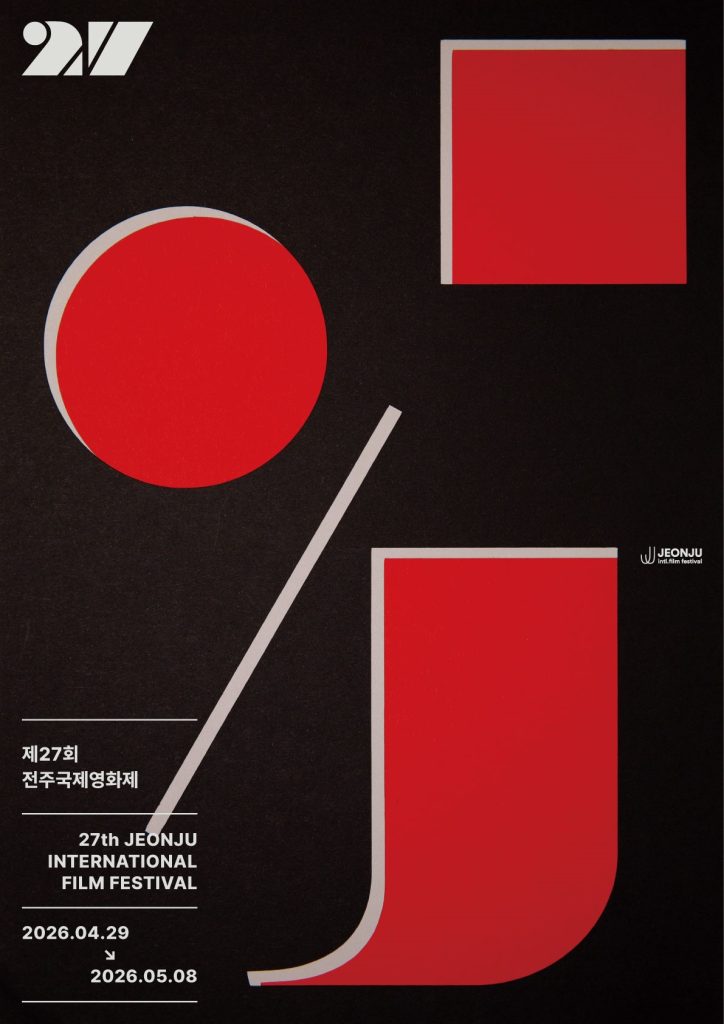
Just over the course of one week from April 29, to May 5, 2026, the Jeonju International Film Festival (JIFF), one of East Asia’s largest film festivals, celebrated its 27th year to rousing success. With the thematic focus of “Beyond the Frame”, 236 films in feature and short form were selected to premiere to thousands of attendees, representing the immense talent and infinite stories of young and veteran filmmakers, performers, and production crews from 54 countries around the world.
Held at the Korea Sound Culture Center, just on the outskirts of Joenju’s main city center, the opening ceremony began with a red carpet entrance of some of South Korea’s most well known celebrities and participating directors and artists, and concluded with the festival’s first official screening, the Kent Jones’s–a former film critic and festival director himself–feature drama My Private Artist starring Willem Dafoe and Greta Lee.
After ten days of exciting innovative program screenings, Q&As, panel discussions, street fairs, and exhibitions, Jeonju IFF wrapped up with their award ceremony and closing film, Kim Hyun-ji’s documentary The Longest Night: Namtaeryeong about that tumultuous night in mid December, 2024 when now disgraced former president Yoon Suk-yeol declared Martial Law. The months-long protests that lasted through the remainder of winter reignited the nation’s passion for democracy and community, and captured the world’s attention.
To learn about what it takes to run such a big and successful festival like Jeonju IFF, I interviewed Co-Executive Director and professor of film Min Sung-wook, who’s now in his third year sharing the daunting task with award-winning filmmaker Jung Jun-ho.
We discussed the challenges and joys of running a festival, working with all the people necessary to make it work, how director Min’s work as a professor gives him interesting perspectives on what audiences could want, how his students and the art of filmmaking itself inspires him decades into his career, and an unexpected connected between the history of Jeonju IFF and award-winning filmmaker Celine Song.
The following interview was conducted via email correspondence.
Carolyn Hinds: You have been involved with the Joenju International Film Festival, in different leadership positions for a number of years now such as the secretary general and deputy festival director, before taking on the co-directing duties in 2023.
Can you explain a bit what the main difference is between the requirements of those positions for readers not familiar with festival operations?
Min Sung-wook: While the organizational structure varies from film festival to film festival, at the Jeonju International Film Festival, programmers who select films and curate the program, as well as the Executive Director who oversees general affairs and administration, serve as members of the executive team under the responsibility of the Executive Chair.
The Secretariat is composed of four divisions and 13 teams: the Korean Film Team, the International Film Team, the Jeonju Project Team, the Content Media Division (comprising the Public Relations and Media Team, Marketing Team, Audience Services Team, and Design Team),the Content Business Division (comprising the Marketing Team, Audience Services Team, and Design Team), the Planning and Operations Division (comprising the Invitation Team, Operations Team, and Technical Team), and the Management Support Division (comprising the Administrative Team and Accounting Team).
Explaining each team in detail would take too long, so I’ll focus on the characteristics of each division. The Content Media Division negotiates screening fees with distributors to secure the films selected by programmers, coordinates invitations for directors and actors, creates program events, and invites industry professionals to connect them with works in the planning, development, or post-production stages. It also handles content-related publicity.
The Content Business Office focuses on attracting festival sponsors, designing event spaces, creating merchandise, and managing operations at screening venues and event sites. It is also responsible for the special program, the Cine Tour.
The Planning and Operations Office sets up necessary event spaces, oversees opening and closing ceremonies as well as award ceremonies, checks the condition of acquired films, handles translations to create subtitles, and manages all technical aspects such as projection. In addition, it manages accommodation and protocol for all invited guests and operates programs such as the “Alley Screenings.”
The Management Support Division handles all administrative support and accounting, and is also responsible for creating a work environment that allows staff to work to their full potential.
CH: Thank you so much for explaining in such great detail. As co-director of the festival with filmmaker Jung Jun-ho, what have the last three years been like managing the festival logistically and creatively?
MSW: Since we were to serve as co-executive directors, we needed to divide our responsibilities. We discussed major issues together, such as the overall direction of the film festival and the selection of the opening and closing films. Chairman Jung Joon-ho focused on external cooperation, publicity, and securing sponsors, while I concentrated on programming and internal operations.
When I think of memorable moments, the first thing that comes to mind is the experience of having the Dardenne brothers attend as guests for the first time at any film festival in Korea after we selected one of their films as the opening film. I also remember the decision to shoot director Tsai Ming-liang’s next film, the ‘Pilgrim’ series, in Jeonju. I am also immensely proud that two films produced through the Jeonju Cinema Project—which our festival invests in and co-produces—were selected for the Encounters competition section at the Berlin International Film Festival. In 2023, Lois Patino’s Samsara won the Grand Jury Prize and Best Film, and in 2024, Ben Russell and Guillaume Caillois’s Direct Action won the same awards, marking two consecutive years of success.
CH: I attended Jeonju IFF in person in 2023 and 2024 to cover the festival for KCrush, and one of the things that I’m impressed by and always speak about with others in the industry, is how extremely well planned it is, especially the various accommodations for disabled attendees. Please speak a bit on how important it is to prioritise disabled attendees.
MSW: It seems that the film festival is developing in a stable and natural way because the current directors and team leaders are permanent employees who have accumulated operational expertise. As for why Chairman Jeong and I are interested in barrier-free films and expanding the selection of titles, it is because the experience of sharing the same space is the essence of cinema itself.
As you all know, the world’s first film was the work screened by the Lumière brothers in France in 1895, for which they charged admission. The reason Thomas Edison’s Kinetoscope, invented a few years earlier in the United States, is not recognized as the first film is that the Kinetoscope was a film meant to be viewed alone, whereas the Lumière brothers’ Cinematograph was a film meant to be viewed by a group of people together. Since the pandemic, there has been a noticeable trend of people watching movies at home via various OTT platforms. However, since cinema is fundamentally about watching together, sharing emotions, empathizing with one another, or simply having different perspectives, the act of sharing the experience is what matters most.
In the past, it was difficult for people with visual or hearing impairments to watch movies in the same space as non-disabled audiences, but nowadays, various assistive devices have made this possible. Although the additional screening costs are a burden, we are continuously securing budgets to increase the number of screenings. Ultimately, we dream of a world where everyone can watch movies together without any restrictions.
CH: Thank you for providing the history of film accessibility by relating it to the history of film itself with the Lumière brothers’ film versus Thomas Edison’s. I wasn’t previously aware of that particular aspect to the differences in how the films are thought of historically. Do you discuss this with your students as part of your course curriculum?
Since our department focuses on practical training, there is no separate course on film history in the curriculum. However, because it is essential to cover the fundamental history of cinema, we include a three-hour lecture during the first-year film production class that covers the birth of cinema from a global historical perspective, as well as the history of how cinema first arrived in Korea and began to be produced here. Students who develop an interest in film history often study the subject on their own and ask questions during class.
CH: As a professor at the Baekje Arts University where there are programs for aspiring filmmakers and performers, have you noticed any significant change in the mindset of students throughout the years especially regarding the types of stories they want to tell?
MSW: I started teaching at Baekje Arts University in 1995, and while I don’t really feel the passage of time, I do clearly see how students change from the moment they enroll until they graduate.
When I have students write their first screenplay in my film workshop, most of them draw on stories from their own lives. Since these are based on their personal experiences, they may find them poignant and entertaining, but from a third-party perspective, they’re just run-of-the-mill stories. Of course, there are many excellent films based on personal experiences, but the stories that university freshmen bring in rarely reach that level. That’s why I find it so fascinating and enjoyable to watch them develop stories that address various social issues, ultimately creating works that showcase their individuality by the time they graduate.
CH: Throughout your years of teaching, is there one particular aspect of filmmaking either as theory or practical that has always consistently proven to be unexpectedly challenging for students to initially grasp?
MSW: I find that the classes I enjoy the most are actually the ones I find surprisingly challenging—the ones focused on filming. Things like depth of field, focal length, aperture settings, camera movement, and the different types and characteristics of shots…I find them fascinating, but they also feel a bit unfamiliar. Since I’m used to shooting in automatic mode, switching to manual mode with professional equipment takes some getting used to, but I usually adapt quickly.
CH: How has your work as the co-director for one of South Korea’s largest and most prominent film festivals perhaps influenced the way you approach teaching, and vice versa?
MSW: Teaching students at school while simultaneously serving as the executive director of a film festival is personally fulfilling, and it also has a positive impact on the students. As the festival director, I am able to experience firsthand the trends in Korean and international cinema, and by sharing this knowledge and experience with my students, they are exposed to the latest developments in both the Korean and global film industries faster than others. I believe this greatly contributes to their personal growth.
Most of the staff and volunteers who help organize the film festival are young people in their thirties. As someone who interacts daily with students in their late teens and early twenties, I believe it is very helpful that I haven’t lost my youthful perspective, allowing me to work with the staff without feeling a significant disconnect.
CH: Jeonju is known for featuring films in all genres, styles, and expressions limited only by the creativity of the filmmakers and what’s possible with existing technology, so I was very happy to read on the official website that one of the goals this year to do that by reaffirming the “rustic touch” and charm of traditional filmmaking, and rejecting the involvement of A.I. facilitated projects.
It has been very disappointing to see some of the most prestigious festivals in the world accepting projects made with a technology that’s proven to be destructive to the environment and human creativity, and is actively taking away the livelihoods of thousands of people working in film, with the most recent example being the 1000 people fired by Marvel this month. The majority of whom were from the VFX and other arts departments.
Please speak about the festival team making such a bold and inspiring decision to stay true to the core values of Jeonju IFF and heart of filmmaking, rather than conforming to a trend of creative suppression and erasure.
MSW: In fact, the Jeonju International Film Festival is one of the organizations most open to new technologies. When we first launched the festival in 2000, our key themes were “digital,” “alternative,” and “independent.” At a time when most films were still made on film, we focused on digital technology. Now that we’ve entered an era where almost all films are made digitally, I believe our vision has been realized, though it’s true that a sense of nostalgia for film still lingers in the back of my mind.
When AI films first began to emerge, we considered whether we should embrace this trend just as we did with digital technology, but it was difficult to find films with the level of polish required for festival screening.
In the film era, digital cinema represented a generational shift in equipment, but there was no difference in the quality of the films themselves, whether they were shot on film or digitally. However, while we believe AI will eventually reach a point where it can produce fully polished works on its own, we judge that time has not yet come.
CH: Can you talk about the process of selecting this year’s opening film My Private Artist by Kent Jones, and the closing film The Longest Night: Namtaeryeong by Kim Hyun-ji? The first is about an aging poet rediscovering his love for his art through the appreciation of others, and the other is a documentary set two weeks after the attempted coup by former president Yoon Seok-yeol.
What is it about them that represents what you and your team want them to convey to everyone attending the festival, the jurors, attendees, many of which are student filmmakers, and filmmakers themselves?
MSW: The selection of the opening and closing films involves a process in which the executive committee watches and discusses films recommended by the programmers.
Typically, about three to four candidates are brought to the discussion table. For the opening film, programmer Moon Sung-kyung recommended Kent Jones’s Late Fame, which had its world premiere at the Venice Film Festival. While the film’s production quality and atmosphere were excellent, what really caught my attention was Greta Lee’s outstanding performance. Willem Dafoe’s performance was also impeccable, but Greta Lee’s was truly the best. Greta Lee is an actress well-known to Korean audiences through director Celine Song’s Past Lives. Director Celine Song is a daughter of Jeonju and has close ties to our film festival. Born in Jeonju, she immigrated to Toronto, Canada, at a young age with her parents.
Director Celine Song’s father is Director Song Neung-han, and her uncle is writer Song Gil-han, who wrote many screenplays for Director Im Kwon-taek’s films. Writer Song was a founding member of the Jeonju International Film Festival and served as Vice Executive Director and Advisor. For these reasons, the opening film was selected unanimously by the executive committee, and the same was true for the closing film. Namtaeryeong was recommended by Programmer Moon Seok, who curates the Korean film program.
Among the many films related to the December 3rd Uprising, this work stood out for its narrative approach, the message it conveys, and its portrayal of the process of solidarity and understanding, leading to its unanimous selection as the closing film. Personally, when I first watched it, I found it fresh and entertaining, but the second time I watched it, I remember being overcome with emotion and crying uncontrollably. As I’ve gotten older, I rarely shed tears while watching movies, but this film evoked a deep emotional response in me.
CH: I watched Past Lives and loved Greta Lee’s performance. She has a very enigmatic presence on screen that really holds your attention, and I’ve interviewed Celine Song for the film, so know of her immigrating from South Korea to Canada, and eventually to New York to pursue filmmaking, but I had no idea of her close familial connections to the festival. That’s great to learn, so thank you for sharing that.
I also appreciate you sharing how watching Namtaeryeong made you feel. As we age humans tend to become more jaded with life having seen and experienced so much, so it’s always poignant when we can fully embrace unexpected emotional responses to film or a new piece of art.
As such, for my final question to you in this interview, is if there was one definitive piece of advice you could give to an aspiring filmmaker, artist, and storyteller, what would it be?
MSW: I don’t know if this will be decisive advice, but there’s something I always tell my students. There are forsythias and cherry blossoms that bloom in spring, roses and hibiscus that bloom in summer, and chrysanthemums and cosmos that bloom in autumn—but there are also camellias and plum blossoms that bloom in winter.
My time of success or my prime may come early, like a spring flower, but there are also flowers that bloom in winter, when it seems unlikely they will. If you persevere in your own way, staying true to your unique colors, the flowers will bloom eventually. Don’t get complacent if they bloom too early, and don’t be disappointed if they don’t bloom. The flowers will bloom someday. It’s just a matter of the season.
Carolyn Hinds
Freelance Film Critic, Journalist, Podcaster & YouTuber
African American Film Critics Association Member, Tomatometer-Approved Critic
Host & Producer Carolyn Talks…, and So Here’s What Happened! Podcast
Bylines at Authory.com/CarolynHinds
Twitter & Instagram: @CarrieCnh12
#JeonjuIFF2026 #FestivalCoDirectorMinSungwook #kcrush #kcrushfilminterview #27thJeonjuIFF2026 #BeyondTheFrame #KimHyunjidocumentaryTheLongestNight:Namtaeryeong #DirectorCelineSong #writerSongGilhan #writer Song Gil-han #kcrushamerica #kcrushmagazine
The post KCrush Jeonju IFF ’26 Interview with Festival Co-Director Min Sung-wook appeared first on K Crush America Magazine.