

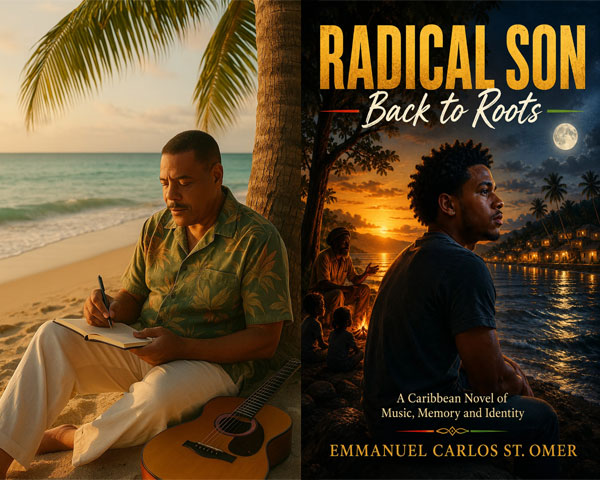
A Grammy-worthy reggae soundtrack meets a debut novel in a multimedia experience that honors heritage, heals grief, and redefines what music can be Saint Lucia’s award-winning songwriter channels personal loss into a cinematic journey of identity, faith, and redemption Ten original songs and a full-length Caribbean novel fuse into one unforgettable cultural landmark
Some artists make records. Some write books. Occasionally, a visionary does both at once, and in doing so, creates something the world hasn’t quite seen before. Emmanuel Carlos St. Omer, the award-winning songwriter, recording artist, producer, and now debut novelist from Saint Lucia, has done exactly that with the release of Radical Son Back To Roots Vol.2, the official soundtrack to his debut novel simply titled Radical Son Back To Roots. Released on May 1st, 2026, this ten-track original reggae album doesn’t merely accompany a story – it breathes life into it, page by page, chapter by chapter, note by note.
This is not a concept album in the traditional sense, nor is it simply a book with a playlist attached. What Emmanuel Carlos St. Omer has crafted is something far more intentional and far more intimate. He calls it a “Cinematic Reggae Novel Experience,” and that description does the project justice. The novel follows a young Caribbean man named Brandy – a character drawn, with profound emotional honesty, from the memory of Emmanuel‘s late son Brandon, who was tragically taken in a car accident in 2018. Rather than retreat from that grief, Emmanuel walked directly into it, and this project is what he found on the other side.
The novel traces Brandy’s journey through identity, family legacy, faith, systemic injustice, and the long road toward redemption. Each chapter is paired with a corresponding song from the album, and QR codes embedded throughout the book allow readers to stream the soundtrack in real time as they read. It’s a model of storytelling that the Caribbean literary and musical tradition has never quite seen formalized this way before, and it works with remarkable emotional precision. When a reader reaches a passage about spiritual doubt, they can press play on “Jah & I Luv U” and feel the weight of that doubt dissolve into something luminous. When Brandy confronts the invisible walls that Babylon builds around young men like him, “Babylon Can’t Read My Heart” rises from the speakers to confirm that the system has never had access to what truly matters.
What sets Emmanuel Carlos St. Omer apart from the first moment of Radical Son Back To Roots Vol.2 is his command of Caribbean cultural memory. The album opens with “Firelight Cinema,” a roots-reggae invocation built on cricket drumrolls, moonlit backyards, folklore, and the mythic presence of grandparents as cultural guardians. It is an opening statement that doesn’t simply welcome you into a story – it wraps you in one. The oral tradition of the Caribbean, so often marginalized in mainstream media, is here elevated to the level of cinematic art.
The album’s socio-political conscience arrives swiftly and with sharp clarity. “Before the Music” strips away any illusion that reggae is mere entertainment, declaring through its composition alone that the genre was born from pain, survival, and moral necessity. “Justice Come in Jah Own Time” takes that foundation further, addressing corruption, false witness, and the exploitation of the poor with a Rastafarian theological conviction that refuses to trade justice for comfort. These are not protest songs in a nostalgic sense. They feel urgently current, rooted in the same Caribbean realities that shaped Emmanuel’s songwriting long before this project took shape.
At the same time, Radical Son Back To Roots Vol.2 never loses sight of its capacity for beauty and restoration. “Sow Good Seeds, Reap Good Days” is the kind of rhythmically infectious, morally grounded anthem that could warm a community gathering or a quiet evening equally well. “Old Souls Know Better” is a meditative mid-tempo groove that argues, with patience and grace, that the elders have always known something the noise of modernity drowns out. And “Barefoot in Paradise” offers a lovers-rock respite, a vision of uncorrupted freedom and intimacy set against island imagery so vivid it almost carries a scent.
Then comes “West Indian Moon,” and the album shifts into something altogether intoxicating. A slow-grooving, silver-lit celebration of Caribbean nightlife and communal joy, the track explicitly honors the legacy of Bob Marley, framing reggae itself as a living, breathing sanctuary where rhythm and romance become acts of cultural resistance. It is the album’s most purely joyful moment, and Emmanuel earns every second of it. Where other tracks carry the weight of history and injustice, “West Indian Moon” reminds us that Caribbean culture does not only survive – it dances, it glows, it pulls strangers close under a midnight sky and makes them feel like family. In the context of Brandy’s journey, this track lands like a deep exhale, proof that even the most tested soul deserves a night when the music takes over and nothing else exists but the groove.
What ties all ten songs together, beyond their shared roots-reggae aesthetic, is an emotional architecture that mirrors the novel’s narrative arc. The tenth and final track, “My Very Own Brother,” is perhaps the album’s most courageous moment, confronting the psychological inheritance of betrayal and the slave trade’s long shadow with a bravery that is neither self-pitying nor performative. It closes the album the way the best final chapters close the best novels – with the protagonist finally free, not because the world has changed, but because he has.
The biographical context behind this project cannot be overstated without understanding how it quietly transforms every lyric. Emmanuel Carlos St. Omer has spent a lifetime devoted primarily to songwriting, earning international recognition including Songwriter of the Year honors at the OGIMA Awards in London and a First Place Award in the Great American Song Contest. His catalogue spans reggae, gospel, and contemporary music, and his songwriting has always been shaped by Caribbean culture, faith, and a commitment to social justice. But Radical Son Back To Roots is different from anything that came before it, because it carries the full weight of a father’s grief and a father’s love simultaneously.
That Brandon’s memory lives inside Brandy, and that Brandy lives inside this album and this novel, is one of the most quietly extraordinary acts of creative preservation in recent Caribbean music history. Emmanuel has not simply commemorated his son. He has given him a world to inhabit, a story to tell, and a soundtrack to tell it with.
To call Radical Son Back To Roots Vol.2 a debut novel’s companion album is accurate but insufficient. To call it a reggae album is true but incomplete. What Emmanuel Carlos St. Omer has released is a new form: a Caribbean multimedia experience that treats music and literature not as separate disciplines, but as a single language capable of saying what neither could say alone. In doing so, he has opened a door for Caribbean artists, storytellers, and cultural archivists that will not easily close again.
Radical Son Back To Roots Vol.2 is available now on all major streaming and sales platforms worldwide. The novel Radical Son Back To Roots and its embedded QR soundtrack experience await every reader willing to enter the world that grief, love, and creative genius built together.
OFFICIAL LINKS:
Amazon Book: https://www.amazon.com/dp/B0GZN8LZFV
Goodreads Book: https://www.goodreads.com/author/show/70134914.Emmanuel_Carlos_St_Omer
YouTube Album: https://www.youtube.com/watch?v=MyIYhpNZ5cY&list=PLMs_WsXFgjwLpcptyKhtSuZbEVNr0eCsp
Spotify Album: https://open.spotify.com/album/3elm9rFxHn4SugP2NQWJdf
Apple Music Album: https://music.apple.com/us/album/radical-son-back-to-roots-vol-2/1895115872
Website: https://www.carlosstomer.com
For notable awards and achievements: https://www.carlosstomer.com/music-awards.html