

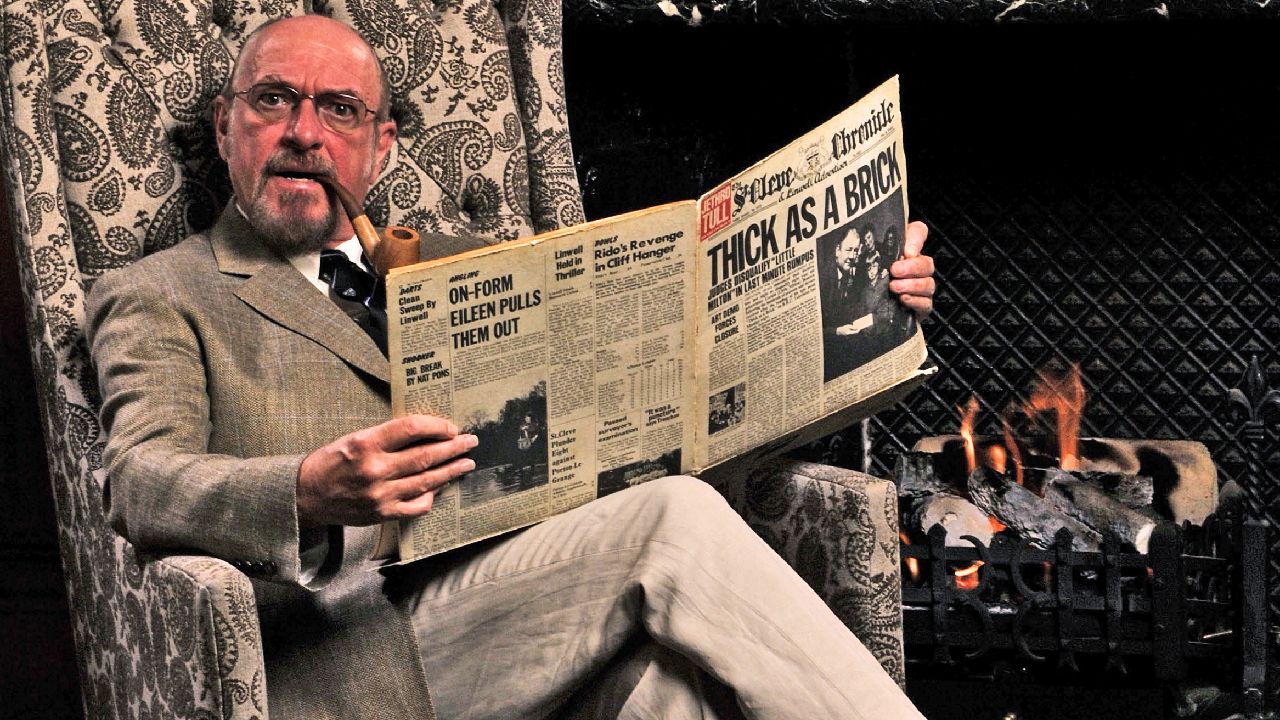
Jethro Tull’s venerable bandleader Ian Anderson is no stranger to interviews, but he’d never done one quite like this before. Prog lined up an all-star cast of friends, collaborators and admirers to give him a grilling he won’t forget! We get his thoughts on all manner of topics, from the serious to the candid, in one of the most revealing Q&As he’s ever given.
Ian Anderson is a hale-looking 78, and Jethro Tull, the band he formed in London in 1967, are fast approaching their diamond anniversary, but neither show any signs of slowing down. Tull are on a late-career hot streak, having released three new studio albums in the last four years, not to mention their ongoing reissues campaign, which has just reached 1984’s divisive but vivid Under Wraps.
When we speak, Anderson is on a day during from the band’s latest tour. He’s in good spirits, despite recently fracturing a rib going up some stone steps a week previously. “I’m struggling a little to do two hours onstage with this,” he says. “So please don’t try to make me laugh with these questions.”
No promises there, given that this is a slightly different interview from the ones he’s used to. We’ve thrown the floor open to a host of friends, collaborators and admirers who’ve known him or followed his long and illustrious career.
“I’m curious to know if the Prime Minister or Donald Trump is on the list,” he says. Sadly not – but there’s plenty of other stuff to chew on.
Rick Wakeman: What instrument do you tend to use when composing? Does it ever start with flute ideas?
There have been times in the last 15 to 20 years when it actually began with a monophonic line played on the flute. However, the acoustic guitar is the source of, I suppose, 90 per cent of what I have ever written.
I admire Rick’s capacity for a more academic approach to writing complex music. If you play keyboards like Rick Wakeman, you have the world at your fingertips – all 10 of them. If you play guitar like Ian Anderson, you have, at most, about three and a half.
Hugh Cornwell (ex Stranglers): When the Sex Pistols appeared on TV and their subsequent meteoric success happened, did you feel a seismic moment in rock music was happening, or was it just another phase in its history?
I saw the whole thing as being somewhat inevitable. The MC5 was punk to me, then along came the Ramones. And then it crept into the world of British music in the mid 70s. It became interesting when The Stranglers came along, because they had a real musicality. They seemed like a bunch of old hippies who got a little angry at not being successful and became ‘punk,’ for want of a better term.
(Image credit: Getty Images)
I do remember Joey Ramone coming up to me at one point to ask for an autograph. He was a bit bashful: “It’s not for me, it’s for my mother.”
Gavin Esler (TV presenter): Do you think teenagers now are missing out on the long-form creativity of albums in favour of the rapid turnover and immediacy of streaming? Also, what’s the hottest variety of chilli you’ve managed to grow in England?
The short-form has always been there. Much of the great pop and rock’n’roll music that inspired me before I began to play rarely lasted more than three minutes. Elvis Presley singing Jailhouse Rock and Heartbreak Hotel; Johnny Kidd & The Pirates’ Shakin’ All Over was perfect. Much of the early output of The Beatles thrived on being short, punchy and to the point.
However, musicians can always do what they want. The opportunity for musicians to be developmental and expand on their ideas always exists. They just might not get paid very much for it.
As for chillis, I’ve grown most of the hot chilli peppers available over the years. They all have to be grown indoors because they require specific conditions.
My taste for them came from the mother of a drummer called Ritchie Dharma, who briefly played with [Tull precursor] The John Evan Band. His mum had cooked lunch – some genuine Indian home cooking – and the two of them decided to play a joke on us by souping up an egg curry to incendiary levels. The rest of the band looked like their heads were turning into tomatoes about to burst. I, on the other hand, thought, “I like this!” That was the start of my love for Indian food.
Derek Shulman (ex Gentle Giant): Who have you met in the worlds of acting, politics and so on, who were fans of your band – people you’d never imagined?
There are a couple of Labour politicians who have been big Jethro Tull fans, which surprised me because they aren’t people you would associate with pop or rock music, let alone being fans. There have been some American folk from the world of movies as well, though I can’t remember any of their names.
There have been a few unlikely musicians – none more so than John Lydon. He once came over to me at an event. He’d obviously had a few beers, but he was being completely over the top, saying how much he loved the Aqualung album and that particular song.
Anna Phoebe (Ava Waves): When and where do the madly creative ideas on how to shape a performance come to you – scuba diving outfits, phones ringing?
Many of those early ideas, particularly with Thick As A Brick, came in quite an organic way from other band members. We shared the same sense of humour, which went from The Goons to Monty Python. It was that slightly surreal, strange thing that made people stop and go, “What did I just see?”
There were things that, in true Spinal Tap fashion, were a step too far. We opened one US tour in Buffalo, upstate New York. At some point during the intro tape, five giant white fluffy rabbits would come onstage and start dancing around. Each rabbit would unzip the rabbit suit in front of him and we, the band, would jump out, grab our guitars and start playing live.
Predictably, three of those zips jammed and the band members had to be cut free with the kind of knives you can’t take on airplanes any more. It was just so unbelievably embarrassing. I don’t think the rabbits ever got a second shot after being slashed open.
Billy Sherwood (Yes): I was proud to produce you on the version of The Thin Ice on the Back Against The Wall tribute album to Pink Floyd’s The Wall, on which you sang lead vocals and played flute. Do you have any recollections as to why you chose that track?
If I choose a particular song to play, I’m probably going to have a number of parameters. Number one: what’s the easiest thing to do? Number two: practically speaking, what’s something that I can learn and perform fairly quickly?
I have to feel that the instrument isn’t too intrusive or too unlikely to add to the musical arrangement. I don’t want to mess it up just because I was asked to play on it. And I think it has to be a positive contribution that’s slightly out of my comfort zone, because that presents a challenge, which makes it more interesting to do.
Carl Palmer: Why did you never learn to drive?
I don’t drive because, in the words of my wife, I am not temperamentally suited to driving a motor vehicle. I’m quite a big fan of F1, but that doesn’t make me want to go and get on the road in a Kia or whatever practical car people drive. It just doesn’t fill me with any kind of interest at all.
If I were to have a nice, shiny, smart, expensive, fast sports car, I’d be afraid to take it on the road, and certainly afraid to leave it in the Waitrose car park because someone might get a little twitchy or jealous and scratch it.
Dave Pegg (Fairport Convention, ex Tull): Any government would benefit from your organisational prowess. Do you regret not getting involved in politics? And is the anal intruder we purchased at Frankfurt airport still making the odd appearance during concerts?
I’ve been interested in politics since the 70s, but I don’t want to bring it into the songs that I write and I don’t really want to bring it into my public life in any way. In terms of my organisational style, that goes back to the years when Terry Ellis and Chris Wright decided to form a record label – Chrysalis – around Jethro Tull.
I’ve always been a hands-on person. To me, it’s important to understand how record contracts are put together. Besides, I’m too mean to pay for lawyers anyway.
(Image credit: Martyn Goddard)
Prog: And the anal intruder?
That was from Dr Müller’s sex shop in Frankfurt airport, when Dave was a member of Jethro Tull. He pulled this thing out that looked like a big rubber drumstick – it was all kind of wobbly and strange – and it was in a pack with a label saying ‘anal intruder’.
We used to lower it down on a fishing line over the head of our drummer, Doane Perry, in the middle of his drum solo. Every night he would throw it away in a wastebasket at the back of the stage, thinking he’d never see it again, only for it to reappear the next night.
It still exists. I have a photograph of Scott Hammond, our drummer today, discovering the anal intruder in some old drum case.
Steve Hackett: What attracted you to playing the flute?
Portability and not wanting to drag a guitar around. If you want to keep life simple, it makes sense not to have a guitar or, even worse, a tuba or a cello.
I suppose I was also a failed guitar player, at least in my own mind. I was nowhere near the standard of Steve Hackett, even then, or Jimmy Page, Ritchie Blackmore or Jeff Beck. I decided it was better to be a big fish in a small pool and find an instrument that other people weren’t using in the context of blues and rock music. It certainly got us noticed in the early days.
Fish: You once told me that retirement was not an option because becoming a dedicated whisky drinker wasn’t deemed attractive enough. But given the current state of the music industry, the financial pressures of gigs and touring, and the demand for extensive social media promotions to sell tickets, would you ever consider returning to salmon farming?
No, I wouldn’t, for many reasons. Mostly they have to do with the hard-nosed commerciality of it and also due to environmental matters, but because it’s too demanding to be responsible for 400 people working in the fish farms and factories while simultaneously gallivanting around being a musician.
I did recently ask my son James – my agent and co-manager – when we were in Edinburgh, if Fish wanted to come to our show, and the answer was, “No, I think he’s on an island somewhere north of Skye with some sheep.”
Fish is a fine man, a very intuitive and creative writer, but I know he has had difficult relationships with the whole machinery of the industry throughout his professional life. I suppose I just got to grips with it earlier on and accepted it for what it was.
As for whisky, he probably wouldn’t like to hear that I gave updrinking alcohol many months ago – I’m now a connoisseur of zero-alcohol beers from many different countries.
(Image credit: Hulton Archive/Getty Images)
Tim Bowness: What do you feel is the most misunderstood and underrated of all your releases?
Under Wraps, on the grounds that it didn’t quite click at the time for Jethro Tull to be experimenting with the early days of sampling synthesis and pre-computerised drum machines. It has to be said that the only thing on Under Wraps not played in real time by real people is the drum machine. The rest of it was done just like we make every other album.
It was still a bunch of Jethro Tull songs, whatever they are; they just happened to have more emphasis on keyboards and a bit more of that slightly irritating drum machine sound we had at the time. I hope there’ll be people who’ll revisit that album and say, “Hey, this wasn’t so bad after all.”
Tree Stewart (The Emerald Dawn): How did the incredible baton twirling with your flute come about? Have you ever dropped it or hit an audience or band member?
Certainly not deliberately. It came about out of nothing other than recklessness. I started twirling them around like a baton, throwing them in the air and catching them most of the time. However, there were occasions when twirling that the head joint sailed off into the audience. These days I could be facing a half-million-pound lawsuit for a piece of a flute landing on somebody’s head, but happily, it never seemed to cause an injury that I’m aware of.
I suppose if somebody did get a bit of a dent on the head, they probably thought, “Hey, it’s Ian Anderson’s flute,” and waited another 20 or 30 years for eBay to come about.
Mysteriously, I noticed the dustbin man at a previous address wearing some of my old clothes. My wife refuses to this day to admit that she threw them out
Andy Glass (Solstice): How have you coped with the attention you’ve received as the face of a hugely successful band, particularly through the 70s and 80s?
Really, just by keeping myself to myself. I don’t socialise; I don’t hang out with musicians. I don’t hang out with anybody much, really. I escape into my own little world of solitude: travelling alone, eating alone, and sitting backstage quietly alone. I just try to keep things in a comfortable balance.
It’s my temperament; I would probably be the same if I were an astronaut. I wouldn’t be hanging out with the guys drinking Russian vodka on the space station. I’d probably just be sitting in a corner reading an Agatha Christie novel.
Neal Morse: You wrote Thick As A Brick as a kind of parody of prog concept albums. Were you surprised at how well-received it was around the world? Are you still surprised by its longevity?
I’m always surprised when anything I do is well-received at any time – in the past, the present, or probably the future. Thick As A Brick did well because it was so unusual. It was rather surreal, an album of not just complicated but detailed music, both lyrically and musically.
I guess it just caught people at the right time when Jethro Tull was in the ascendancy, particularly in the USA. We were in there at a point where it was possible to make a mark, and for that mark not to necessarily fade too badly over time.
John Mitchell (Asia, Arena, Lonely Robot): Having been brought up by an English mum and a Scottish dad and having moved to Blackpool aged 12, do you identify more as English or Scottish? And what do you think are the defining characteristics – if any – of each of those nationalities?
Well, I identify, really, as being British. I also identify as being European, since the genealogy of both my parents probably goes back to northwestern Europe. It’s traditional that we take our nationality from our father, but I’ve always thought of myself as being a product of the union.
That’s a union in the sense of the mating of two individuals of the opposite sex, but also a union in terms of the traditions of Scotland and England. I desperately hope that doesn’t get overturned in the near-future, now that the ugly question of Scottish independence has raised its head again. I, for one, will be very sad if that comes about.
I’ve always felt that Scotland and England have so much in common. They have shared so much on the battlefield, and in terms of commerce, industry, science and technology. Why break up a good thing?
(Image credit: Getty Images)
Roy Harper: I used to hear it said that you only left Blackpool because I did. Is there any truth in that? And have you still got the codpiece you toured Aqualung with?
When I was at art school, I was aware of this legendary person from the Blackpool area who’d become a folk singer and gone to London to seek his fortune, and his name was Roy Harper. In that sense, he was a sort of talisman. He was something you could hold up and say, “Well, he did this just all by himself; he went there.” So in a way, it’s partly true that he served as an example.
As for the codpiece, I don’t have any of that clobber any more, basically any nice bits of kit that I had. Mysteriously, I noticed the dustbin man at a previous address wearing some of my old clothes. My wife refuses to this day to admit that she threw them out.
Geoff Downes (Yes, Asia): Years ago I asked you to contribute to a charity remake of Smoke On The Water. You called me from your farm in Scotland and said, “How the hell can you incorporate a flute into that song?” Have you worked out how to do it yet?
That track is ian example of how something can be so much of a guitar-driven piece with such a classic guitar riff that it feels like the flute would be intrusive. However, I did in fact play Smoke On The Water on a big German television show with Jon Lord and some other musicians in the house band.
Of course, I played the riff and played something vaguely solo-like. So yep, I’ve been there and done it – but unfortunately not for you, Geoff.
I think there’s a degree of desperation as you get older, knowing that this isn’t for ever and that time is running out
Mikael Akerfeldt (Opeth): You took one of my favourite bands of all time, Carmen, on tour in North America. What did you think of them? Why did you decide to approach their bassist John Glascock to join Tull? And is it true you gave one US crowd a bollocking for not treating them well?
Carmen were a support band, I think, in 1975, who were offered up by our agent to potentially be a little different from the support bands we usually had. They were flamenco-based and included dancing from two members of the band. I don’t know how well it really went down with the audience, but we were impressed with the band as a whole.
John was the Englishman in a band of Americans, and Latino-Americans, in at least one case. He was an easy fit for Jethro Tull when Jeffrey Hammond decided to leave. John had indicated that Carmen was coming to an end anyway due to a lack of success, so he was very happy to find a new job.
I’m not sure if I ever gave a US crowd a ticking-off for not being nice to Carmen, but there may have been occasions where I did so for support bands that got a rough ride from audiences who were impatient for us to get onstage. I can think of a few bands that didn’t do well with the audience back in those days in the USA, particularly where audiences were a little blunt in presenting their feelings.
Robin Armstrong (Cosmograf): What keeps you interested in writing new albums after all this time?
I think there’s a degree of desperation as you get older, knowing that this isn’t for ever and that time is running out. Practically speaking, you do well to capitalise on any creative thoughts you have while you’re still capable of translating them into music you can perform on record and, to some degree, onstage too.
So it’s desperation, if you like: don’t let time go by and then find it’s too late to do these things.
Roine Stolt (The Flower Kings): In the early days, was there an intention to be different in terms of sound, look and the clothes you wore?
As was the case with bands then, there was a self-consciousness about the way you appeared onstage and your choice of clothing. My own clothing was a little eccentric and a bit silly around the time of Thick As A Brick, A Passion Play and War Child. I guess we all tried to dress up a little bit.
It’s an honour to be standing at the side of the stage waiting to go on, seeing a bunch of folks around the corner looking for their money’s worth. I never take it for granted
But at the time, it seemed practical because I would get very active onstage and become very hot and sweaty. I needed a layer of clothing that I could easily wash in a basin in a hotel room every couple of days. That was part of the reason for wearing a thin silk shirt and tights. I would wash my tights and my blue stage shirt in the hotel sink.
Lynsey Ward (Exploring Birdsong): Do you have a favourite place in the world where you feel especially inspired to write songs?
Back in the late 60s and early 70s, my favourite place in the world to write songs was a Holiday Inn bedroom, because I had my guitar with me. Chances are, when I got home after a long tour, I just didn’t really feel musically motivated. I saw hotel rooms as a quiet haven where, while the others might be out doing whatever they did on a day off, I could stay in my room and write a song or two.
These days initial ideas can come anytime, anywhere: sitting on a train, in a dressing room, or sitting in my office. Quite often they come during the night when I wake up with a sudden thought that might be a good idea for a song.
This article first appeared in Prog 171 (Image credit: Future)
Ultimately, I don’t really think where I write songs is that important. The important bit is when you have an idea and develop it. I tend to choose a place at home, which is a quiet space. I have one in the house that I live in. I’m not telling you where it is in case you come to my house and discover me.
Mike Holmes (IQ): How did it feel to have your music featured in the Prog Proms at the Albert Hall?
I was asked to go along and play a couple of songs with the orchestra. Unfortunately I was somewhere else – in Italy, Spain or somewhere. I wish I’d known ahead of time because I’d have quite liked to have done that; it would have been an interesting experience.
Is it an honour? It’s an honour to be standing at the side of the stage waiting to go on, seeing a bunch of folks around the corner looking for their money’s worth. I never take it for granted. I’m the luckiest guy I know in being fortunate enough to do this.