
The Cult’s Billy Duffy divides his band’s career into two massively uneven parts. “It goes Death Cult to She Sells Sanctuary,” the guitarist told Classic Rock in 2022, “and then She Sells Sanctuary and everything else.”
It’s right that he names The Cult’s 1985 single as the point on which everything pivots. This instantly recognisable swirl of patchouli-soaked psychedelic goth-dance genius transformed these ambitious post-punk contrarians into unlikely chart stars. The Cult weren’t the first alternative rock band – everyone from Siouxsie And The Banshees, U2 and The Cure to Devo and REM might have something to say about that. But She Sells Sanctuary is one first true alternative rock anthems, a song that quickly became bigger than the narrow scene it came out of.
Duffy and singer Ian Astbury first teamed up in early 1982 after leaving their respective groups, Theatre Of Hate and Southern Death Cult. They figured the latter had enough brand recognition to repurpose part of their name for the new band: Death Cult. By the time their debut album, Dreamtime, was released in August 1984, the name had been truncated even further, and Death Cult had become The Cult.
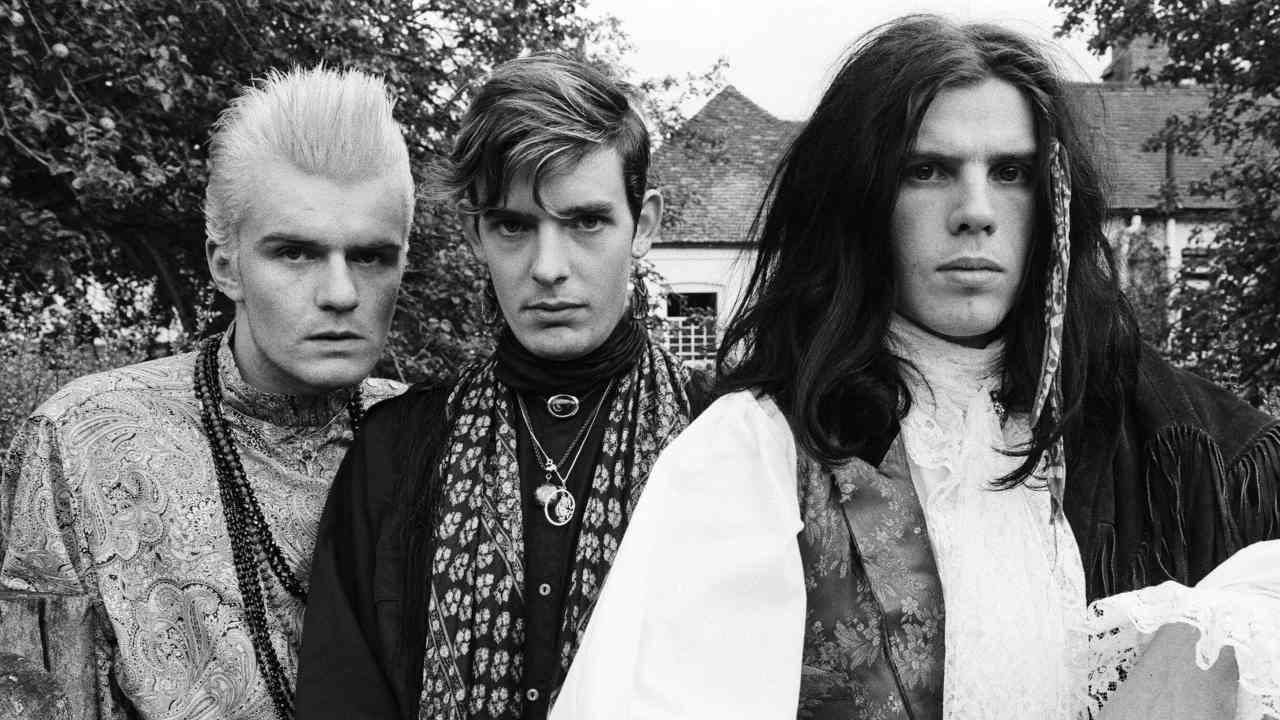
The Cult in 1984: (from left) Jamie Stewart, Billy Duffy, Ian Astbury, Nigel Preston (Image credit: Erica Echenberg/Redferns)
Dreamtime was a fine start, defined by Duffy’s ringing white Gretsch and Astbury’s fascination with indigenous cultures around the world. But these post-punk gunslingers were in love with the mythology of rock’n’roll too. They namechecked Led Zeppelin, The Doors and Hendrix at a time when most of their peers would rather admit to having a poster of Margaret Thatcher on their wall than owning a copy of Physical Graffiti.
“There were certain guidelines in the post-punk, new wave movement, and that was to stay clearly away from long hair and guitar solos,” Astbury told Classic Rock in 2010. “Then you hear Jimi Hendrix and Led Zeppelin and The Doors, and suddenly it’s like, ‘What is this? We’re not supposed to listen to this? You’re kidding me!’”
Dreamtime had barely cooled on the shelves when The Cult – completed by bassist Jamie Stewart and drummer Nigel Preston – began working on the song that would become She Sells Sanctuary.
“Sanctuary came together very easily,” Astbury said in 2010. “I took the bassline from [The Cult’s 1984 single] Spiritwalker. Billy came up with the melody, and we worked out a vaguely psychedelic guitar sound which seemed to fit it well. We were heavily into 60s psychedelic music.”
They debuted the new song in October 1984 on the Dreamtime tour. It immediately became a fixture of their set and a shoe-in for their next album. An early demo of the song shows all the parts in place, albeit in more muted form – The Cult hadn’t quite thrown off the shackles of post-punk at that point.
It was a marker of the band’s ambition that they wanted Steve Lillywhite to produce the follow-up to Dreamtime. Lillywhite was white-hot at the time thanks to his worth with U2 and Simple Minds. A meeting was arranged at the offices of the band’s label, Beggar’s Banquet. There was just one problem – they’d got the wrong Steve.
“This guy turns up and says, ‘Hey, I’m Steve,’” Astbury told The Telegraph in 2023. “We sat down and we started to work out that it wasn’t Steve Lillywhite, it was Steve Brown. But he was cool. We said ‘What have you produced?’ and he said ‘Wham!’. I’m like ‘Wham!?’ We just went with it.”
Brown – a schoolfriend of Lillywhite, ironically – would ultimately turn out to be a blessing in disguise. But at the time, the band still needed to make sure they could work with him. “Our record company said, ‘Look, this is a gamble. Why don’t you go in, do one song with him and see how it goes?’” Duffy told Classic Rock. “That turned out to be Sanctuary.”
The Cult’s Ian Astbury in 1985 (Image credit: Andy Hosie/Daily Mirror/Mirrorpix/Getty Images)
The Cult and Brown entered London’s Olympic Studio in March 1985 to road-test this new partnership. It worked better than Astbury and Duffy could have imagined. As Brown put it in 1985: “I like to produce songs that you want to turn up.” It was a maxim that the band fully brought into. Between them, The Cult and Brown punched up the song, and She Sells Sanctuary went from being black and white to full colour.
“He was very focused on pop and wanted to bring out the commerciality in the band,” Duffy told Classic Rock. “He felt we had talent but hadn’t quite gotten our pop hooks together. He was instrumental in helping us work on that.”
The finished song drew on the band’s love of classic psychedelia and hard rock (Duffy employed a violin bow he found lying around in the studio on the song’s instrumental opening, reasoning that if it was good enough for Jimmy Page then it was good enough for him), as well as their more recent post-punk past and the goth scene in which they had one military surplus boot firmly planted. But Brown gave it a modern pop gloss and a pulsing heartbeat that made it eminently danceable.
Lyrically, it was wilfully enigmatic, all turning heads, burning backs and sparkling eyes. “The fire in your eyes/Keeps me alive,” Astbury sang on the chorus, wolverine howl set to max. “I’m sure in her you’ll find/The sanctuary.” What was it all about? “Sex,” said the singer, “plain and simple.”
The Cult hadn’t even started recording their new album when She Sells Sanctuary was released in the UK in May 1985. It climbed to No.15 in the singles chart and got the band on Top Of The Pops for the first time.
Not everyone was convinced by the all-new Cult. Astbury’s commitment to their rock-forward transformation had extended to his look. The mohawk he’d sported during his Southern Death Cult days was long gone, replaced by beads, paisley shirts and long, ironed black hair – Jim Morrison by way of a Native American shaman. “When I grew my hair, people were having a meltdown,” he told Classic Rock. “They were tripping out.”
Shit-talking was the least of his worries. “I remember going out when She Sells Sanctuary got in the charts and some kid came up and punched me right in the face at a concert,” Astbury said. “There was so much hatred in his eyes, and all that was because we came from the streets in Brixton, we came from punk rock and I think this guy saw us as breaking the code by not pretending we couldn’t play our instruments or for having success.”
There was turbulence within the band too. She Sells Sanctuary would be the last Cult song Nigel Preston played on. The drummer was fired after failing to turn up to the video shoot for the song (Preston died of a heroin overdose in 1992).
(Image credit: Jane Simon/Getty Images)
But the good stuff outweighed the bad stuff. She Sells Sanctuary ensured Brown passed his unofficial audition as producer, and went on to work with the band on their second album, Love (that title was a fuck you to the notoriously vitriolic British music press – the NME sniffily dismissed She Sells Sanctuary as “gimmicky”).
The song also cracked open the door to America for The Cult. College radio picked up on it, and the band even got to play it on a December 1985 episode of Saturday Night Live. Tellingly, it was a big radio hit in Seattle, where it didn’t go unnoticed by some of the city’s young musicians. Future Mothe Love Bone singer Andrew Wood was a fan, as was Layne Staley, later of Alice In Chains. “[AIC guitarist] Jerry Cantrell told me that Layne was really into us – the gothic stuff,” Duffy recalled. (Perhaps coincidentally, another local band, Nirvana, shared their name with Love’s opening track).
It wasn’t just grunge’s future superstars who were listening to The Cult. A line can be traced from She Sells Sanctuary’s psychedelic rock swirl to the shamanic stew of Jane’s Addiction, who were just beginning to coalesce in the freakier corners of the LA club scene. (Ian Astbury’s godfather-of-the-alternative-nation bona fides were solidified by 1990’s The Gathering Of The Tribes, his visionary-but-forgotten festival which cross-pollinated genres a year before Perry Farrell did the same with Lollapalooza).
She Sells Sanctuary heralded the first of The Cult’s many transformations: the bangle-shaking hippie-goth era soon gave way to AC/DC-channelling rock’n’roll, hair-swishing arena rock and beyond.
The song itself has had a similarly unlikely journey, travelling from mid-80s goth club dancefloors to big-budget movies (Singles, Layer Cake, The Pope’s Exorcist), TV shows (Billions, Euphoria, even Love Island), games (notably Grand Theft Auto) and TV ads (it’s been used to sell everything from Budweiser to online gambling games). Today, it stands as one rock’s great all-purpose anthems, up there with the classics that inspired them in the first place.
“It’s funny,” Duffy told Classic Rock, “you write a song like that, where everything comes together far beyond what you could’ve expected and then you spend the rest of your life trying to write another one as good.”