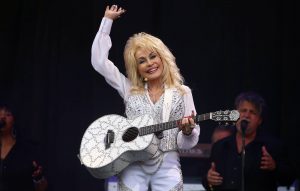
In 2014, Dolly Parton drew one of the biggest crowds in Glastonbury’s history when she graced the Pyramid Stage for the festival’s coveted Legends slot. An estimated 180,000 punters gathered to watch the Queen of Country strut her stuff, her rhinestone-encrusted suit glistening as she rattled off a rap about the mud on Worthy Farm: “We won’t let it ruin our high.”
READ MORE: The Big Read – Dolly Parton: “I take care of business”
She even parped away on a saxophone (also covered in rhinestones), playing the novelty instrumental ‘Yakety Sax’ (AKA the theme to The Benny Hill Show). In fact, she played it twice: once forwards, once “backwards” – as in, with her back to the crowd. “I know it was corny, but it was fun,” she joked afterwards.
Corny but fun, triumphant in the face of adversity and wearing her undoubted genius with a lightness of touch, this was Dolly Parton all over. The performance introduced the star, who has died at the age of 80, to a whole new generation, proving her long-held talent for unifying audiences. Go to a Dolly Parton gig, and you would meet folks – as she’d likely call them in her downhome Southern patter – from all walks of life.
A cheerful contradiction in terms, she retained the values of her dirt-poor background but was always the most glamorous person in the room. Here was a salt-of-the-earth gal who was worth an estimated $650million, had won 11 Grammys (including the Lifetime Achievement Award), sold more than 100million records, released 49 solo albums and donated 100million books to children around the world through her Imagination Library charity. The world’s first cloned mammal, a sheep, was famously named after her and, in 2020, at the height of the pandemic, Parton donated $1milllion to the development of the Moderna Covid vaccine.
In interviews, she was unfailingly positive and charismatic, managing the tricky tightrope walk of appeasing all corners of her fanbase by remaining apolitical. Instead, she expressed sincere beliefs about fairness, kindness and respect for all. When she appeared on the cover of NME in 2019, journalist Leonie Cooper asked Parton if anything ever made her angry. “Oh, of course!” she replied, explaining that lateness and complacency got her goat: “I don’t remember the last time I shouted. I get more pissed off. I take care of business however I need to do it.”
Dolly Rebecca Parton was born in January 1946 to a family who shared a two-room log cabin in Pigeon Forge, Tennessee, a town nestled in the Great Smoky Mountains. “I grew up on a farm in a family of 12 children,” she told the BBC in 1978. “We made our living from the land. That goes back to the fact that we got our strength from that religious background and the fact that we knew how to survive with what we had… I’m ambitious because I like to have nice things, but I managed to keep my childhood, my roots, sturdy and deep.”
It was a musical family – her mother, Avie, was a singer – and Dolly sang in church from the age of six, soon learning to play the guitar. She began performing on local TV and radio stations when she was just 10 years old and appeared on the legendary Grand Ole Opry at 13. In pursuit of stardom, she moved to Nashville the day after graduating from Sevier County High School in 1964.
On her very first day in the big city, she met Carl Dean, an asphalt paver whom she would marry two years later. In her 1994 autobiography My Life and Other Unfinished Business, she portrayed a man whose simple pleasures in life were at odds with her own showbiz glamour: “He’s a great mechanic who will work all day on a truck or tractor then come in and sew up the pocket on his old work shirt.”
Dolly Parton in 1976. Credit: David Redfern/Redferns
Carl remained a mysterious figure as Parton’s career scaled unparalleled heights; no matter how famous she became, he always shunned the spotlight. She made her first big step to celebrity on The Porter Wagoner Show, whose titular star was so impressed that he signed her up to perform on the programme for five years (she stayed seven). Although Wagoner became her mentor and manager, the turbulent pair “were like oil and water”, as she recalled on The Martha Stewart Podcast.
Parton’s first song to chart, ‘Dumb Blonde’, peaked at Number 24 on the Billboard Hot Country Singles list. “This dumb blonde”, she sang over a freewheeling country shuffle, ”ain’t nobody’s fool”. So it proved: when she resolved to part ways with Wagoner, she wrote a song about her feelings. 1974’s staggeringly beautiful ‘I Will Always Love You’ topped the Billboard Hot Country Songs, just like her previous single, the immortal ‘Jolene’.
As she rose to greater stardom in the country world (she was crowned The Country Music Association’s Female Vocalist of the Year in 1975 and 1976), her creativity was matched by a steely business sense: Parton controlled her own publishing rights almost from the start. She reluctantly refused Elvis permission to cover ‘I Will Always Love You’ because his controversial manager, Colonel Tom Parker, demanded she relinquish half of the publishing, an instinct that paid off when Whitney Houston’s version of the song topped the Billboard chart for 14 weeks, and Parton reaped the rewards.
She understood the appeal of her aspirational approach to country even as the alternative likes of Emmylou Harris emerged in the mid-1970s. “I love the glitter and the rhinestones and all of that,” she told NME’s Mick Farren in 1976. “The new underground people in country music, they wear the patches, the faded denim. I wore that when I was a kid. I had nothing else then.”
Dolly Parton at Glastonbury 2014. Credit: Tabatha Fireman/Redferns via Getty Images
Nevertheless, Parton crossed over to the pop charts with 1977’s ‘Here You Come Again’, a keening country pop ballad penned by Barry Mann and Cynthia Weil. She smashed Hollywood with her role in the 1980 comedy 9 to 5, a vehicle for her classic pop song of the same name (or was it the other way around?), which appeared on its soundtrack.
There were further movies (she won a Golden Globe Best Actress nod for 1982’s The Best Little Whorehouse in Texas) and a clutch of hit singles (her Kenny Rogers duet ‘Islands In The Stream’ is a karaoke classic). In 1984, she was diagnosed with endometriosis and underwent a partial hysterectomy that meant she would never realise her dream of motherhood. Devastated, Parton vowed to pour her energy into philanthropic endeavours. One of the many results was Dollywood, her theme park in Pigeon Forge, which boosted the local economy.
Her last studio album, 2023’s ‘Rockstar’, her first-ever rock album, showed that Dolly’s fun-loving spirit remained undimmed as she reached her late seventies. The following year, heartbroken, she announced Carl’s death at the age of 82 and eulogised him with ‘If You Hadn’t Been There’, a gorgeous ballad on which she asked: “If you hadn’t been you – well, who would I be?”
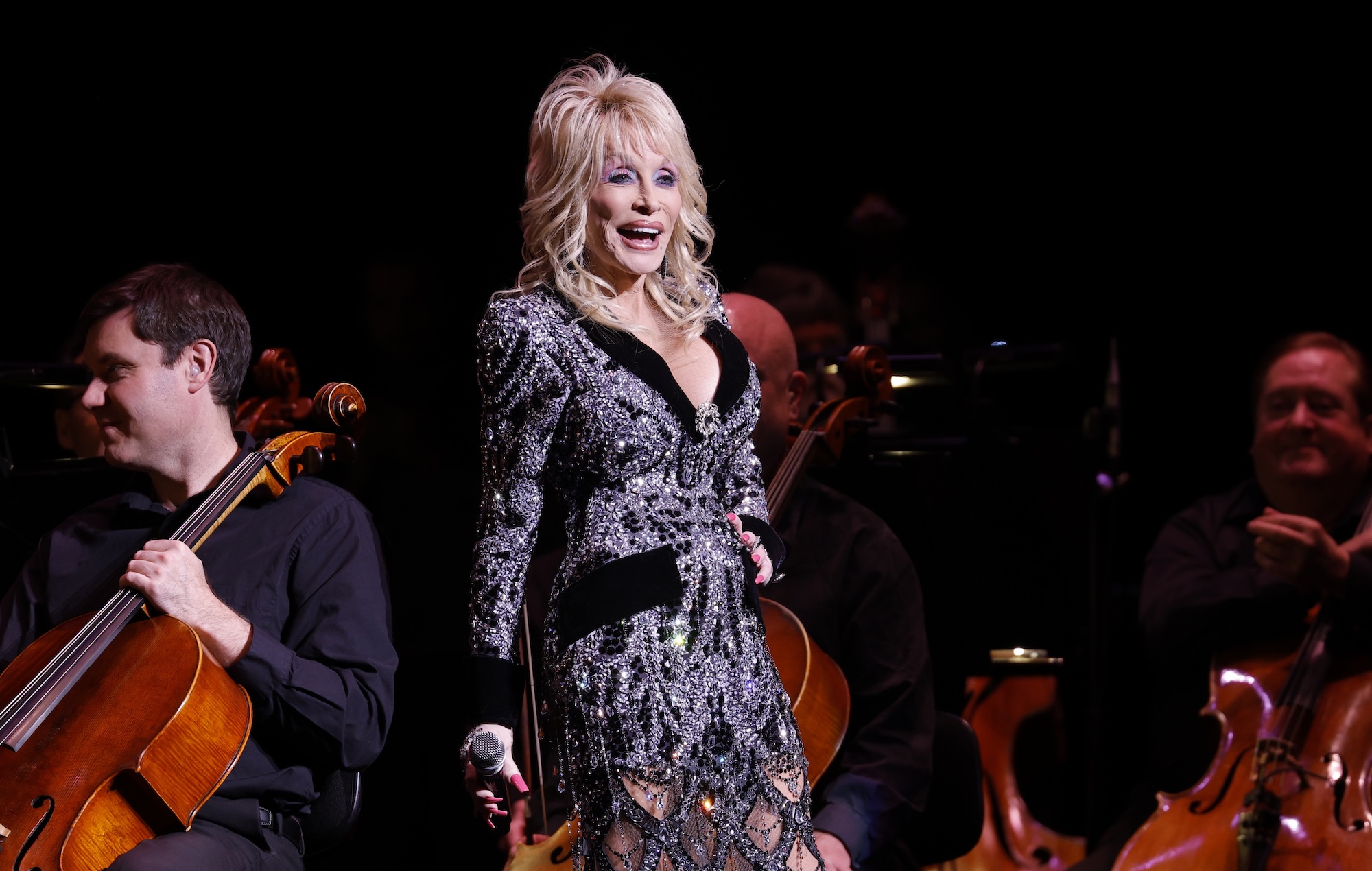
Last year, Parton was due to dazzle audiences once again, with a six-date residency at Las Vegas’ Caesars Palace. As she suffered some “health challenges” in late 2025, she announced the run would be postponed to September 2026, but in May scrapped the plans altogether. She would make one final major appearance on stage prior to her death, sharing an update on her health and life after Carl during a keynote speech at Dollywood’s 41st anniversary celebrations. “I just kind of got worn down and worn out, grieving over Carl and a lot of other little things going on,” she said.
As we all reel from Dolly Parton’s death, that glorious 2014 Glastonbury set may prove a balm. Introducing ‘Coat of Many Colors’, her 1971 country hit about a patchwork coat sewn by her mother, this humble “farmer’s daughter” paid tribute to her family’s love and resilience. Resplendent in her rhinestone suit, she embodied both qualities as a unifying icon. The world has become more divided since that set, but everyone will always love Dolly.
The post Dolly Parton, 1946-2026: the Queen of Country was a unifying force in a divided world appeared first on NME.