
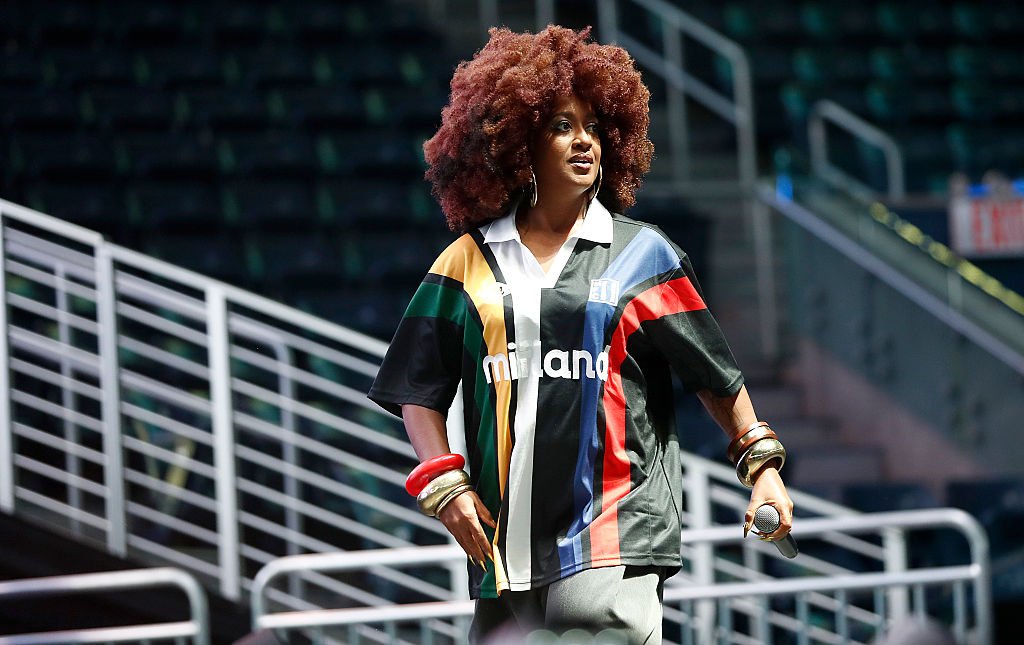
Rapsody has covered significant ground in the last two decades, emerging first as a talented upstart to garnering well-deserved attention from the industry overall. Rapsody’s latest body of work, God Gotta Afro & Gold Hoops, is not only a culmination of her years of focused evolution, but also a vivid reminder that being Black is and should be seen as a celebratory act.
Rapsody, affectionately called Rap by both her peers and fans alike, won her first Grammy Award last year for Best Melodic Rap Performance for her track, “3:AM” featuring Erykah Badu. Rap’s last album, Please Don’t Cry, on which “3:AM” appears, was her first without mentor and Jamla honcho 9th Wonder’s production touch.
For those who experienced that project, Rap allowed listeners to learn the inner workings of the artist born Marianna Evans, doing so with a vulnerability rare for an artist of her ability.
Before that album, Rap had become the female avatar of “Real Hip-Hop,” a weighty yet empty descriptor that divides rather than unites. Resisting the urge to cater to one segment, Rap may have lost some fans who were seemingly taken aback by her desire to promote the all sides of the culture and different production while centering herself on Please Don’t Cry, sidestepping the Hip-Hop savior mantle many tried to bestow her with.
This trend continues on God Gotta Afro & Gold Hoops. Under the guidance of Denaun, also known as Mr. Porter, the album’s central theme is, simply, seeing the beauty of God in Black music, culture, and in self. Being Black, to the North Carolina wordsmith, is a reflection of the divine and a high honor all at once.
She constantly reminds us that Blackness is rebellious, loud, but also distinguished and varied. The kaleidoscopic views that Rap puts forth grabs the ear immediately, and the musical backdrop, full of soulful vocals, self-affirming chants, poems, and verve never relents.
The opening track, “Peace, God!” is an effective tone setter, easing into the dance floor-ready “Free Yo’ Mind” which cleverly melts into a mantra of gratitude and self-reflection. Following with “No Way,” which features the gospel choir stylings of KARABA YA MORENO, Denaun’s use of African rhythms and the choir’s backing is nothing short of triumphant.
One of Rap’s signature gifts is her unflinchingly stark sincerity. Semi-autobiographical tracks like “Never Break,” experimental funk journeys such as “OMG! (Love to Sun Ra),” sultry love songs like “Apple Juice,” and especially the bombastic “God Gotta Afro” are all different shades of Rapsody yet can all be traced to the Tar Heel State native’s early promise when she a developed deep passion for the music and culture that had become her life’s work and calling.
Features from other male voices aside from Denaun are intermittent, however, Malice of Clipse fame sounds at home next to Rap on the “Black Love” track. Madlib is one of just a handful of producers on the album, and “The Peejays” is unlike anything we’ve heard Rap on.
Despite the warm production, jazz influences, and Black excellence at its core, God Gotta Afro & Gold Hoops doesn’t skimp on allowing Rap to highlight why her pen has the respect it does from those aforementioned Hip-Hop fans deeply mired in certain eras and sounds.
With assistance from DJ Whoo Kid, “YOU!” is Rap at her sh*t-talking best. All through the album, you sense that Rap was ready to pop on anyone who dares to test. But while it appears at first she’s speaking to her musical opps, she uses the song as a moment to speak life into herself and anyone who leans in.
Madlib’s deft touch is applied once again on the dynamic “Black Is Beautiful,” and the emotionally moving “Pretty Bird/Way U R” are late album standouts due to Rap’s soul-stirring songwriting.
The album’s closer, “Act II: Bloodline/Growing Older,” is a two-part emotional gut punch, especially for those close to their mothers or are mourning the loss of a parent. It is such a beautiful segment of music that nobody would be blamed for needing a moment alone to process what they heard.
Rapsody has once more proved to the world, and to herself, that she belongs. And yes, she always had belonged, even if she didn’t possess her musical skillset. It may not be the album for the kickback or turn up, although it very well should be. Yet, it certainly is a project that celebrates, signifies, and solidifies that Black is indeed beautiful.
Please find God Gotta Afro & Gold Hoops at your preferred DSPs below.
—
Photo: Getty