

When Yes convened in Paris in 1979 to record the follow-up to troubled record Tormato, late producer Roy Thomas Baker found five musicians at each other’s throats. Those “pub sessions” were to spell the end of the band’s classic line-up – again – for another 16 years, while a new line-up would release Drama in 1980.
Yes’ first collaboration with Queen, Journey and The Cars producer Roy Thomas Baker took place in Paris in 1979 – but the resulting recordings never saw the light of day, although many of those tracks later appeared on solo records, expanded reissues of Yes albums, or the 2002 In A Word box set.
But what happened at the end of the 70s in the French capital? Why did the recordings not amount to a finished release? And why did events there lead to the departure of Jon Anderson and Rick Wakeman?
Baker recalls the initial excitement about the material presented by the band. “There was some great stuff,” he says.
Wakeman, however, has a very different view: of an outfit that was failing to keep up with outside musical change. “In 1979, the world of music was going through serious changes and Yes was not embracing them,” he recalls.
Cape of no hope: Wakeman in 1978 (Image credit: Getty Images)
There are contradictory views of the city itself. “I find Paris excessively inspiring,” states Baker, although he accepts that they were too far from the centre. For Steve Howe, Paris was not conducive to a healthy, happy atmosphere, especially compared to Montreux in Switzerland where they recorded 1977’s Going For The One.
“Paris was a whole different reality – ‘reality’ being the operative word,” the guitarist says. “It wasn’t beautiful like Montreux. There was no fantasy here – it was not a place we could sit back and relax.”
After having to fight through traffic to get to the studio, things hardly improved. “There were definitely issues in terms of communication within the band,” says Baker.
Howe recalls Anderson playing harp instead of his usual guitar and so found it difficult to bounce ideas off him. He remembers the singer and keyboardist “had done some music together” that he and Chris Squire “were not that clear how to treat guitaristically.”
They were, he says, “very bouncy and very Rick in musical style, and a bit new; a new kind of thinking about Yes, because Jon usually wrote with Chris or me and now suddenly he was writing with Rick – which we weren’t against, but it was a different breed of music.”
Looking for harp-iness: Anderson in 1978 (Image credit: Getty Images)
Howe and Squire weren’t excited by Anderson and Wakeman’s ideas, and the feeling was evidently mutual: How vividly remembers a “farcical” situation involving Wakeman chucking peanuts at Alan White’s drum kit, so displeased was he with the state of affairs. “This was the kind of mayhem we were creating for ourselves,” says Howe.
Wakeman agrees that it was “not the happiest of times” for Yes. “It was completely the opposite to the feelings of the band a few years earlier when we recorded Going For The One, where everybody was driving down the same musical road,” he says. “In Paris, not only were we not on the same road but we were not even heading in the same direction!
Jon and I felt it was slipping away and so it was time for us to slip away, too. That’s exactly what we did
Rick Wakeman
“Jon and I had put some songs together during the previous tour and we felt they had great potential. Sadly, tht was not felt by Steve, Chris and Alan, and sessions in the studio were laborious and not pleasant at all.”
Baker acknowledges the factions within the band. “There were two camps. Trying to pull the whole thing together, I felt more like a referee than a producer.” Did he have to bang any heads together? “No,” he laughs, “they were doing it amongst themselves!”
The situation eventually became so difficult that Atlantic Records majordomo Ahmet Ertegun flew over from New York for a crisis meeting. Baker recalls: “His attitude was, ‘How the fuck do we get this back on track?’ Trying to get them in one room and get them to talk were two different things.”
Push to play: Howe in 1978 (Image credit: Getty Images)
By this point, Wakeman knew things had gone too far. As he puts it: “Not even Henry Kissinger could have resolved that mess.” Matters reached a sorry end just before Christmas, when drummer White broke his foot on a roller skate. Wakeman and Anderson took solace in spirits: “Jon and I met for a drink. Well, actually, it was a whole bottle of Calvados,” he laughs. “We both agreed this wasn’t the Yes we loved and believed in.
“I don’t mean the guys – I still have great respect and love Steve, Chris and Alan very much. as they’ve been a big part of my life. But I always refer to ‘Yes’ as the music. I always felt we were guardians of Yes’ music and should be treated with respect.
“Jon and I both felt it was slipping away and so it was time for us to slip away, too, and that’s exactly what we did.”
The final straw was that broken foot. “We had a drummer who couldn’t play,” Howe says. “That was the catastrophic moment when we said: ‘Let’s stop.’ I think there was a feeling we all wanted to stop anyway, because the session was going nowhere.
“It didn’t have the same bright feeling we’d had on Relayer or the sense of a reunion we had on Going For The One. There was no magic or chemistry between us and Roy Thomas Baker. It was just a write-off.
Worst foot forward: White in 1978 (Image credit: Getty Images)
“We weren’t challenging Yes to go forward – we were finding a party line, a kind of music that was easy for us to do: sprightly and mellow and nothing like Drama would be.”
He believes they developed a new lease of life with the arrival of Buggles duo Trevor Horn and Geoff Downes for the band’s real 10th album. “Chris, Alan and I proved the point because when we got on to Drama, we made an album that really stung at you. It shouted and it had attitude.
Yes had lost its guarantee of selling hundreds of thousands of records. The record company didn’t know what to do with us
Rick Wakeman
“We didn’t have any attitude in Paris, apart from, ‘Where’s the next bottle of wine?’ or ‘Should we drive a Rolls Royce or a Bentley?’ All decisions that had fuck-all to do with music.”
Were they galvanised by punk on Drama? “There might have been a subconscious awareness of what was going on,” Howe concedes, adding that the record “was more aggressive and heavier than some of the things we’d done.”
Following the events in France, Wakeman recalls, “The studio was cancelled and everybody went their separate ways. I spent a few more days in Paris walking my German Shepherd before going home to Switzerland to contemplate a future I wasn’t expecting.
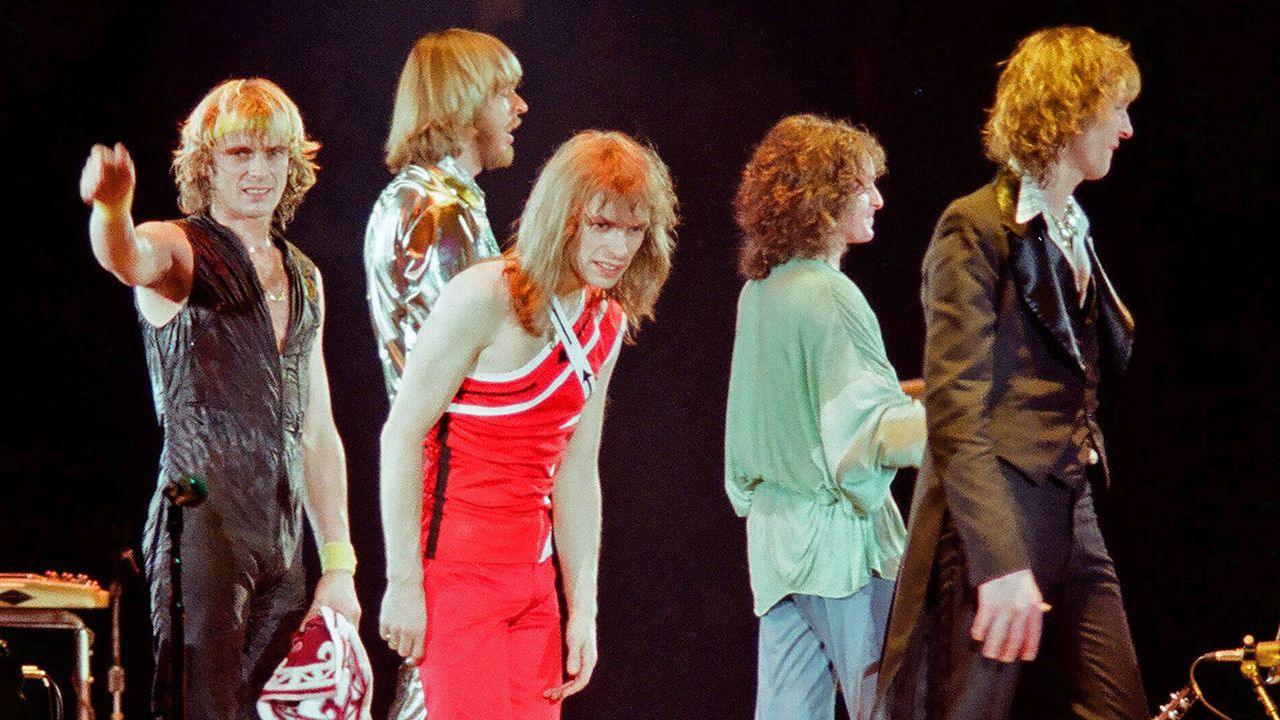
Yes on stage in 1978 (Image credit: Getty Images)
“Yes had already lost its guarantee of selling hundreds of thousands of records, the record company didn’t know what to do with the band and we still had more egos than the entire Premier League footballers put together.”
Not that he believes the experience was a waste of time. “Not for me! My father always drummed into me to learn from things that haven’t gone to plan, and I did learn a lot about myself.”
For Howe, the Paris sessions haven’t quite acquired the status of legend à la The Beach Boys’ Smile, nor does he have much stomach for piecing together the finished tracks to make something approaching a complete album. But he doesn’t have any regrets.
“I’m not morbidly sad about it,” he says. “We had a good run and did some great things. That wasn’t one of them.”