

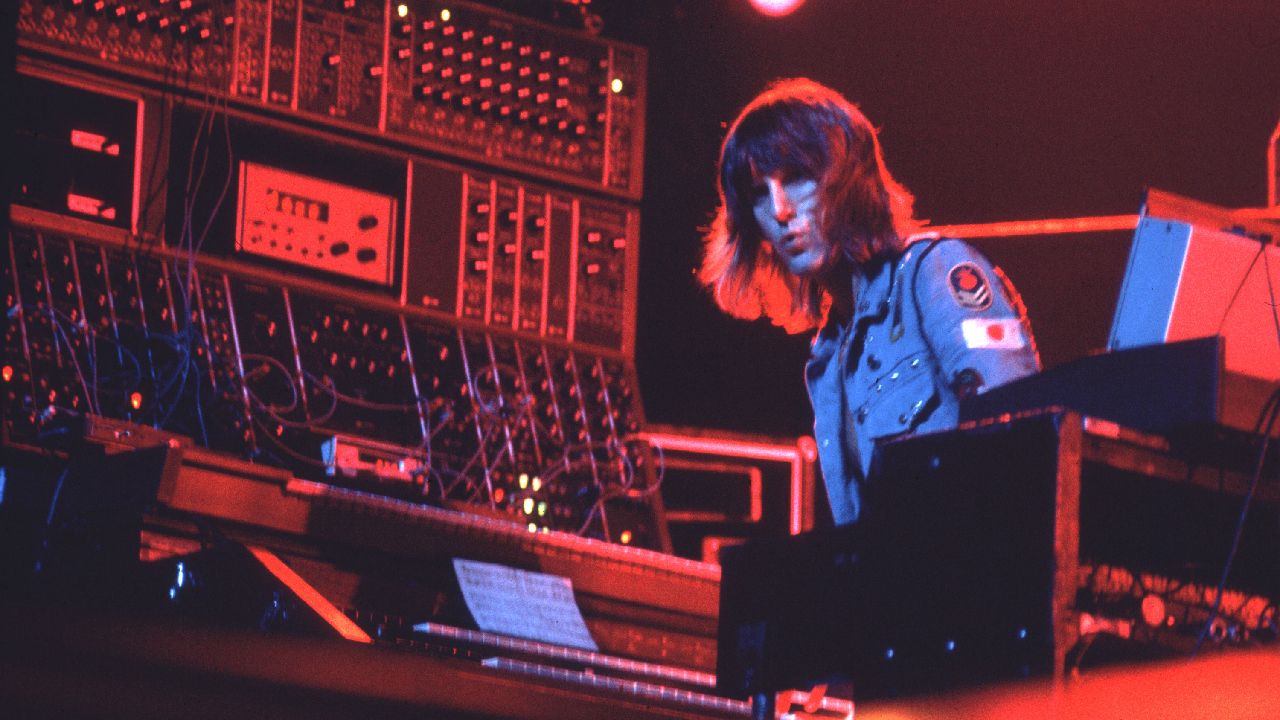
The 20th century was a period of explosive advancement in the music industry, introducing electric instruments and amplification, stage and lighting innovations, recording developments and much more.
Among all of those was the Moog synthesiser, developed by American engineer Bob Moog and first launched in 1964. Within a few years, and partly thanks to Wendy Carlos’ Switched-On Bach album, everyone who was anyone was using a Moog – providing they could afford it.
The late Keith Emerson made contact with the company when he was forming Emerson, Lake and Palmer, and preparing to record their first album in 1970.
“I thought, ‘I really need one of these,’” he said in 2014. “I got hold of the Moog company and I said, ‘I thought I might get one of these for free. I could promote this – I’ll endorse it.”
It was a brave effort. The letter he got in reply said: “Thank you for your request; but first of all, the Moog synthesizer is not generally recommended for live stage use.
(Image credit: Getty Images)
“Furthermore, if your request is that you want one for free, seeing as the Rolling Stones paid for theirs and The Beatles also paid for theirs, I see no reason why you shouldn’t pay for yours.”
So he did. The Moog Synthesizer Model I-CA was custom-shipped to him on July 10, 1970, and cost around £4000 – equivalent to about £55,000 today.
“It was a lot of money,” Emerson said, “and I don’t think the rest of the band were that enthralled. But I made the right decision, because it did define the new way of sound. It opened up the possibilities of keyboards.”
Between them Emerson and Moog (who died in 2005) inspired generations of musical explorers. In 2019 Frost*’s Jem Godfrey chose Moog as his prog icon, saying: “Keyboard players had been accompanists playing organ, piano and Mellotron. But they had never really had a voice to compete with guitars.
“The organ is a very linear instrument and basically on/off; but with the Minimoog it was suddenly this malleable voice where you could bend the notes, change the tone and overdrive it. Finally keyboard players could compete with guitarists both in style and volume!
“Bob Moog redefined the role of keyboard players completely. Suddenly we weren’t these guys at the back – we could be up at the front, wearing capes! Without him, keyboard players would’ve taken a lot longer to come to the fore. Bob was a pioneer.”
In 2023 Rick Wakeman, while paying tribute to old friend Emerson, expressed similar thoughts to Godfrey’s. “One of the big problems with keyboards was that guitarists were so loud. When it came to a solo for the organ, piano or electric piano, the whole band had to drop in volume.
“Then the wonderful Bob Moog gave us the Moog synthesiser – an instrument that could cut through concrete, and Keith embraced it brilliantly.”
Back in 1970, with all that yet to come, Emerson wasn’t quite finished running his mouth off. “When I first started using the Moog, I said to Melody Maker, ‘Well, this can replace most members of the classical orchestra,’” he recalled in 2014. “And boy, that got me into trouble! I was banned from the Musicians’ Union for some time.”