

In January 1982, Def Leppard entered Park Gate Studios in Battle, East Sussex to make the follow-up to their breakthrough album High ’N’ Dry. Under the aegis of producer ‘Mutt’ Lange, they pieced together a record the likes of which had never been heard before: the gleaming pop-metal behemoth Pyromania. And Photograph was the perfect single with which to launch it.
Photograph embodied Leppard’s brave new sonic world. Gone were the gritty AC/DC-isms of High ’N’ Dry, replaced by machine-tooled melodies and Lange’s hi-finish gloss, oven-ready for brand new music channel MTV.
Lange himself came up with the song’s lyrical hook. “Mutt had the line ‘All I’ve got is a photograph,’” said Elliott. “I said, “That’s a Ringo Starr song.” He went, ‘Nobody will ever notice.’ For Elliott, the song title referred to an unobtainable someone.
“I said to Mutt, ‘Wouldn’t it be great to write a song about a woman who’s the ultimate woman, but also a woman you could never have?’ He said, ‘What do you mean, never?’ And I said, ‘Because she’s fucking dead!”
The video featured footage of Marilyn Monroe, suggesting the iconic Hollywood star was its subject. “Over the years it’s become exaggerated to Biblical proportions that Photograph was written about her,” said Elliott. “I don’t want to break anybody’s heart here, but Marilyn Monroe was just another average actress to me.”
“I used to live in a little basement apartment on the outskirts of London, toward Heathrow,” he told Rolling Stone. “It was a real dump – there was a hole in the wall with a poster covering it up, kind of like in The Shawshank Redemption. It wasn’t an escape hatch, but it looked like one! And the poster that was over this hole was Marilyn Monroe.”
“Def Leppard’s Photograph looked different from anything at the time,” said the video’s famed director, David Mallet, who’d previously worked with David Bowie, Queen, Blondie, the Rolling Stones and more. “Different colours, mood, visuals, editing, photography. It’s hard to believe now, because it looks like every heavy metal video ever made. But nothing had ever looked like that before.”
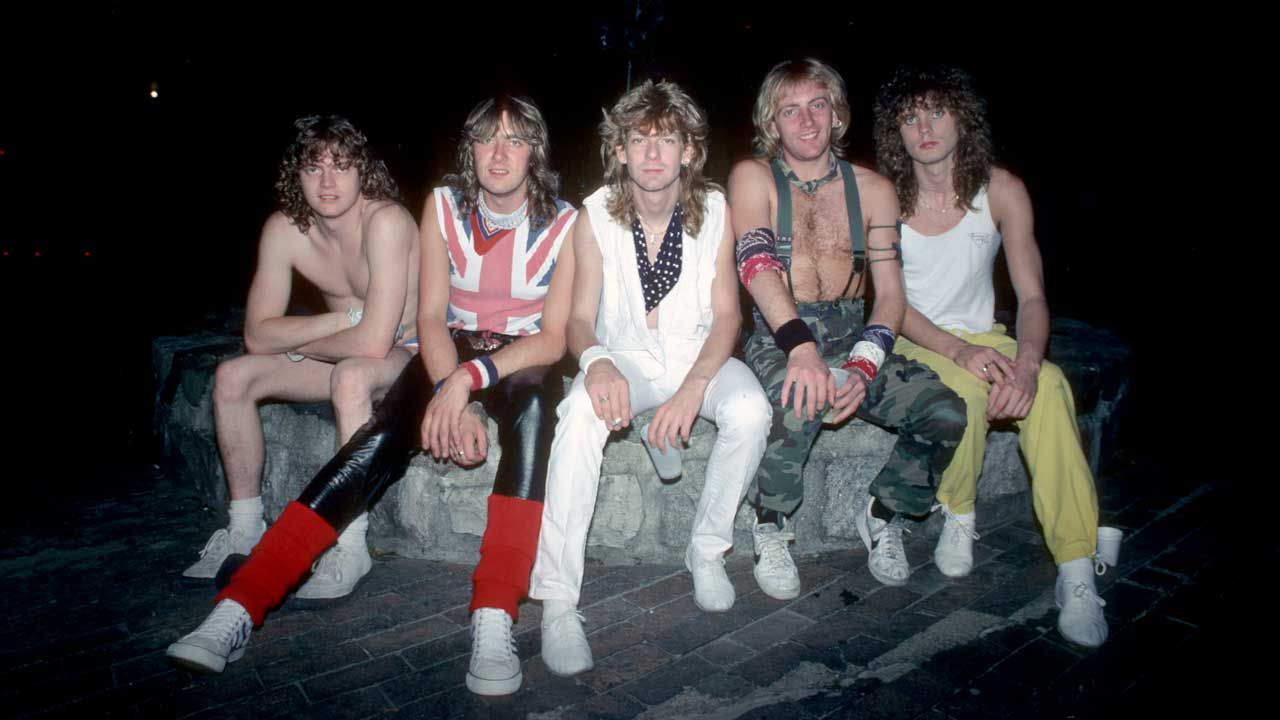
“When we did Photograph, we went mental,” said Elliot, who frosted his hair for the first time on the morning of the shoot. “Phil wore a polka-dot top. Steve wore all white. The day before the shoot, I had £25 in my pocket, and I went down Kings Road in London to get some clothes. I found a pair of black pleather trousers that were too short by about four inches, so I bought them, and some leg warmers, which I’d seen in the TV show Fame.
“When I was done buying the pants and the effeminate leggings, I had £8 left. I walked past a punk rock shop, and they had a red, white and blue Union Jack shirt in the window for £7.99. It was all I could afford, and it was loud. After that video, the shirt became so iconic that we sold almost 100,000 of them on tour that summer.”
The reception to Pyromania in Britain was decidedly cool, a hangover from Leppard allegedly “selling out” to America a few years earlier. In the US it was a different story: Photograph was a huge hit on radio and MTV. “Photograph blew out the door the way More Than A Feeling or Radar Love or Black Betty did,” says Elliott. “I met George Michael, and he said: ‘I bought Photograph – great song!’ That’s when you know you’re crossing over.”
Not everyone appreciated it. Photograph was one of the videos that spurred Tipper Gore to form the PMRC, the organisation that advocated for increased parental control over children’s access to music, after she watched it on MTV alongside videos by Van Halen, Mötley Crüe and Scorpions. “The images frightened my children; they frightened me,” said Gore. “The graphic sex and violence were too much for us to handle.”
Nevertheless, the single was the first proper stepping stone on Def Leppard’s journey to megastardom, helping to push the sales of Pyromania into the multi-millions. It remains a staple of the band’s live set today.
“When I was a kid in Sheffield,” Elliott says, “I was this geeky twat who liked music and wasn’t living in the real world. All I ever wanted was to be a star.”
It was Photograph that helped him achieve that dream.