

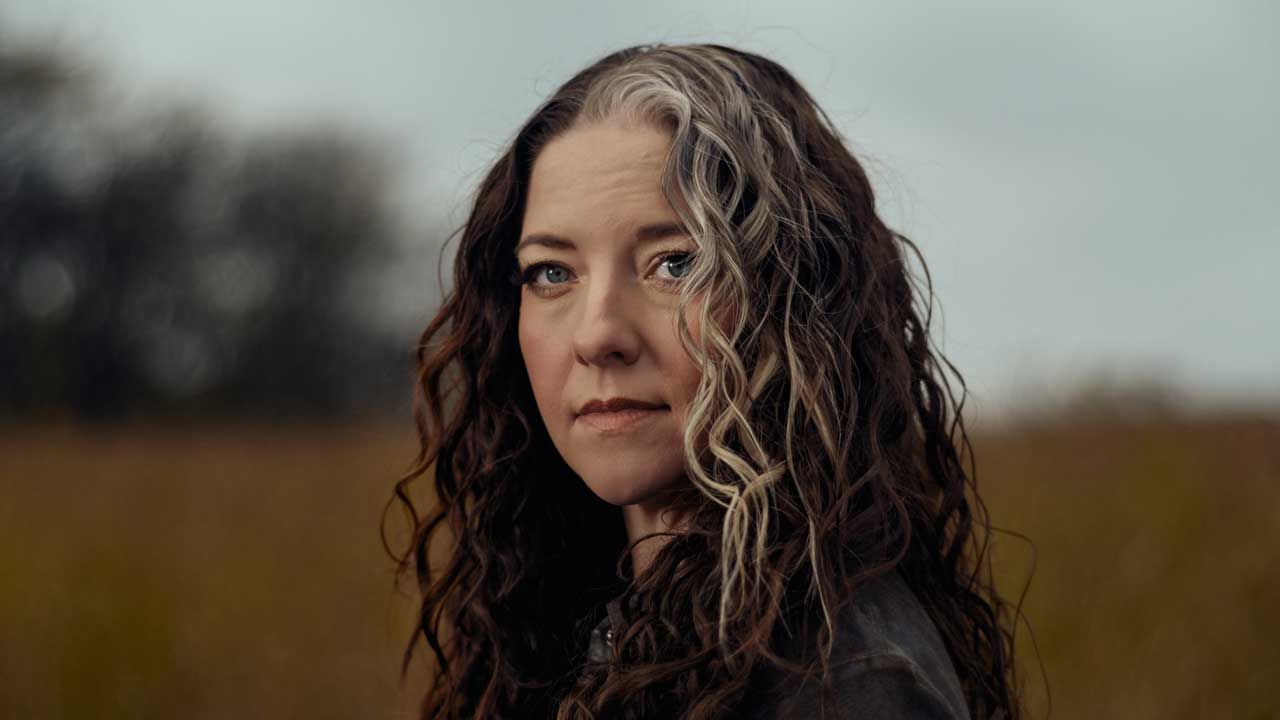
Years ago, at home in rural Arkansas, in the foothills of the Ozark mountains, Ashley McBryde decided to dig a hole. Big enough for her to get inside. Certain boundaries were set by her parents: it couldn’t be somewhere that livestock, stray dogs or neighbours could accidentally fall into, and it had to have safety parameters. Otherwise, they told her, “knock yourself out”.
Mission approved, Ashley took a shovel and a pickaxe, went outside and dug that hole. She was 12.
“It’s kind of a weird thing to do, but I’m glad I grew up that way,” the Grammy-winning country maverick tells us today, sitting in an upscale hotel suite overlooking London’s Hyde Park. “Or if I wanted to build a ladder, there was no ‘run to Home Depot and buy lumber’, because ‘with what job, with what money? Here’s a hatchet, go out in the woods, get what you need.’ It had elements that were very backwards, but the superpowers I got from that upbringing, you can’t get those in a book, you can’t get them in school. I wouldn’t trade that.”
Immaculate but rock’n’roll in jeans, T-shirt and boots – fresh make-up, arms toned by boxing, and brightly covered in tattoos – McBryde, 42, combines Southern friendliness with the sharp focus of a seasoned TV and radio interviewee. Over 45 minutes she relaxes, enthusing about her favourite old Nashville joints, cooing at dogs in the park below and showing us the pocket knife inked on her right forearm. She learned to whittle as a kid, and generally still carries one.
“Well, with flying it’s really difficult to remember to put them in checked baggage,” she concedes. “But otherwise yes, I carry. And in my band, anytime anybody goes: ‘Anybody got a knife on them?’ every single person reaches into their pocket and produces this tool that they carry at all times!”
(Image credit: Nathan Chapman)
More deeply than any of McBryde’s previous four albums, new one Wild evokes the sounds, sights and stories of her childhood. Produced by John Osborne (the elder, guitarist half of duo The Brothers Osborne), it finds McBryde planting her boots firmly in rock soil, stirring heavy guitars with shrieking bluegrass and emotive melodies. Think Loretta Lynn trading experiences and ideas with Black Stone Cherry and Bruce Springsteen. As a listener, it’s like being in a country dive, and at a rock show, and reading a great collection of short stories – capturing the grit and beefiness of her live show, in a way that her other releases haven’t.
For those who have only heard her American radio ballads (e.g. 2020 country hit One Night Standards, 2023’s Light On In The Kitchen), that live muscle often comes as a shock.
“We sound more like we do live on this record,” she says. “And that’s a luxury I didn’t know I needed so badly. I’ve watched some audiences be really confused, if all they’ve heard is what’s been on American radio. Because then we would go play a live show, and we would open with [2023 rocker] Blackout Betty, and they were so confused! I’m happy this one presents a better snapshot of what you’ll experience with us live.”
The album charts her life through to 2022, when she decided to stop drinking. That year she became a member of the Grand Ole Opry. Four years later and still sober, on Wild she takes a wide, autobiographical approach, going deeper into the people, places and things that really shaped her. Meticulously crafted songs, some of them written years ago and previously deemed (by label and other industry folks) too raw, too swampy, “just too much”.
Now, it’s all here. This, you sense, is who Ashley McBryde really is – as well as a bracing antidote to Nashville’s glossier country pop and bro-heavy hybrids. Collaborations with respected if lesser-known songwriters (e.g. Terri-Jo Box, Lori McKenna, Lisa Carver, Lauren Hungate…), championed by McBryde, are peppered across the track-list. McBryde’s late friend Randall Clay wrote feral, boot-stomping lead single Rattlesnake Preacher.
“There are those of us that really care about crafting a song, whether that’s to pull on your heart strings, or tell a story that provides a mirror for you, or that provides an antithesis. And then there are those that just go, I dunno, ‘Leg rhymes with keg’… and they make gajillions of dollars, and sing ‘leg rhymes with keg’ to billions of people.
“And you’re allowed to do that,” she adds, sincerely. “And I could do that. But then there would be one less of the thing that I am.”
To understand Ashley McBryde today, you have to go back to Mammoth Springs, Arkansas in the 80s and 90s. The family home was at the end of a long dirt road with a low-water bridge. The family kept cattle. They drove 45 minutes to school. Growing up, McBryde and her five elder siblings whittled with pocket knives, went fishing and rode horses and mules out in the woods for days.
“There’s six of us kids, lots and lots of trees,” she recalls. “I can feel the dirt between my teeth when I talk about it. And I know that red dirt is the name of a genre now, but the dirt is red, especially up in the foothills of the Ozarks.”
Her mother looked after the family. Her father was a preacher and a “tyrant”. The nearest building was the church – located at the end of their driveway.
“He made it so that any male anywhere is to be feared,” she says, a low note of anger creeping in, “and you are to be in complete submission to at all times. I was always in trouble, because I was always going: ‘What do you mean don’t raise your voice? He raised his voice, I have to raise mine or he won’t hear me’ [slaps one hand hard on the other], that’s not gonna fly.”
The presence of her parents comes out in the familial imagery of Hand Me Downs. Branching out into a sadly common situation, the devastating Lines In The Carpet tells of wives trapped in domestic isolation: ‘When you’re born that pretty, you get to be Miss Mississippi and nothing else.’ From an early age, McBryde knew that could never be her.
“I watched my mother raise all six of us and go unthanked, but the acknowledgement she deserved for the vast thing she was tackling at all times, and watching her feel small…”
She pauses, slightly disarmed.
“That feels gross just saying it. And my sister Aubri, who’s so strong, did the same thing, and was married, had two beautiful children, they’re married for thirty-four years… They married when she was eighteen. I don’t remember seeing her much, and now I know it’s because she was behind the vacuum.”
When McBryde was 17, her father left. There’s heat in her voice when she says this. Suddenly you wonder if that’s at the heart of Wild’s tougher rock highlights like the hard-punching Arkansas Mud. That tension between fear, anger and inspiration – things that might drive someone to get out, though not without leaving a few scars.
“Looking back at it, I get frustrated because I was such a scared child,” she says. “I was scared of everything. I had plenty of protection and a roof over my head, but I was constantly terrified that any minute Jesus was going to rip the sky open and that I’d be left here. That isn’t religion, that’s control, that’s terrifying a child into being too scared to do anything.”
(Image credit: Laura Halse)
At college in Arkansas she studied the French horn, and played her first bar gig (“and loved it”). By 19 she was working as a songwriter in Memphis, living in ‘stab ’n’ shoot’ complexes, medicating her anxieties with music and alcohol. Even so, it was a turning point, drawing her out of the fundamentalist fear that had governed her young life.
“It’s like, you’ve been fed the information that you’re inherently bad, and you will never do enough things to not be inherently bad…” her eyes widen, “what is there to lose? It doesn’t matter if I’m damned at home, or in Memphis, or in Nashville, or because I didn’t make it to church on time, or because I play in a bar on Friday night. So I can do anything I want, because nothing I do will ever be good enough.”
In 2005 she moved into a storage unit in Nashville. She now lives in a “less congested” spot outside the city.
Booze and bars were part of her world for years, feeding into sad, darkly funny moments in her records. Sometimes drinking was fun. In time, it got ugly. Wild ballad The Bottle Tells Me So reflects her blacked out nights and days. Finally, in 2022, she reached a precipice.
“It was definitely ‘change or die’. And I had done that many, many times, and waking up for the millionth time in not my house, in not my clothes, don’t know where my phone is, I have no idea how I got here. Where is my truck? Where are my keys? Does anyone know that I’m safe?”
That millionth time, she went to find water and found her team waiting in the living room. Just recently, she asked her manager who called him back then, to say where she was. He told her: “You did”.
She started treatment that day. Pieces of her life have since shifted into sharper focus, fuelling the rich vignettes and rootsy rock cocktails of Wild. Boxing sessions help. So does her close circle of band, crew, friends and family. Like almost any recovering alcoholic, she has days when the temptation to drink returns.
“When that happens, my question to myself is: ‘Okay, you can have it. Will you trade everything from then to now, being a member of the Grand Ol’ Opry, winning a Grammy, like, will you trade it for that?’ Get out of here! Course, I wouldn’t!”
Unclouded by hangovers, she relishes surviving staples of old Nashville. Bluegrass nights at The Station Inn. The local songwriting community, largely unsung but so crucial to the city’s musical ecosystem. She has a great relationship with her mum and stepdad. Siblings Aubri and Dan are close allies. Her father is in poor health and lives up a mountain. She sees him about every other year.
“I imagine that I’ve been watching a series for forty-two years,” she reasons, “and the actor that played my father has aged a bit, so they had to recast it. So when I see his face, I try not to associate the terrorist, the tyrant, with him, because the person playing him now is this old man who lives on a mountain, he moves kind of slow, none of his kids live within two hours of him, and they don’t visit very often…”
She shrugs. “And he’s got some cool stories. We agree on knives and guns and conserving wildlife. So we can keep it at that.”
Wild is out now via Warner Records Nashville.