
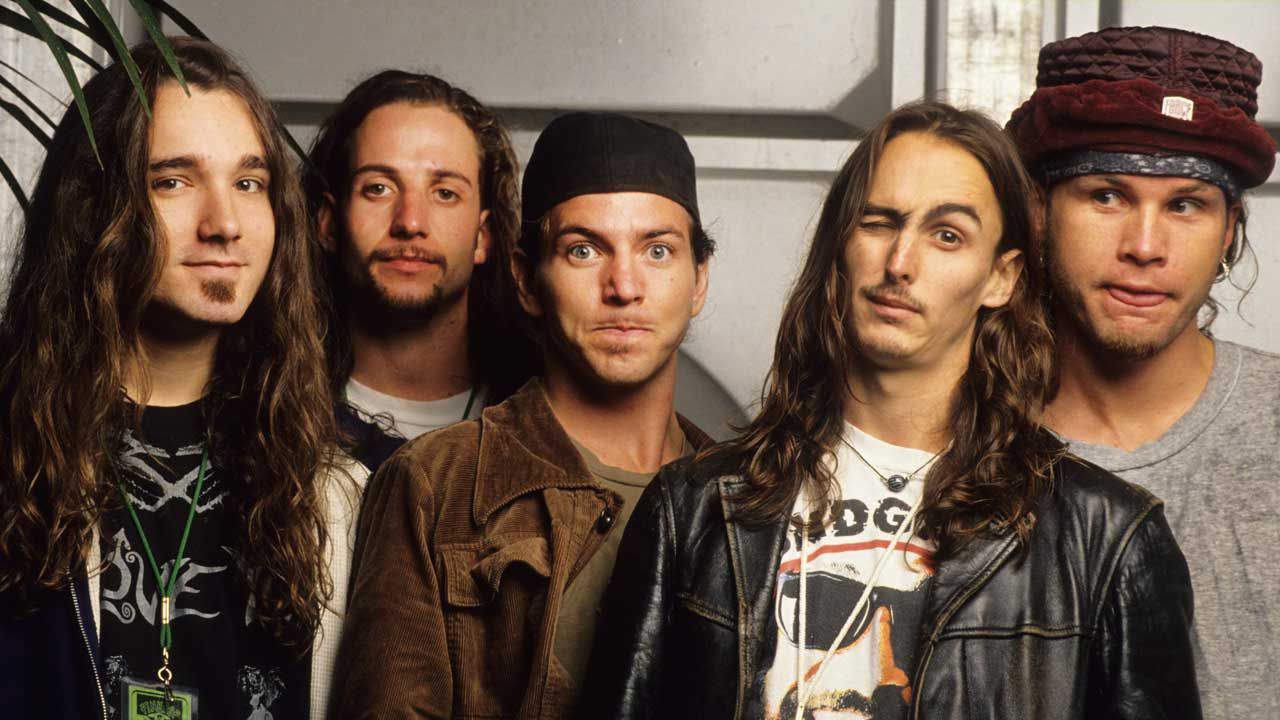
Rarely has a rock song deceived its audience so successfully as Pearl Jam’s Alive. To the casual fan, thrilled by the stadium-rock riff and radio-tooled chorus hook upon its release in July 1991, this was a feel-good anthem with no strings attached. But to those in on the secret – not least the Seattle band’s frontman and lyric-writer Eddie Vedder – Alive was a defiant shout from the murkiest emotional depths, exorcising poisonous demons of childhood. “It was a work of fiction based on reality,” Vedder once explained. “In some ways, that song was a way to get it out.”
The music for Alive, originally titled Dollar Short, pre-dated Pearl Jam themselves: the song had already been played live at a show in Portland, Oregon by the band’s future lineup in their early group Mother Love Bone, but the band never got round to recording it. Guitarist Stone Gossard recalled that “it was exactly the same arrangement, but [singer] Andy Wood had a completely different set of lyrics”.
When Andy passed away, we hadn’t done anything with that song,” Gossard recalled in 2013. “It stayed in my pile of demos. I liked the way it had this nice minor/major shift in it.”
Gossard mailed the demo to Vedder in San Diego, who took a darker tack while surfing in the foggy swells off Pacific Beach. “It all came together as a piece, just in the water,” he recalls. “I didn’t catch any waves that day, but, well, one – the big one.”
If Alive’s chorus sounded euphoric and defiant, its verses were more troubled, Vedder chronicling a deceived child who is informed that ‘what you thought was your daddy was nothin’ but a…’, and that furthermore, ‘while you were sittin’ home alone at age thirteen, your real daddy was dying’.
Vedder knew of what he sang: he too had been unknowingly raised by a stepfather, discovering years later that his real parent had succumbed to multiple sclerosis.
“I think I would have just wanted to know if he loved me, and how much,” the singer reflected. “By the time adolescence came along, I didn’t really trust any adults.”
Shortly after Alive was released as Pearl Jam’s debut single, the band stopped by RKCNDY, an intimate all-ages venue in Seattle, to shoot the now-iconic black-and-white video for the song. Directed by Josh Taft, a longtime friend of Gossard’s who later worked on the videos for Even Flow and Oceans, it showed the band playing live rather than lip-syncing, a trick that captured the wildness of the band’s early shows. It also featured an early glimpse of what would become a familiar Vedder pose, with the singer hanging upside down from the lighting rig.
“We were seeing our friends make videos, like Soundgarden and Alice in Chains, and it seemed absolutely ridiculous to be spending so much money,” said guitarist Jeff Ament. “One video could be as much as an entire recording budget. We went to Josh and said, ‘We don’t want to spend more than twenty thousand dollars,’ and he said he could do it.
“We wanted the music to be live, so it was a little bit more representative of what it was like to be at one of our shows. Lip-synced videos had run their course, from our perspective. That way, if it failed, we didn’t break the bank on it, and the record company wouldn’t drop us for blowing three-quarters of a million dollars on two videos.”
MTV loved the clip, even though the subject matter was hardly mass-market, but the band’s thundering musical backdrop ensured Alive went overground, cracking the Top 20 in the US and UK. Hearteningly, as the song became a benchmark of early-’90s alt-rock, Vedder found catharsis in its performances.
“A couple of years later, we’re playing for larger and larger audiences, and responding to this chorus that I, you’d never thought,” he told VH1’s Storytellers. “You know, folks jumping down in the aisles, using their body to express themselves, belting down, singing along ‘I’m still alive’ en masse.
“So every night, when I look out on this sea of people, reacting on their own positive interpretation, it was really incredible. The audience changed the meaning of these words. When they’re singing ‘I’m still alive,’ it’s like they’re celebrating. And here’s the thing: when they changed the meaning of those words, they lifted the curse.”