
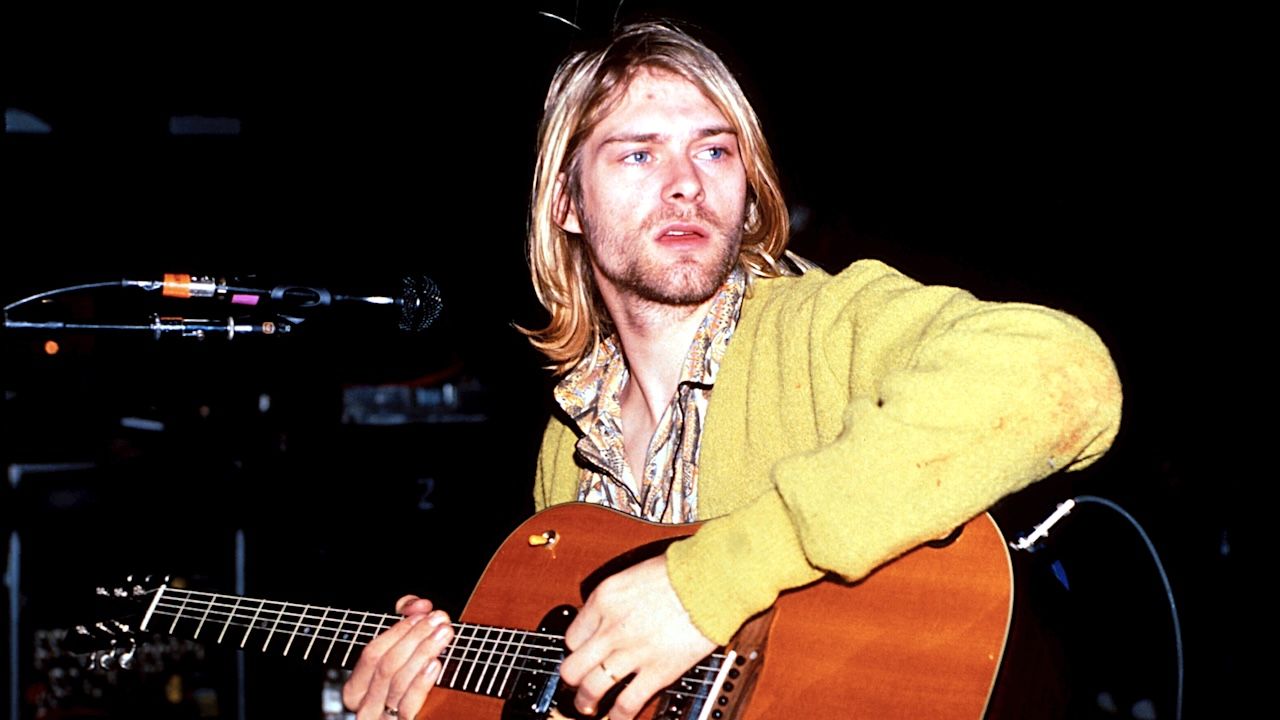
In July 1993, following Nirvana‘s show at New York’s Roseland Ballroom during the annual New Music Seminar, Kurt Cobain sat down with a handful of writers from select English music magazines to discuss his band’s upcoming third album, In Utero.
Scheduled for release on September 21, 1993, the album – the follow-up to the Seattle trio’s game-changing 1991 release Nevermind – was inarguably the most anticipated record of the year, with Cobain’s lyrics destined to be pored over, dissected and analysed on a forensic level by fans and music journalists desperate to gain insights into Cobain’s state of mind in the aftermath of his band’s wholly unexpected success.
But when Phil Sutcliffe from Q magazine sought to quiz Nirvana’s frontman on the meaning of his lyrics on In Utero, Cobain suggested that anyone trying to pull apart individual songs for interpretation might be frustrated.
“I’ve always painted abstracts,” he said. “I love dreams that don’t make sense. I’d much rather watch a film that doesn’t have a plot. Most of my lyrics don’t connect because I’ve taken lines from lots of different poems of mine and put them together. I’ll make up a theme well after the fact, oftentimes while I’m being interviewed.”
Nowhere was this truth of these words more evident than in Cobain’s original outline of the meaning behind In Utero‘s first single, Heart-Shaped. Box.
Written at Cobain and Courtney Love’s apartment at 448 North Spaulding Ave in Los Angeles, Heart-Shaped Box was first demoed by Nirvana during a three day recording session at Ariola BMG Studios in Rio de Janeiro, Brazil. and re-recorded with Steve Albini at Pachyderm Studios, Cannon Falls, Minnesota during the two week In Utero sessions.
In an interview conducted by Rolling Stone writer Michael Azerrad for Nirvana’s official biography Come As You Are, published soon after the release of In Utero, Cobain claimed that the lyrics of the song were in inspired by the pain and anguish he felt seeing children with cancer.
“Every time I see documentaries or infomercials about little kids with cancer I just freak out,” the singer told his biographer. “It affects me on the highest emotional level, more than anything else on television. Anytime I think about it, it makes me sadder than anything that I can think of.”
“Most of the lines in it are just from [different] poems anyway,” Cobain added. “I just thought they painted a good picture, every line, But the basic idea of the song is about little kids with cancer.”
As much as Azerrad, as Nirvana’s trusted biographer, had assumed the responsibility of sharing Cobain’s truth with the world, his instincts as a professional music writer compelled him to point out that even a cursory reading of Heart-Shaped Box suggested that it had precious little in common with Cobain’s emotional revelations about the song’s key theme, and that, in fact, it seemed to be about Courtney Love.
“Lines like ‘Throw down your umbilical noose so I can climb right back‘ and being ‘locked inside your heart-shaped box‘ describe an almost horrific dependency,” Azerrad noted, adding that the lyric “I wish I could eat your cancer when you turn black” seemed to be a reference to Love’s “storm-cloud disposition.’
Although the song’s title was originally believed to have been inspired by Love’s gift to Cobain of a heart-shaped box, filled with trinkets and dolls, before they were married, an alternate interpretation put forward the idea that it was basically a tribute to Love’s vagina. This theory gained a stamp of authenticity when Love effectively confessed as much in a tweet to singer Lana Del Rey.
After learning that LDR had covered her huband’s song during a 2012 gig in Australia, Love tweeted to say, “You do know the song is about my Vagina right? ‘Throw down your umbilical noose so i can climb right back,’ umm. On top of which some of the lyrics about my vagina I contributed. So umm next time you sing it, think about my vagina will you?”
Earlier this year, in conversation with her long-time friend Billy Corgan, on the Smashing Pumpkins’ frontman’s podcast The Magnificent Others, Love shared another revelation, revealing that one of the song’s key lyrics, and certainly its most sarcastic line, was inspired by Cobain’s irritation with the couple’s one-time friend Kim Gordon, and specifically what they perceived as her over-officious gatekeeping of the alternative rock world.
“You know the lyric from Kurt which is,’Hey, wait. I’ve got a new complaint / [Forever in debt to your priceless advice]’ That’s about Kim,” Love explained. “That’s literally about Kim.”
“He was so mad at her. Kurt’s whole thing was he hid his light under a bushel for [Nirvana’s debut album] Bleach,” she continued. “Because one, Seattle, which he wasn’t from, and two Kim Gordon.”
Heart-Shaped Box was released as a single on August 30, 1993, accompanied by an arty Anton Corbijn-directed video. The single peaked at number 5 in the UK, and reached number two on the US AOR Tracks choice, which must have caused the band some amusement.