

Cotton T-shirts stick to sweat-slicked skin as Britain tries to survive the June heatwave, so fans can only be packing this sold-out Kamal. show out of pure devotion. The George Tavern reeks of that nostalgic mix of legacy and stale ale. Drenched in fluorescent blues and pinks, the 23-year-old singer grabs his microphone and sings for a crowd that’s far more interested in being present than clip-farming, bellowing his featherlight tunes back to him. In an era obsessed with manufacturing main-character moments, Kamal. has cultivated a community happy simply to share one.
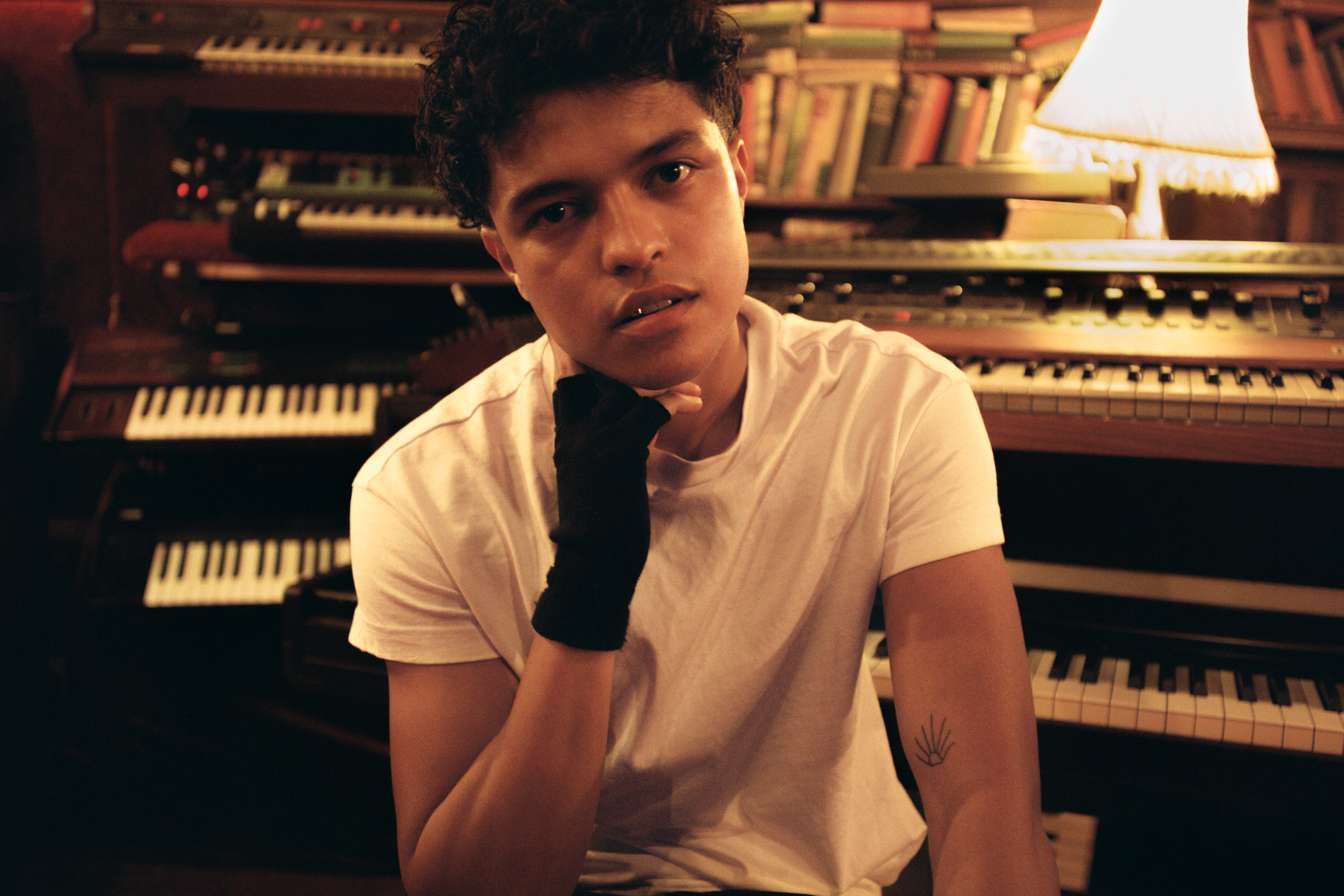
Kamal. on The Cover of NME. Credit: Gabriella Drew for NME
Perhaps that’s because Kamal. hasn’t been particularly interested in being a main character himself. Across the last six years, the singer-songwriter from northwest London has quietly distinguished himself with a hushed croon and pensive lyricism. Since signing to boutique label Neighbourhood Recordings at just 16, he’s released sleeper hits like 2020’s ‘Blue’ and earned co-signs from the likes of Billie Eilish, Dave and Central Cee. But after all this time, Kamal. still isn’t interested in making himself larger-than-life – it’s the outside world that captures his attention.
“Asking ‘why’ [as a kid] just made me more and more curious, and I don’t think it’s ever really fully left [me],” he tells NME hours before the gig. We’re tucked in the corner of a Shadwell café, Kamal. with his elbows on the table, hands clasped, head resting on his forearms. That curiosity has become the defining characteristic of Kamal.’s catalogue, which occupies emotional grey areas and lingers in uncertainty. His 2020 debut single, ‘Homebody’, was a pandemic-era lockdown anthem which reflected on his own reclusion and anxieties. But with each release since, like his 2021 debut EP ‘War Outside’ and 2023 mixtape ‘So Here You Are, Drowning’, he has slowly pulled the lens back into broader meditations on loneliness, love, isolation and the absurdities of modern life.
Credit: Gabriella Drew for NME
That evolution seems impossible without written stories. He didn’t “start with any high-brow shit” – but remembers being enthralled by the dark fantasy series Skulduggery Pleasant from a young age. Today, he pulls out a paperback of Toni Morrison’s Sula, which he’s reading for his friends’ book club. “From my experience of reading, just fiction… it gives you such a sense of empathy and understanding about other people. I genuinely think world relations would be so much better if everyone just read more,” he says and laughs, before catching himself. “I get to live extra lives. I want other people to live extra lives and get those little bits of wisdom and learn lessons before they have to make the mistakes themselves.
“I think that’s why I love songwriting as well because it’s a way to tell a story,” he muses. Kamal. says music allows him to float through ideas without needing a destination, letting the words “pour out” of him and only “make sense [of them] afterwards”. Five years ago, speaking to NME around the release of ‘War Outside’, Kamal. described ‘Homebody’ as “the rawest, most stripped-back thing that I’ve put out”, adding that “the stuff you come up with when you’re not overthinking can be what people relate to the most”. He continues to follow that gut instinct now, his approach to songwriting still an impulse that comes from deep within: “The honest stuff is always where the magic’s at. If it almost feels taboo for you to say, you should push yourself to say it. It’s the only way I really know how to write.”
“Waves are temporary. I’d rather try and build something that people feel a genuine emotional attachment to”
Kamal.’s relationship with music predates any ambition to build a career from it. His earliest musical memory is his dad holding down guitar chords while letting him strum the strings as a toddler, which instilled in him a lifelong reverence for music. Later in his Harlesden childhood, he’d have piano lessons, play the ukulele, compete in school talent shows; he struggles to pinpoint the exact moment music became his future, but one thing for certain was that he knew he “couldn’t live without it”.
While pursuing his music studies at the prestigious BRIT School, his trajectory changed when his first-ever SoundCloud upload, the jazzy confessional ‘Smilingdownthephone’, caught the eye of London label Neighbourhood Recordings, which signed him at just 16. He speaks about that milestone now with surprising ambivalence. There were obvious privileges – studio time, mentorship, the freedom to spend his teenage years making records – but also the strange dislocation of becoming an artist before fully becoming an adult. “When I was 16, I thought I had it all figured out, but I didn’t know enough about the world to know what was truly my calling – or, even if it was my calling, how to navigate it.”
Credit: Gabriella Drew for NME
Young artists who grow up inside the industry are often moulded into a ready-made identity – but for Kamal., that hasn’t been the case. He has shared stages and songs with Dave and Central Cee, earning fans in the UK rap scene. But, on his debut album ‘How The F*** Does Everybody Else Manage?’, released last week, he’s found a kindred spirit in Natanya on the soaring coming-of-age ballad ‘Back Then’, and finally convinced one of his songwriting heroes, Keaton Henson, to appear on the folky standout ‘No Friend, No Lover’.
Yet, Kamal. doesn’t claim to belong to any of those worlds – he is, in many ways, scene-less. Ask where the singer belongs, and he laughs. Sometimes he feels “floating”, “untethered”, “unanchored in the middle of the ocean” when it comes to his place in British music. Mostly, though, he’s made peace with that uncertainty. “I don’t want people to look back and be like, ‘Oh yeah, this was that guy from this wave,’” he says. “Waves are temporary. I’d rather try and build something that people feel a genuine emotional attachment to.”
That idea runs against the grain of an industry increasingly built on instant categorisation. Kamal. doesn’t believe people are simply discovering music anymore; they’re often discovering identities first, then choosing artists that fit them. “The word ‘fan’ is changing a bit now,” he says. “It’s almost virtue signalling in order to assume a cultural identity, whereas previously it was just as simple as: ‘I love this song, so I’m going to go to this gig.’ Now you almost shop for an identity, and then you get the artist. I don’t think that’s the individual’s fault, but I think it’s a sad time.”
Credit: Gabriella Drew for NME
While others might have chased bigger labels, louder aesthetics or quicker routes to success, Kamal. admits he’s often gone the other way. “There are so many things that could have been more business savvy for me to do so far in my career,” he says. “But I just could not physically live with myself if I took a single decision that didn’t feel authentic or natural to me. That’s always been where I’ve struggled a bit: marketing versus music. But as much as that is a struggle, I always want music to be the predominant force in that battle.”
If the last few years have been spent resisting easy categorisation, then ‘How The F*** Does Everybody Else Manage?’ feels like the first time all of Kamal.’s instincts finally converge – he just needed to stop procrastinating and actually drop his debut album. Just like getting his first tattoo earlier this year – a minimalistic sunrise on the inside of his arm – he had to learn that “there’s no time like the present! I just had to say, ‘Fuck it,’ because otherwise I’ll never get a tattoo. And it’s kind of like that for debut albums for me.”
“I just could not physically live with myself if I took a single decision that didn’t feel authentic or natural to me”
Besides making a debut, this leap was also about widening the scope of his music. Earlier Kamal. records often explored his own emotional turbulence, living inside heartbreak, anxiety and isolation – but on this album, he interrogates the world around him. Scroll social media for a few minutes, he says, and you’re forced to carry “so many juxtapositions” in your head: “between the poor and rich people”, “between genocide in the world and influencers doing Get Ready With Me’s.” Trying to reconcile it all became the emotional engine behind the record. “Trying to find a balance between [and] to find a sort of morality in that is really difficult,” he says. “I was just asking questions about that because it felt like it was driving me nuts.”
Even the music has become bigger. Long associated with his whisper-soft delivery, Kamal. found himself abandoning the restraint that had become his signature. Working alongside producer Jonny Coffer, he was encouraged to stop hiding behind it. “‘Need Me Less’ was definitely where it came out the most,” he says. “He hears me sing in the room and he’s like, ‘If you can do that, why are you always just doing the soft-boy whispery tone thing?’ There was no better way to show desperation than to just scream sometimes.”
Yet, for all its existential weight, ‘How The F*** Does Everybody Else Manage?’ isn’t really searching for answers. Ask Kamal. whether he ever figured out the question his debut poses, and he laughs almost immediately. “No. Not at all. I’ve got no clue.” Instead, he hopes the album leaves listeners with something simpler than certainty. “There’s a real strength in acknowledging that we’re all suffering and we’re all going through shit,” he says. “[Life] can feel so individualistic sometimes, but the more you realise and have empathy for other people’s problems, the more we can get somewhere together.”
Kamal.’s debut album ‘How The F*** Does Everybody Else Manage?’ is out now via Def Jam Recordings / Neighbourhood Recordings.
Listen to Kamal.’s exclusive playlist to accompany The Cover below on Spotify or on Apple Music here.
Words: Kyann-Sian Williams
Photography: Gabriella Drew
Glam: Maya Man
Location: Fiction Studios
Label: Def Jam / Neighbourhood Recordings
The post The empathetic ethos of London storyteller Kamal.: “The honest stuff is where the magic’s at” appeared first on NME.
