
In May 1965, at the end of a two-month solo tour of the UK, Bob Dylan was considering giving up performing. “I was drained,” he said afterwards. “I was playing a lot of songs I didn’t want to play. I was singing words I really didn’t want to sing.”
On his flight home, Dylan wrote something that would change his mind. It was a 20-page stream-of-consciousness poem, which he jokingly called “a long piece of vomit.” A few days later, in his Greenwich Village apartment, while looking it over, he hit on what he called the “slow motion phrase” of “How does it feel?” and that brought the song into focus.
He edited the verses, setting them to a simple three-chord progression nicked from La Bamba by Ritchie Valens. While Dylan’s interviews of the time are notoriously unreliable sources of information, one thing that he couldn’t camouflage was his delight with Like A Rolling Stone, calling it the “best song he’d ever written.”
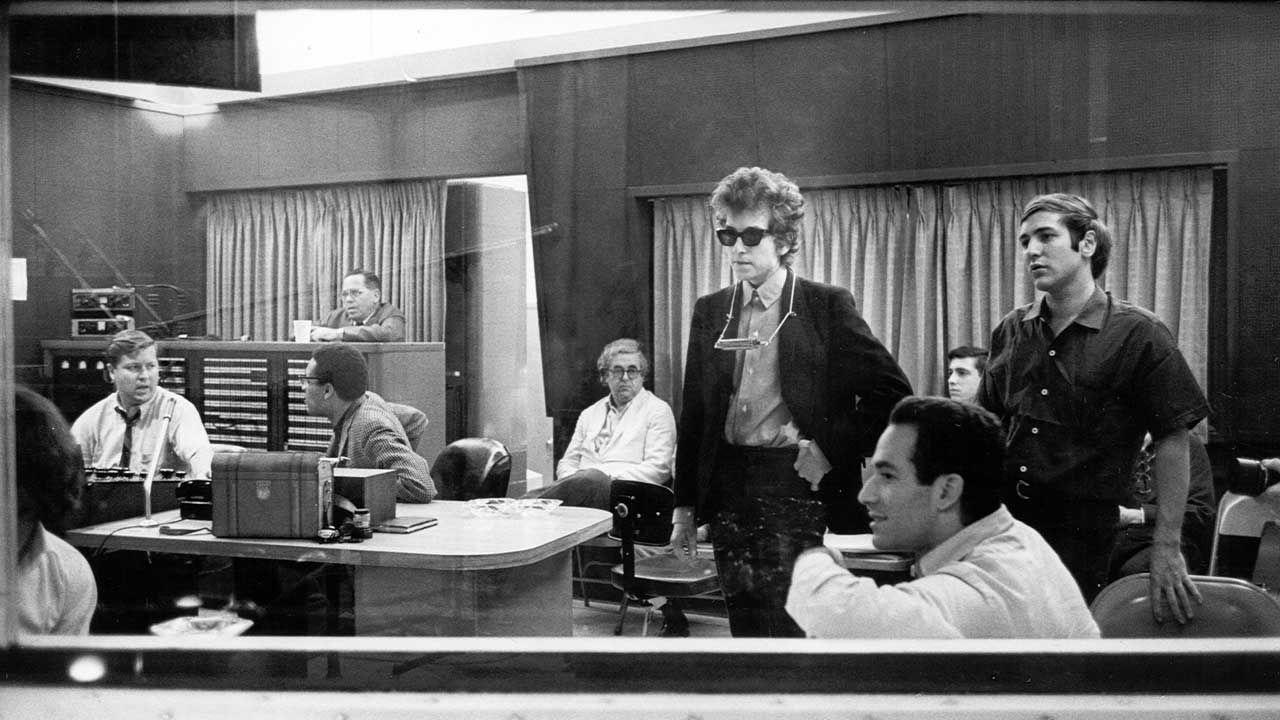
On June 15, 1965, he brought it into Columbia Studio A in New York, running through it with producer Tom Wilson and a band led by prodigal blues guitarist Mike Bloomfield. Dylan had handpicked Bloomfield for the session, though strangely insisted he not play “any of that B.B. King shit.”
Early takes of the song were in waltz time, moody and a bit unfocused. Then the next day, a catalyst arrived in the form of Al Kooper. Bloomfield’s presence denied the guitarist his usual spot, so Kooper played the Hammond B-3 organ instead. In one of rock’s happiest accidents, he ignited the band to a once-in-a-lifetime groove.
But Like A Rolling Stone is first and foremost about words. Rhymes dovetail with rhymes, lines bend meter, images startle (‘Napoleon in rags’). It’s like proto-rap. And it’s all delivered with a sneering attitude.
Even the six-minute length was a middle finger to the three-minute rule of the day, with Columbia initially hesitant to release the single until an acetate was leaked to Arthur, a newly opened, high-profile discotheque in Midtown Manhattan, by the label’s new-releases coordinator, Shaun Considine.
It all fell into place. The club DJs played the song on repeat, the crowd loved it, and several watching DJs called Columbia the following morning to request their own copies. Like A Rolling Stone was then released as a single on July 20, reaching No. 2 in the US Billboard charts (No. 1 in Cashbox) and becoming a worldwide hit.
The song was the pivot point where he stopped being a folkie and started being a rocker, and he rubber-stamped the deal five days later at the Newport Folk Festival, when Dylan famously played the first “plugged-in” set of his career. After kicking off with a fiery version of Maggie’s Farm, he followed it with the new song, much to the apparent chagrin of festival organiser and folk legend Pete Seeger, who told the sound crew, “If I had an axe, I’d cut the cable.”
Decades later, Seeger wrote a postcard to Dylan clarifying his stance, claiming that his fury was not directed at Dylan’s choice to go electric, but at the “distorted sound” of the PA system he was obliged to play through.
“My mistake was not challenging from the stage the foolish few who booed,” Seeger wrote. “I shoulda said, Howling Wolf goes electric, why can’t Bob?”
“I’d never written anything like …Rolling Stone before,” Dylan later said. “And it suddenly came to me that that was what I should do. After writing that, I wasn’t interested in writing a novel or a play. I wanted to just write songs.”
And didn’t he?