

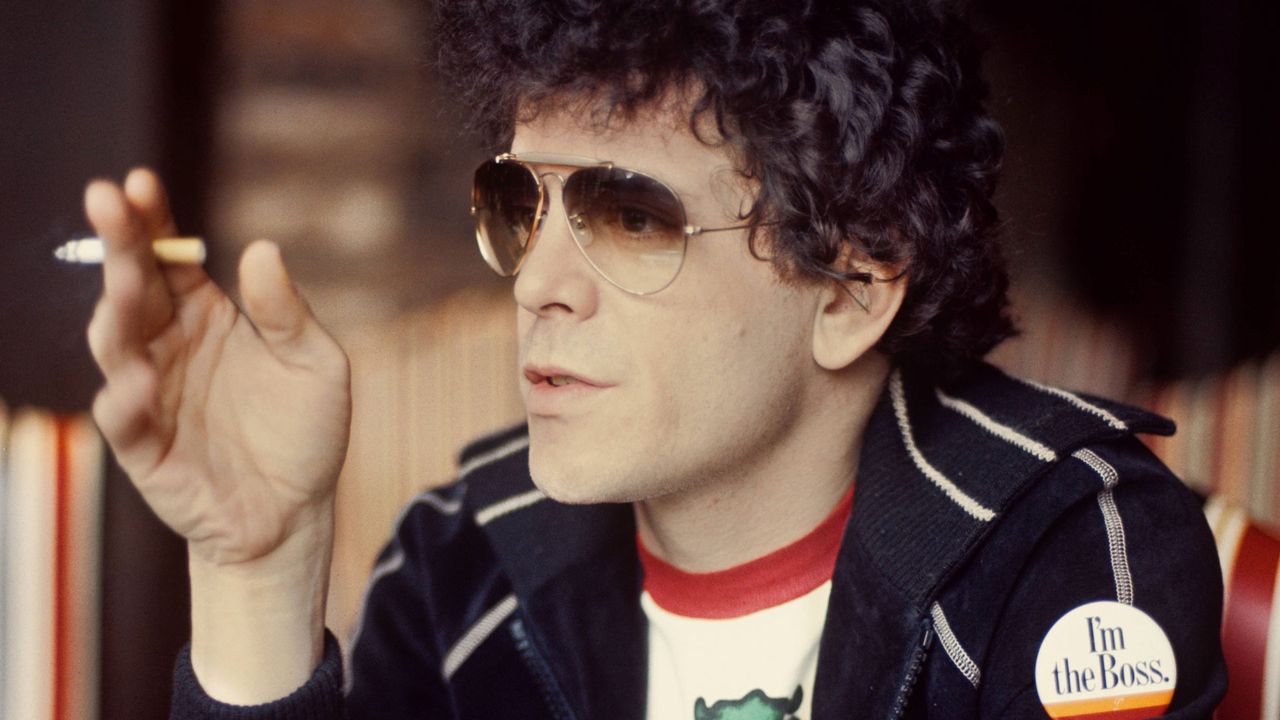
When regarding the decidedly colourful back catalogue of the late Lou Reed, the phrase ‘all of human life is here’ springs to mind. Staged against a uniquely urban backdrop, Reed would habitually pick at the persistent scab of human frailty, shine white light upon darkness and generate searing white heat in the process.
The original version of this feature appeared in Classic Rock 264, in June 2019.
In Reed’s world, emotions were raw. His dramatis personae personified facets of his own complex personality. The darkest desires of his darkest characters – from the sexually transgressive (Venus In Furs) to the purely evil (Rock Minuet) – and the simple sentimentality of the unreconstructed romantic (Coney Island Baby, My House) mirrored Reed’s intrinsic duality.
So who was Lou Reed? Many of his songs formed the core of an unwritten autobiography: from idyllic infancy (Egg Cream) to ruined adolescence (Kill Your Sons) and beyond, Reed’s essence endures in his art. With an accumulated writing style that was one part poet (Delmore Schwartz), one part Tin Pan Alley (Doc Pomus) and one part gossip (Andy Warhol), Reed wrote stories so painfully real that rock’n’roll still bears their scars.
THE GIFT
Eventually appearing on the Velvet Underground’s second album White Light/White Heat, released in 1968, darkly comedic spoken-word short story The Gift dates from ’64. Reed recalled: “I wrote this [in] my last year at Syracuse University, where I was an English major. John Cale suggested we set it to music. We put the story on stereo left and the music on stereo right so you could listen to one or the other or both.”
As the Velvets jam in support, a deadpan Cale recites the macabre tale of what transpired when lovelorn Waldo Jeffers mailed himself to Marsha Bronson inside a large cardboard box. Part-Hitchcock, part-E.C. Comics, the final grisly denouement involves the fateful plunge of a sheet metal cutter that causes ‘little rhythmic arcs of red to pulsate gently in the morning sun’.
I’M WAITING FOR THE MAN
A defining moment in rock’n’roll, Reed’s tale of copping $26 worth of heroin uptown in Harlem on the corner of Lexington Avenue and 125th Street transported the gritty verité style of Nelson Algren and Hubert Selby Jr from the printed page on to vinyl.
The song’s protagonist, most probably Reed himself, feels ‘sick and dirty, more dead than alive’. As he clucks impatiently, conspicuous, out of place, he draws attention (‘Hey white boy, what you doin’ uptown?’), before The Man – his dealer – finally arrives (‘all dressed in black’, with ‘PR shoes and a big straw hat’). So what exactly are ‘PR shoes’? “Puerto Rican fence-climbers” according to Lou. So now you know. And there’s a happy ending. Our hero ultimately gets his fix and we leave him temporarily elated: ‘Feeling good, feeling oh so fine… Until tomorrow, but that’s just some other time.’
PERFECT DAY
Simple, concise, practically perfect in every way. Perfect Day is a succinct précis of idealised love that seasoned Reed-watchers – reluctant to accept that he would ever deliver a romantic ballad without a sneering side of whisky-embittered cynicism – spent decades trying to convince the wider world was actually about heroin use.
“That’s not true,” Lou said unequivocally. “You’re talking to the person who wrote it.” It was actually about the day that Reed proposed to his first wife, Bettye Kronstad, in Central Park, a day which, as Kronstad recalls, was far from perfect. Although Lou had already decided to propose, Bettye had just had a riding accident in the park and was severely traumatised.
Despite this, Lou persisted in delivering his ‘perfect day’, even dragging his fiancée to Tiffany’s to buy a ring against her will. Perfection is clearly in the eye of the beholder. “The key to Perfect Day is the last line,” Lou admitted when we spoke in 2004, “You’re gonna reap what you sow.” The couple divorced in 1973.
BERLIN
When Alice Cooper producer Bob Ezrin met Reed to begin work on his third album, the follow-up to his Bowie-produced breakthrough Transformer, he observed that while Reed’s stories had great beginnings they lacked satisfying conclusions.
Citing the central romantic set-piece of Reed’s self-titled solo debut, Ezrin wanted to know what happened to Berlin’s central protagonists (lovers entwined in its ‘candlelight and Dubonnet on ice’ opening verse, but estranged by its ‘I’m gonna miss you now that you’ve gone’ chorus).
Retrieving Ezrin’s gauntlet, Reed used the ensuing sessions to expand Berlin to a full concept work, a dark song cycle incorporating alcoholism, addiction, spousal abuse, prostitution, depression and, ultimately, suicide. Contemporary US critics railed against Reed’s ‘lousy’ (Creem) ‘disaster’ (Rolling Stone), but subsequent reassessment reveals a uniquely moving collection: a Gothic edifice of exquisite pain and sumptuous misery.
Building through the heartbreaking Caroline Says II (‘You can hit me all you want to, but I don’t love you anymore’), the harrowing The Kids (‘They’re taking her children away’) and the painfully graphic The Bed (‘This is the place where she cut her wrists’) towards Sad Song’sclimactic emotional release, it leaves the listener physically and psychologically drained.
In 2004, Reed likened Berlin to “a Bergman or Kurosawa movie. An intense film noir… Boy meets girl, boy gets girl, boy loses girl.” When I observed that ‘girl slashes wrists’ isn’t normally part of the romantic narrative, he countered simply: “That’s the point.”
STREET HASSLE
Arguably Lou Reed’s magnum opus, Street Hassle combines a pair of monologues over a mesmeric repeated string section figure and an impassioned ‘love has gone away’ coda written in the wake of his tumultuous three-year relationship with trans woman Rachel Humphreys. Street Hassle was the Godfather Of Punk’s first artistic statement subsequent to unintentionally acquiring the title, and he rose to the occasion.
Part one describes Waltzing Matilda’s $80 physical dalliance with a male escort, while part two finds a drug dealer addressing the ‘hassle’ of a particularly incautious client’s girlfriend fatally OD-ing before having the good grace to vacate his premises. ‘When someone turns that blue,’ observes The Man, ‘it’s a universal truth, you just know that bitch will never fuck again.’
“It’s a great monologue,” Reed opined in ’04. “Two monologues, really. The person acting out the first part is one way, the person in part two the polar opposite. They’re not even vaguely of the same species… Based on a real incident, as my things inevitably are.”
Street Hassle channels John Rechy, Tennessee Williams and none-more-noir Raymond Chandler. Its first part echoes Herlihy’s Midnight Cowboy, its second Selby’s Last Exit To Brooklyn and its conclusion (enhanced by an uncredited spoken-word cameo from young pretender Bruce Springsteen) is an uncharacteristically passionate requiem for star-crossed love. Ultimately it’s Reed’s great American novel, condensed to the bone and propelled by a monumental ear-worm riff.
NEW YORK
Ever since Reed led us up to Harlem’s ‘Lexington and 125’ to open our eyes to an unseen alternative reality, his narrative has been grounded in New York City. His songs have described characters unsung elsewhere: the transvestites and hustlers of Walk On The Wild Side, the junkies and speed freaks of Heroin and Sister Ray. But with 1989’s New York album Reed – galvanised by the ever-widening divide between the Empire City’s rich and poor – sealed his position as NYC’s poet laureate with a concept work of rare lyrical brilliance.
Here are astute essays on the inner-city ghetto, the environment, and the gay community’s resilience in the face of the AIDS epidemic, along with serial indictments of an oblivious political elite. Literate, poetic, driven and compelling, New York is Lou Reed’s defining achievement as rock’s greatest storyteller.
The original version of this feature appeared in Classic Rock 264, in June 2019