
Rock’n’roll bands don’t come much bigger than Bon Jovi. In a career spanning nearly 40 years, they have sold 130 million albums and played to an estimated 34 million fans in more than 2,700 shows.
At the heart of this classically all-American success story is the man born John Francis Bongiovi, Jr, in Sayreville, New Jersey in 1962. Blessed with movie-star good looks and driven by a ferocious work ethic and an unshakable will to succeed, he was the kid who had the Superman logo tattooed on his arm and believed it. And after renaming himself Jon Bon Jovi – less “ethnic”, more “rock star” – he found the path to glory.
Having served a lengthy apprenticeship in various bar bands and working at his cousin Tony Bongiovi’s recording studio, The Power Station, Jon got his first break in 1982 when his song Runaway became a radio hit in the Jersey area. A contract with the Mercury label followed, and a band was formed under the name of Johnny Electric, hastily changed to Bon Jovi.
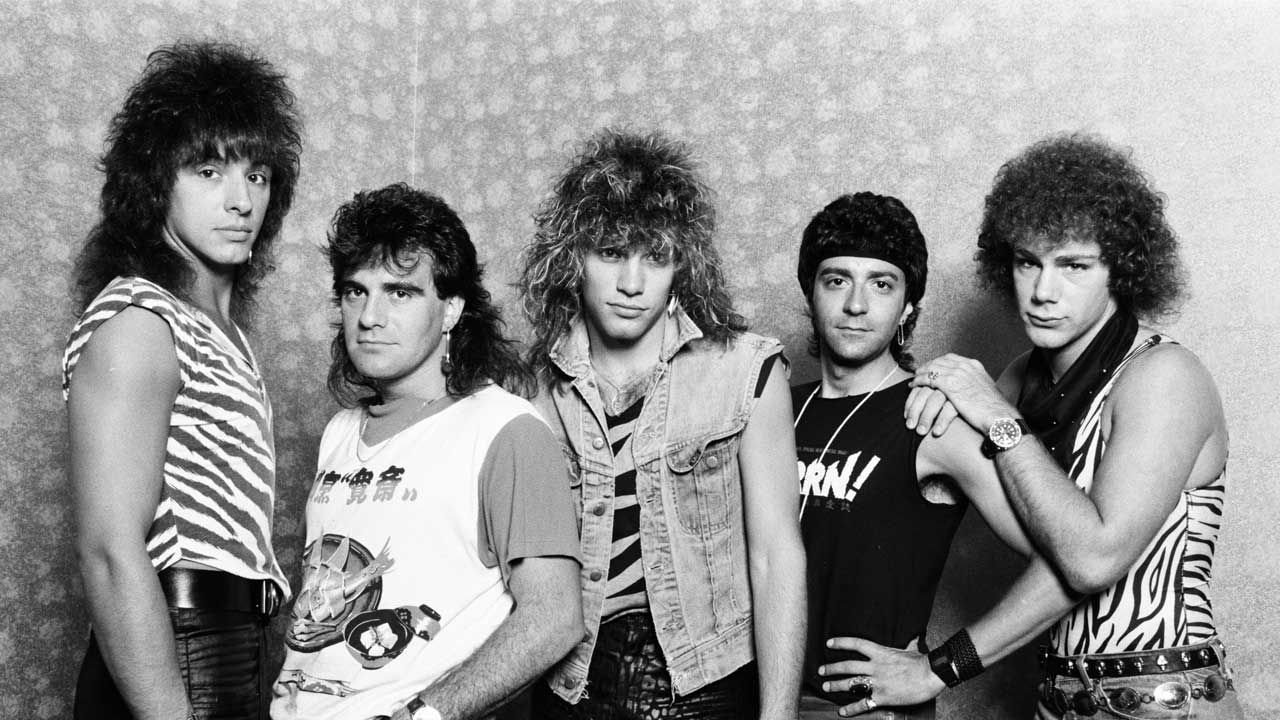
The band’s original guitarist was Dave ‘Snake’ Sabo, a childhood buddy of Jon’s who went on to form Skid Row. But in 1983 Jon settled on the line-up with which he would conquer the world: guitarist Richie Sambora, keyboard player David Bryan, bassist Alec John Such and drummer Tico ‘The Hit Man’ Torres.
It was in 1986, with their third album, Slippery When Wet, that Bon Jovi became one of the biggest bands in the world, and Jon Bon Jovi, with his fluffy hair and million-dollar smile, was transformed into rock’s leading sex symbol. The follow-up album, 1988’s New Jersey, was another multi-million seller. But arguably, Bon Jovi’s greatest success has been their longevity.
While many big 80s acts were killed by grunge, Bon Jovi rode out the storm with 1992’s Keep The Faith, but the last few years haven’t been easy. Sambora left the band more than a decade ago and shows no sign of returning, while Bon Jovi himself underwent reconstructive surgery of his vocal cords after their 2022 tour. But next month, they’re back again, with nine shows scheduled at New York’s Madison Square Garden, and five UK and Ireland Stadium shows booked for September.
Thank You, Goodnight: The Bon Jovi Story, the band’s well-received 2024 docu-series, told a story of four decades at the coalface of rock’n’roll, but it also conformed something else: That the 80s was when Bon Jovi were at their big-haired, hard-rocking best, when Jon sang without a trace of irony or embarrassment: “I’ve seen a million faces, and I’ve rocked them all!”
How we loved him for it.
What About Now (Mercury, 2013)
“The record is sounding great,” Richie Sambora told Classic Rock ahead of the release of What About Now. He also promised: “We’ll be at a stadium near you very soon!” But as it turned out, the album was a long way off being great, and – more significantly – Sambora quit the band before the first stadium show of their 2013 world tour.
Jon Bon Jovi promptly installed Phil X as his new guitarist, and for Sambora, after the best part of 30 years’ service, What About Now proved a sadly underwhelming swan song. From lame self-help anthems Because We Can and Army Of One to the Springsteen-lite of The Fighter and What’s Left Of Me, it’s surely the worst album Bon Jovi have ever made.
Burning Bridges (Mercury, 2015)
Bon Jovi’s first album without Richie Sambora was also their last for Mercury Records. The best track, Saturday Night Gave Me Sunday Morning, is actually a Sambora co-write, possibly included as a warm send-off to the guitarist.
There is nothing warm, however, about the album’s title track, a parting shot at Mercury’s powers that be, in which JBJ spits. “Here’s a last song you can sell/Let’s call it Burning Bridges/It’s a singalong as well/Ciao, adieu, goodnight, guten abend/Play it for your friends in hell.” Such piss and vinegar would be more admirable were it not for the fact that this album reeks of contractual obligation. JBJ described its contents as “songs that weren’t finished, that were finished, a couple of new ones…” In short, a dumping ground, which he had the chutzpah to call a “fan record”.
The release of Bon Jovi’s 15th album was delayed for five months by the global pandemic. As a result, two late additions were made to the track listing, including a song named American Reckoning, a meditation on the death of George Floyd and the birth of the Black Lives Matter movement.
Musically and lyrically, American Reckoning is very much influenced by Springsteen. What the song lacks is vocal power – a weakness that runs through the whole of this album. There is no hiding that. However, even at his youthful peak, JBJ would have struggled to get anything out of songs as flimsy as the bland opening track Limitless and the hokey ballad Story Of Love.
In the wake of 9/11, Bon Jovi’s response was an album with a life-affirming message. This much is set out in the lead single, Everyday, of which Richie Sambora said: “Time is the most precious thing that you have, so you should try to live every moment to the fullest.”
The album’s title track is built along similar lines, with a defiant positivity in the lyrics and a dense guitar sound. For all the good intentions, however, it’s an album lacking in both depth and finesse. Amid a bunch of formulaic songs co-written with Swedish pop producer Andreas Carlsson is a ballad, You Had Me From Hello, that Westlife might have considered too cheesy.
Forever (Island/Universal, 2024)
First there was Forever. Then, a year later, there was the Legendary Edition, featuring re-records with a host of guest stars. The original album marked the debut of a seven-piece line-up recognising guitarist/producer John Shanks and percussionist Everett Bradley as official band members. More importantly, it was the first new recording since Jon Bon Jovi had vocal cord surgery.
For all that, it’s another humdrum album from a band that has been sleepwalking for years now. The whoah-oh hook in Legendary, the lead single, is a faint echo of past glories. The Legendary Edition includes a new song, Red, White And Jersey, which is as corny as its title suggests, and among the various duets (with Robbie Williams, Avril Lavigne and others), there’s a dream come true for JBJ – singing with his hero Springsteen on the sombre Hollow Man, the best song on the album.
This House Is Not For Sale (Island/Universal, 2016)
In Richie Sambora’s absence, John Shanks handled the guitars as well as production on 2015’s Burning Bridges. A year later, the band’s 14th studio album saw both lead guitarist Phil X and long-serving bassist Hugh McDonald elevated to full band member status. This House Is Not For Sale was also the first album for new label Island Records, and it arrived with JBJ boldly proclaiming: “This record is about our integrity. Integrity matters and we’re at a stage of our career where we don’t have anything left to prove.”
Classic Rock reviewer Emma Johnston concurred: “At this stage in their career, these old dogs don’t need new tricks.” But she added, with unerring accuracy: “This House Is Not For Sale is no masterpiece, and while the punchy title track sonically nods to their heyday, most of it is made up of by-numbers pop.”
Destination Anywhere (Mercury, 1997)
Jon’s second solo album saw him venturing a long way from Blaze Of Glory territory. Destination Anywhere is a mature mainstream pop-rock album with none of the hard rock swagger of his band in its prime. The mood is generally low-key, and it’s the subtler songs that work best – Staring At Your Window With A Suitcase In My Hand, It’s Just Me and Every Word Was A Piece Of My Heart, the latter with shades of U2’s With Or Without You.
Oddly, it’s the songs picked as singles that have aged less well – Queen Of New Orleans, with a stagy drawled vocal, and Midnight In Chelsea, with a prominent bass riff and “sha-la-la” chorus like a parody of Walk On The Wild Side.
Have A Nice Day (Mercury, 2005)
In the three years between Bon Jovi’s eighth studio album, Bounce, and their ninth, Have A Nice Day, there were two major releases from the band: the hits remix collection This Left Feels Right and the rarities box set 100,000,000 Bon Jovi Fans Can’t Be Wrong.
Overall, Have A Nice Day wasn’t much different to Bounce, although the songwriting was marginally stronger – as illustrated by the title track, Who Says You Can’t Go Home and Bells Of Freedom. There’s also a little of the old rowdiness in Last Man Standing, a strangely bitter song about the music business from a man who’s made millions out of it. Also, in an alternative version of Who Says You Can’t Go Home, with Jon in a duet with country singer Jennifer Nettles, there’s a taste of what was to come on the 2007 album Lost Highway.
JBJ described Lost Highway as “a Bon Jovi record influenced by Nashville” – in other words, not strictly a country record. But it’s not far off. Production is split 50/50 between John Shanks (promoted in 2024 to rhythm guitarist for the band) and Dann Huff, the former leader of cult AOR band Giant who has since become a leading figure in modern country music.
In addition, two tracks are duets with country artists – Till We Ain’t Strangers Anymore with LeAnn Rimes, We Got It Going On with the duo Big & Rich. The album’s title has echoes of late-‘80s John Cougar Mellencamp, but the standouts are Whole Lot Of Leavin’ and Any Other Day, expertly crafted songs with a perfect balance of country flavour and rock drive.
Richie Sambora got a little carried away when he said of The Circle: “It rocks hard!” In reality, Bon Jovi’s eleventh studio album and fourth US Number 1 didn’t punch with the same weight as the band’s 80s classics. But it was a marked improvement on 2007’s cheesy country-crossover Lost Highway.
Its first single, We Weren’t Born To Follow, is a vintage Bon Jovi anthem. Brokenpromiseland is U2 on steroids. And although Work For The Working Man didn’t ring as true as Livin’ On A Prayer now that Jon Bon Jovi is worth over $400m, the song was cited as an inspiration by Barack Obama’s chief advisor David Axelrod. At least it wasn’t Dick Cheney.
Blaze Of Glory (Mercury, 1990)
When Jon Bon Jovi’s debut solo single Blaze Of Glory hit Number 1 in the US, it appeared that the band might be finished. But in the end, all Jon needed was a break from a gruelling album/tour cycle. Blaze Of Glory – a mythic cowboy song like Wanted Dead Or Alive – was the theme to the Western Young Guns II.
Featuring heavyweight guests (Jeff Beck, Elton John, Little Richard) and several fine songs (notably Justice In The Barrel), the album was certainly more successful than Jon’s bit part in the film (gunned down in seconds). Better, too, than his other solo album, 1997’s pop-rock turkey Destination Anywhere.
Eight years after Keep The Faith updated Bon Jovi’s sound for the 90s, another monster hit, It’s My Life, repeated the trick in the next decade. In a controversial move, Jon and Richie wrote It’s My Life with Swedish hitmaker Max Martin, whose previous clients included Britney Spears.
But not only is this song one of the heaviest Bon Jovi have ever recorded, it’s also a throwback to their 80s pomp, with a classic fist-in-the-air chorus, talk-box guitar from Sambora echoing Livin’ On A Prayer, and lyrics referencing that song’s lead characters Tommy and Gina. The remainder of Crush is at best solid, but no matter: It’s My Life did all the hard work.
7800 ̊ Fahrenheit (Mercury, 1985)
Although the title of Bon Jovi’s second album recorded the temperature of volcanic lava, the reaction from press and public alike was at best lukewarm. 7800 ̊ Fahrenheit was only a minor hit (US 37, UK 28), and left Bon Jovi lagging far behind their rivals. But while it’s no Slippery When Wet, this album is due a reappraisal.
There are some great songs here. In And Out Of Love is prime mid-80s cock rock and best of all is Tokyo Road, a propulsive hard rocker with Jon’s most risqué lyric (“Snortin’ whiskey, drinkin’ coke…”). Fahrenheit is Bon Jovi’s most underrated record.
Four of the five band members who recorded the debut album stayed in Bon Jovi for 30 years. But the fifth, Alec John Such, was ‘let go’ before this, the sixth album, his exit attributed to that great rock‘n’roll misnomer, “substance abuse”. With old friend Hugh McDonald replacing Such (albeit not as an official member) the Bon Jovi machine kept rolling on. In the UK, These Days hit Number 1.
Hey God was a powerful modern rock anthem, and on the title track Jon came as close as he ever would to emulating his hero, Bruce Springsteen. For many, this was Bon Jovi’s last great record.
In the first UK review of Bon Jovi’s debut album, veteran critic Paul Suter stated: “Jon Bon Jovi has assembled a band of classic finesse… blessed with a commerciality that should ensure plentiful sales and success.” He wasn’t wrong.
Bon Jovi’s debut didn’t “do a Boston”, but it reached 43 on the US chart. Runaway was the standout track, a supercharged hard-rock anthem, recorded in ’82 before the band existed, with Jon using session musicians. But other brilliant songs, such as Roulette, proved that Jon’s new boys had something special. This album, for all its naivety, is the Jovi connoisseur’s choice.
Keep The Faith (Mercury, 1992)
In the year when Nirvana’s Nevermind topped the US chart, Bon Jovi survived the great hair metal bloodbath by playing it very smart. Jon made headlines by having a haircut, and the band released the symbolically titled Keep The Faith.
The album redefined Bon Jovi as a stadium rock act for a new era. Its title track and flagship single delivered the band’s trademark radio-friendly hooks in a more modern style. The nine-minute Dry County showcased a growing maturity. And the cheesy Bed Of Roses kept the soft rock fans happy. If Slippery… made Bon Jovi’s career, Keep The Faith saved it.
After the phenomenal success of Slippery When Wet, Bon Jovi didn’t mess with a winning formula on the next record, retaining producer Bruce Fairbairn and Child, who co-wrote this album’s juggernaut of a hit single, Bad Medicine.
Having planned on using another innuendo – “68 And I Owe You One” – for the album’s title, they chose instead to honour their roots with New Jersey. And the influence of Jersey’s favourite son, Bruce Springsteen, was evident in Blood On Blood. New Jersey topped the charts in 10 countries and yielded five top 10 US hits, the biggest ever haul for a hard rock album at that point.
Slippery When Wet (Mercury, 1986)
Currently ranked as the 34th biggest-selling studio album of all time, with 28 million copies sold worldwide, Slippery When Wet is an 80s arena-rock classic. Moreover, it rescued Bon Jovi’s career after their second album, 7800 ̊ Fahrenheit, flopped.
Their saviour was songwriter Desmond Child, who, with Jon and Richie, wrote the two breakthrough hits You Give Love A Bad Name and Livin’ On A Prayer. However, the singer and guitarist also wrote some great stuff without Child: the rock-star-as-outlaw anthem Wanted Dead Or Alive, and crowd-pleaser Raise Your Hands. By some distance, Bon Jovi’s best album.