

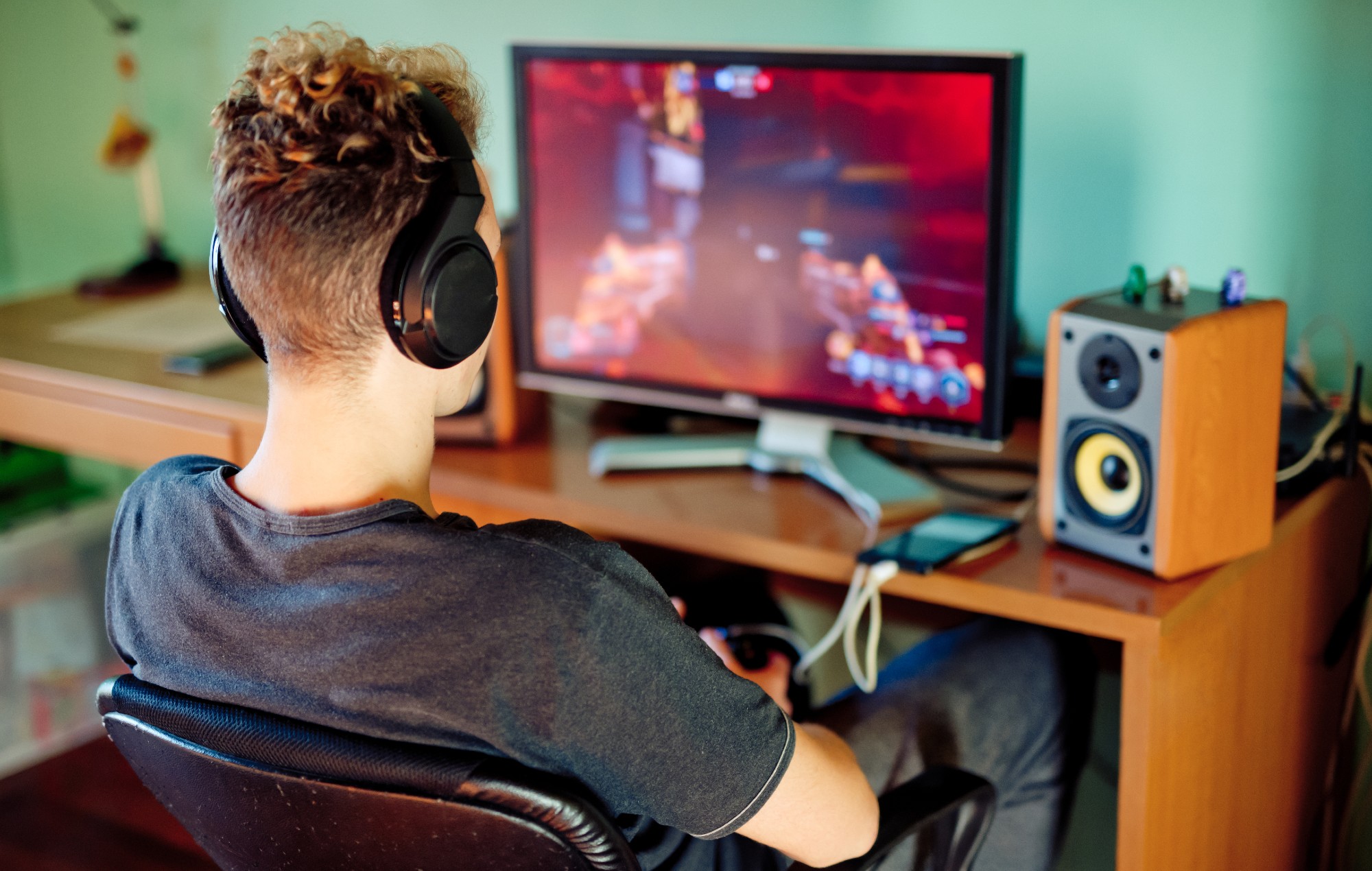
Video game music used to just be a series of chirpy bleeps that played over and over. Now, without composers having to worry about taking up too much space on a blocky cartridge, it’s a genre that encompasses stunning orchestral suites, lo-fi, atmospheric scores, snarling rock bangers and everything in between.
READ MORE: In ‘Wax Heads’, you run an indie record store and fight for grassroots music
Those soundtracks are so good that they’re racking up millions of streams on Spotify, pressed onto multi-coloured vinyl records and being performed at sell-out concerts around the world. In 2023, the Grammys introduced a dedicated category to recognise the genre and the Ivor Novellos have announced they will celebrate video game composers as part of a new awards ceremony.
“Video game music has really grown up over the past 20 years,” says Gordy Haab, go-to composer for blockbuster Star Wars and Indiana Jones games. “There used to be this view that film music was the serious artform, while music for video games [sat at] the kids’ table. It’s really not like that anymore.”
With so much attention now on the previously-overlooked genre, we spoke to some of the biggest composers around to find out what’s shaping video game music in 2026 and beyond.
Streaming, records and gigs are giving gaming anthems a second life
For ages, the only way fans could listen to video game soundtracks was to rip the tracks themselves and upload them on YouTube. “That showed the industry there was a demand and a desire to hear this music outside of the game,” says Haab, who took it upon himself to share his soundtrack to 2009’s Indiana Jones And The Staff Of Kings on Soundcloud when it became apparent the distributor LucasArts had no plans to release it officially.
Now though, the gaming industry is well aware of how important music can be. Composers are an integral part of a game’s rollout and songs are shared ahead of launch day to get fans hyped. “It’s one of the greatest things that’s happened in the past 20 years,” says Haab.
‘Clair Obscur: Expedition 33’s ‘A Painted Symphony’ in London. CREDIT: Sarah Tsang
Despite this newfound attention, video game composers aren’t writing music to help them book sell-out concerts or to find a place on viral Spotify playlists.
“Of course we think about these extra opportunities but I wouldn’t be doing my job if I was writing a gig and then trying to make it work as a game soundtrack. It always has to be the other way round,” says Richard Jacques, whose 2001 Headhunter soundtrack was the first gaming score recorded at Abbey Road Studios. “When we perform it live, we always have a proper beginning, middle and end that will remind gamers of the emotional beats of the story.” With so many video game concerts happening in the coming months, he’s a bit worried his credit card is going to take a hammering. “It’s good for games and it’s good for gamers though.”
The music is designed to get stuck in your head
During the ‘90s and noughties, a lot of game developers were involved in a graphics arms race to make their title look as jawdroppingly realistic as possible. Now though, great visuals are to be expected and players get more hooked on character and plot. It’s why Jacques believes melody has become more important to more recent gaming soundtracks. “It doesn’t matter if you’re playing a platformer, a big-budget role-playing game or a smaller indie title, melody helps the player key into the story and the character.”
However, there’s still plenty of atmospheric music to be found within sprawling open-world games, as composers look to fill the endless space. Woodkid’s reactive alt-pop soundtrack for Death Stranding 2 pushed the boundaries of procedural music, which reacts to what the player is doing in the game, by building his own engine and teaching it to remake the songs based on harmonic theory. Other composers are happy with fade outs. “We have to be careful not to make video game music too interactive though, because then it just ends up sounding artificial and invisible because everything is so smooth,” says Danish composer Jesper Kyd, who’s worked across Borderlands, Hitman and Assassin’s Creed. “I’m not one of those composers who believe that if the music is really great, the player shouldn’t notice it. I think the opposite is true. We have to retain the excitement and depth that a good score can give a game.”
Everyone is talking about AI
Every composer we speak to mentions the potential threat that AI-generated music poses. After all, AI tracks are already flooding streaming platforms and making it harder for actual bands to be heard, so what’s to stop them replacing composers who typically work behind the scenes? Well, according to two-time Grammy-winning composer Austin Wintory (Journey, Sword Of The Sea), the threat of lawsuits helps.
“There are a lot of legal issues around the ability to copyright [artificially] generated music,” he explains, “which makes it a non-starter for most big publishers.” In fact, every contract Wintory has signed over the past few years has included a declaration that none of his work was created using AI.
That might change in the near future as money is still being poured into improving the technology and investors will want to see a return – but Wintory believes most commissioners aren’t looking at game music as a necessary evil to be bought at bargain rates, they’re looking for a creative partner to challenge, refine and develop their artistic vision. “What I sell isn’t music, it’s the process by which we get there. It’s about the collaboration and joy of making art with someone,” he says. “I’m not ideologically opposed to AI, I just think it’s a tool we haven’t figured out yet. But the idea of automating the fun part of making music is baffling.”
He continues: “By its very nature, AI draws on patterns. I think it’s going to encourage people to be even more unpredictable and daring in their approach to music as a result. If AI’s big contribution to gaming is forcing people to embrace their inner radical, then great.”
Indie games are the future
Despite the excitement around the music, video games are in a tricky spot. Games that took hundreds of hours to develop are being taken offline after a few weeks or scrapped before a button is even pressed. For example, Kyd says he was working on a big budget Wonder Woman title when, without warning, they were shut down by Warner Bros.
“We were doing something really out there [with that game],” he remembers sadly. “I’m sure there will be more great [blockbuster] AAA games coming out, but in terms of interesting, fresh ideas, it seems like indie titles are really leading the charge at the moment.”
American-Canadian composer Lena Raine agrees. Her dreamy score to surprise 2018 hit Celeste led to an approach from Sony to work on playful 3D platformer Sackboy, which is the gaming equivalent of signing to a major label. She also contributed to Minecraft’s calming, lo-fi soundtrack but when the offers started getting samey (“it felt like I was being pigeonholed as this synth and piano artist,”) she pulled back and focused on the indie projects that offered space for experimentation and self-expression.
And there’s a whole ecosystem of grassroots games being made, with veteran developers putting money into indie funds to help encourage the next generation. “There’s no shortage of incredibly talented people wanting to work in games and that indie scene will never die,” says Raine. She is worried about how the big awards shows only seem to celebrate recognisable IPs and well known composers though. “There’s such a wealth of talented composers out there but the industry as a whole needs to do better.”
Especially because she believes those big, blockbuster games are only going to get “more conservative” as production costs rise and games take longer to make. “I don’t think [the major studios] have the ability to tap into the excitement and creativity that we’ve seen recently. They have to answer to all the higher powers within the corporate structure that only seem interested in making the next [viral mainstream hit such as] Fortnite or Roblox.”
What’s next is exciting and unknown
Making music for a video game? “It’s a pretty amazing and fun job,” says Lorien Testard, who spent five years working on the soundtrack to 2025’s celebrated crossover title Clair Obscur: Expedition 33. “I take my job very seriously but it’s important not to forget that we’re creating games. We compose music for an imaginary world and there’s so much joy to that.”
A lot of composers we spoke to mentioned the Clair Obscur soundtrack as proof that something new, original and created with love will cut through. But Testard doesn’t see himself as an influential figure. “Each composer [contributes] to what video game music is in 2026. It’s all pretty individual. The direction that every composer takes, that’s what will shape the sound of tomorrow.”
“The fact I can’t see any trend line is what’s so exciting to me,” adds Wintory, who believes the best is yet to come. “We’ve put some real solid pins in the map, but given how young games are as an art form, it feels like the crazy, bold ideas are still ahead of us. I think that’s what’s fuelling the spirit of adventurousness. It would be sad to think that we’ve already peaked within the first couple of decades.”
Austin Wintory will appear with Troy Baker for Game Music Festival’s ‘The Art Of Game Music’ next month in London. ‘Indiana Jones And The Great Circle’ is out now for Nintendo Switch 2
The post AI, vinyl and indie supremacy: what’s shaping video game music in 2026? appeared first on NME.