

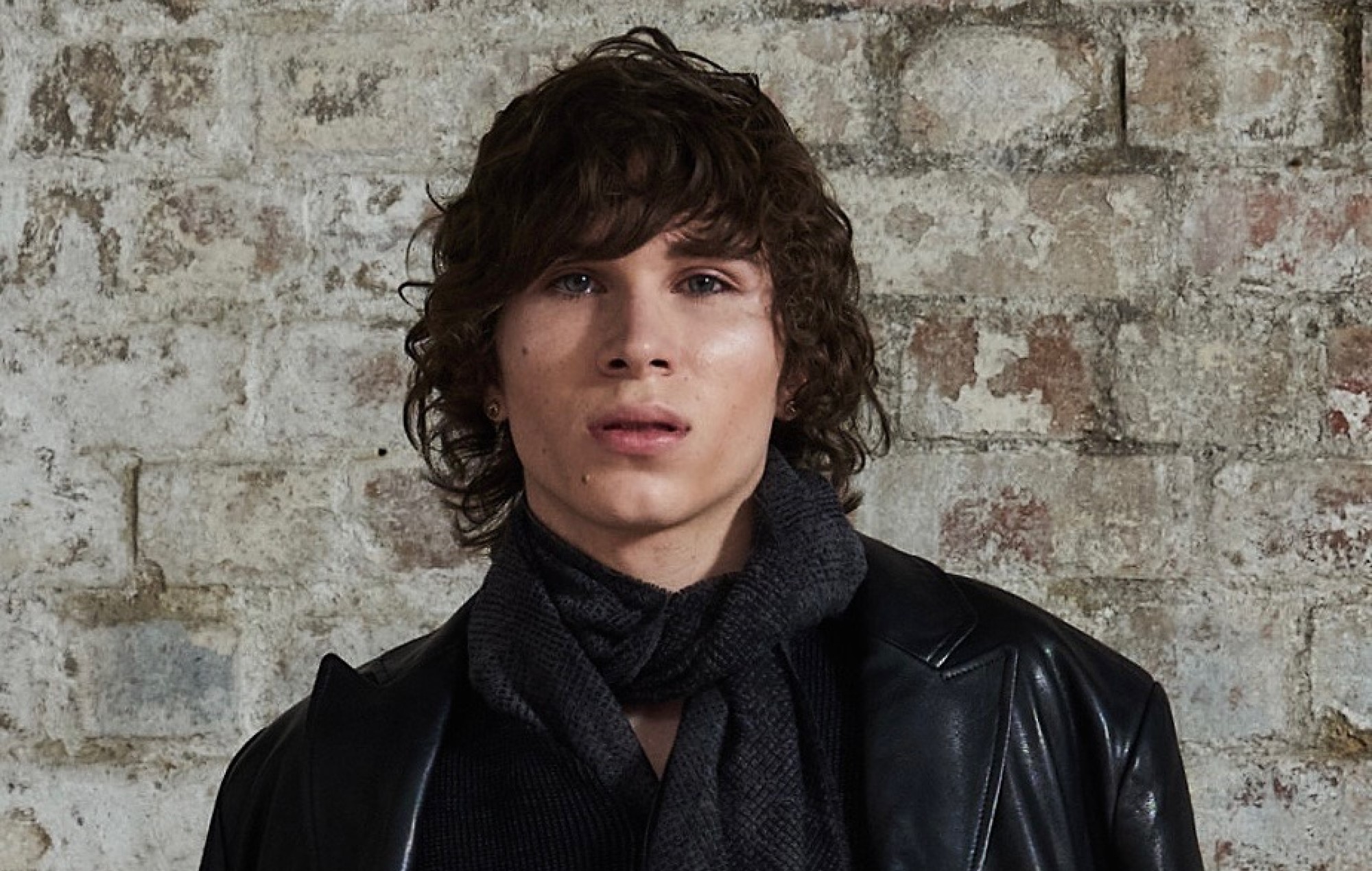
Over the past year, Saam Sultan has built a cult-like following off the back of his visceral, self-produced sound: a blend of misty cloud rap, ambient pop and film-score sensibilities that’s guided by instinct rather than genre. Breakout tracks like the astral, lovesick pull of ‘Locked In Love’ and the blown-out, mantra-like ‘Ydoifeel?’ have quietly gathered momentum online, positioning the Fort Lauderdale-born, Brighton-raised artist as one of the UK’s most intriguing new voices. There’s little doubt why he earned a spot on this year’s NME 100.
READ MORE: La Reezy makes hip-hop full of heart and humanity
Although the 20-year-old says recognition has “never been something that’s on my mind” and prefers to keep his focus on the music itself, scoring a place on NME’s list of essential emerging artists was worth it to see his mother’s reaction. He lights up, recalling how she “jumped and got excited” at the news. “She’s such a music nerd,” he explains, nestled in a plush leather seat at London’s The Standard hotel, a fuzzy cashmere hood swallowing his unruly curls. He credits her expansive record collection – spanning Persian music, Motown, Latin sounds, ’80s J-pop and everything in between – as the root of his wide-reaching taste. It’s a foundation that explains why Sultan’s music feels so unbound: it was never raised in one place to begin with.
Across his growing catalogue, Sultan swings between hushed introspection and cocksure clarity, between ambient confessionals and moments of pure ego – “talking his shit” one minute, dissolving into something far more vulnerable the next. It’s a push-and-pull that feels drawn from a lived reality. His life has been shaped by constant movement: Sultan was born in Florida and raised between the Sunshine State and Barbados. When he was around 10 years old, his family relocated to Brighton after his father lost his job.
“My way of making music is jamming. I just jam. Whatever comes at the moment”
“When we moved to the UK, we lost everything,” he recounts, detailing the “really tight conditions” his family lived in. That instability never calcified into hardship in his mind, though: “I always saw having a bed to sleep on, having my parents there, as the biggest privilege in the world. My family is loving, my circle is tight – that’s what I consider real wealth.”
Sultan learned early to make the most of very little, and his way into music was very much the same. While he didn’t have access to formal training, he was a curious lad who took risks and made opportunities for himself. When he was “eight or nine” – on a brief trip to Brighton before the permanent move – he spotted a MIDI keyboard in the window of the music shop GAK and convinced his parents to let him save up for it. “I had to do chores, wait for my birthday – saved up £60,” he recalls. Around the same time, his great-uncle – a techie with a slight hoarding problem – built him a PC from spare parts. It wasn’t powerful, but it didn’t need to be. The keyboard came with Ableton, and Sultan taught himself everything from there.
At school, he’d skip classes under the false pretence of piano lessons, hiding out in empty music rooms to experiment. Later, at 17, he dropped out of college to pursue music full-time because his mum told him he had “enough time to fail”. Even now, he still resists traditional structure: “My way of making music is jamming. I just jam. Whatever comes at the moment.” It’s why his music often feels less like it’s been written and more like it’s been uncovered – ideas surfacing from somewhere half-conscious, half-remembered.
That instinctive approach also explains why his early breakout moments arrived almost accidentally. Sultan didn’t mean to contribute to the UK’s cloud rap resurgence with ‘Ydoifeel?’, its warped samples and weightless delivery evoking Clams Casino’s production on A$AP Rocky’s ‘Live.Love.A$AP’. “I wasn’t really informed enough to understand that’s even called cloud rap,” he admits. In another world, the song wouldn’t have been released at all. “It doesn’t resonate with me the most personally,” he says. It took a friend pushing him to release music after nearly a decade of making it privately and second-guessing whether it truly reflected him.
To Sultan, music isn’t something to analyse or categorise: “Music is something that’s supposed to plug into your soul. You’re supposed to feel it.” He learnt this young, standing beside his grandfather’s hospital bed as Michael Jackson’s ‘Smile’ played – a moment he still describes as “the most ethereal feeling” of his life. Long before gaining any traction in the industry, Sultan had already committed to the idea that music wasn’t something to “make it” from, but something to live through. “I’d rather be 80 years old and never have achieved my dream,” he says, “but have a whole catalogue of music that someone can find one day and be proud that I lived my life, rather than survived it.”
Sultan’s already had a taste of that dream with ‘Locked In Love’ – the cinematic track that has become his biggest song to date, giving that world its widest audience yet and solidifying his signature soft-focus style. But he’s already evolving with his newer material. Take ‘Crocodile Woman’, a woozy cut from his upcoming EP ‘Seraphim’, where he pushes further into emotional expression – stretching his voice to its limits on a progressive R&B ode to love that feels as unstable as the feeling it’s trying to preserve. The source of conflict here is external: outside voices creeping in, making him “question something that felt pure”.
“My family is loving, my circle is tight – that’s what I consider real wealth”
It’s a subtle shift, but an important one: where earlier work felt like personal observation, ‘Crocodile Woman’ opens that world up, letting narrative lead as much as feeling. In doing so, Sultan starts to stretch beyond the loose underground rap framing that’s followed him so far. He’s simply outgrowing its limits, and although he does rap, he’s hesitant to claim his place as a rapper outright: “I have no issue with someone calling me that, but it’s not what I am in my own world.”
As Sultan evolves, ‘Seraphim’ acts as a bridge – a “crossover period”, as he puts it – between all he’s made so far and everything he’s about to become on his debut album, which he’s already started fleshing out. Before that arrives, though, we’ll have ‘Seraphim’ – a way of showing where he’s at without locking himself into just one category. Maybe that’s the clearest way to understand Saam Sultan right now: not as an artist chasing definition, but as one building a space where that doesn’t matter.
Saam Sultan’s ‘Seraphim’ is out on April 24 via Darkroom Records.
The post Saam Sultan lets his instincts guide the way: “Music is supposed to plug into your soul” appeared first on NME.