
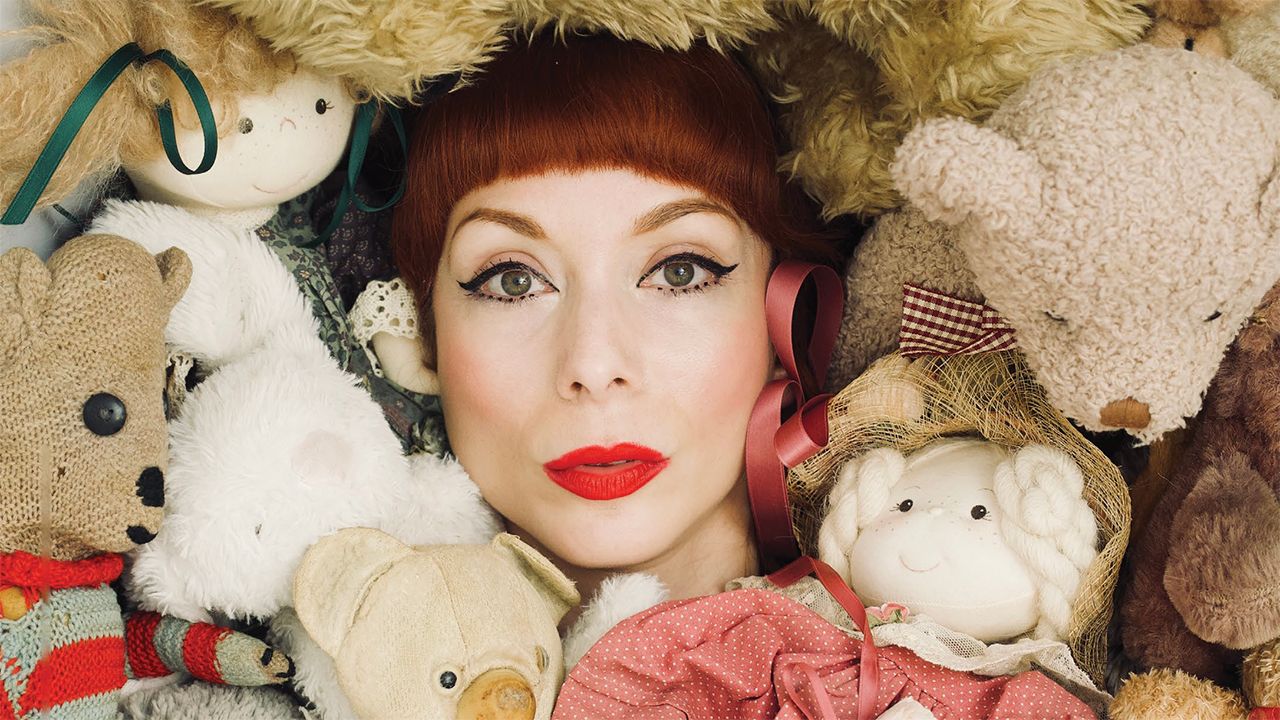
Catherine Anne Davies, aka The Anchoress, explores past, present and future generations of her family on As We Once Were. The album finds her making peace with trauma and tackling temperamental analogue gear in the studio. She tells Prog about its creation, and the old recordings that inspired it.
Catherine Anne Davies has rebuilt her relationship with trauma. On 2021’s The Art Of Losing she approached trauma with a strange twang of longing. Throughout the critically acclaimed release – a triumph of string-embellished agony and layered prog pop suffering – she untangled a web of her darkest, most life-altering tragedies. But alongside the pain was a yearning to mend.
At the time The Anchoress was split in two: the record presented a version of herself after her grief and trauma, while placing the before version of herself on a pedestal. “I think there’s a toxic idea of the tortured genius that persists in music,” she reflects. “We must sit in that space of suffering, and we must sit in that space of reflection and continue to self-destruct. There’s much more value to be found in putting yourself back together.”
Her new album, As We Once Were, concludes that to succeed in the art of losing you have to make peace with what’s been lost,“rather than continuing to break yourself” – that only prolongs the pain. “When certain things happen to us, we cannot be the same as we once were,” she says. “Our initial response is to want to try to repair. We want to go back to the pre-broken version of ourselves. That isn’t possible.”
Peel back the layers of astute musical eccentricity, and Davies’ core is one of logic. In her mind, the importance of acknowledging and retaining trauma makes sense on a grander scale, beyond ourselves. “Evolutionary speaking, it’s useful to remember the mushrooms are poisonous,” she notes. Once we learn that fire is hot, we know not to place our hand over a flame. The same applies to generational trauma.
Her family history includes the drownings of her mum’s older sister and and two others in the River Severn, and she remains cautious of bodies of water, especially when considering the safety of her young child. “I feel my grandmother’s trauma at the loss of her five-year-old daughter,” she says. “It kind of means I’m not gonna let mine go anywhere near water. Those traumas help us survive.”
While The Art Of Losing served as her way of proving herself – a “stubborn refusal to collaborate” – As We Once Were sees her actively seeks the help of feminine pillars in her life to unpack and process trauma. Four generations of Davies ladies are heard in the music; her own voice is accompanied by recordings of her late gran, more recent recordgins of her mum and clips of her own daughter singing.
“It was really emotional, finding those old tapes of my grandma,” says Davies. “I had vague recollections of my sister recording her in the lounge for her history homework, so I knew there was a tape somewhere. Then I found it at my mum’s house… It was almost like it was delivered to me. It was really chewed up, lots of sound reversal. I spent about a week doing audio restoration in the studio.
“I originally wanted to retrieve my grandma’s voice for my mum, but when I first sent her a snippet, it was so moving I cried. Then, as I was listening to it, I realised what the interview was really about – being a woman across the 20th century – and it was inadvertently quite political and transgressive.”
The recordings showed how strongly gran and granddaughter were aligned, not just by blood, but in their beliefs. When she began choosing clips for songs, it felt like an “epiphany,” she recalls. “Then I brought my mum’s voice into it as well, and obviously when you have a small child, you’re always recording little bits and pieces.”
Opening track Du Temps Perdu (Introduction) bridges the gap between generations. There’s a gentle, childlike innocence in its twinkling keys and nostalgic synths, oozing a comforting memory that’s just out of reach. As her grandmother’s voice fades into Davie’s excitable child, it’s asserting a “generational column of steel” – an interwoven structure that both reminds Davies where she comes from and what to look forward to.
“I took a little inspiration from what Kate Bush did with the voice of her son, Bertie, which is woven quite tastefully into 2005’s Aerial,” she explains. “Frank O’Hara had this idea in his collection In Memory Of My Feelings – the title of the album I did with Bernard Butler in 2020 – that a memory of a person can take on another life of immortality through art.”
With old synths it feels like if you don’t record it in the moment it’s going to disappear. That felt so conceptually resonant
There are plenty more literary nods to dig into; Davies is a university professor of English, after all. Throw Over Your Man contains Virginia Woolf and Vita Sackville-West’s love letters to each other in a tambourine-jangling act of seduction. She explains: “I’ve always felt a little bit guilty about my music career: it’s a very working-class guilt. So it’s nice when your work does something good for society, even if it’s just encouraging someone to dive deeper.”
The record isn’t just Davies flicking through the family photo album and wistfully reminiscing. Hand To The Tide is one of its darker moment – and its ominous, creeping sense of fear captures the horror of her relatives who were died in the “freak tidal wave accident.” Stop The World is her most vulnerable track to date; she approached it like a wounded animal, as if it could attack at any moment. The work is defined by a sound that’s actively “embracing the imperfect.”
Rather than using perfected digital synth models, Davies went to Pete Townshend’s studio to get hands-on with some of his analogue synths to capture the feeling. “There was this sort of dual congruence with my old recordings and these old analogue instruments from the 70s and 80s,” she says. “I almost thought I should put, ‘This record was made by humans’ in the credits.
“When you work with an old analogue synth, it can take two and a half hours to get to a specific sound. With modern synthesisers, you can save your preset and go back to it, but with old synths there’s this sense of grabbing gold dust as it’s coming through your fingers. The circuits are so unstable. Nobody else could get exactly the same sound as you, and it feels like if you don’t record it in the moment it’s going to disappear. That felt so conceptually resonant.”
She points to the midpoint track, All I Really Want Is Peace. As it says on the tin, she’s now beyond the drama – and the piece closes out into a glitching, liminal meadow clearing, as intimate recordings of her daughter signal the beginning of Stop The World. It makes the Richard Rohr quote paired with All Fall Down feel particularly poignant: “If we don’t transform our pain, we will most assuredly transmit it, usually to those closest to us.”
As We Once Were is that transformation, as Davies summarises: “If I’m not making something new and useful for myself and my daughter, what’s the point?”
As We Once Were is on sale now.