

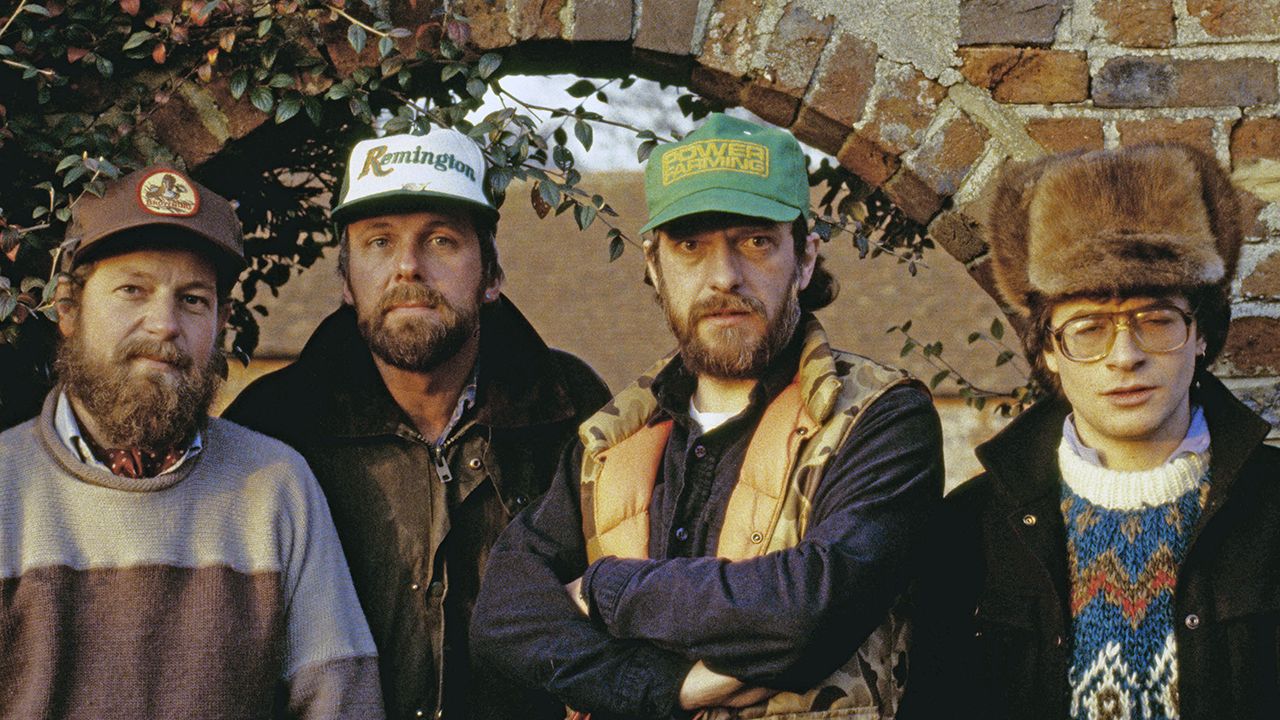
The 1980s brought new elements to Jethro Tull’s music. Following on from Ian Anderson’s would-be solo album A, and The Broadsword And The Beast’s folk-synth hybrid, came a more solid electronic sound. The recently reissued Under Wraps and Anderson’s true solo debut, Walk Into Light, harnessed the latest technology and the talents of new keyboardist Peter-John Vettese. Anderson takes Prog on a journey through their creation.
Where does Jethro Tull end and Ian Anderson begin? The longtime leader of the British prog institution was forced to ponder that question at the turn of the 1980s, when his eagerness to explore new creative pastures had him to put the band he’d led for 12 years on hold.
But his plans to release a solo album, leaning into digital technology and exploring more contemporary lyrical themes, were compromised when his label insisted A should be released under the Tull name. With his old bandmates (except long-serving guitarist foil Martin Barre) left out in the cold – a changing of the guard that seemed partly triggered by the passing of bassist John Glascock – Anderson accepted up the label’s suggestion, and a new era for Tull took shape.
It was a rebirth reinforced by the introduction of plugged-in young synth maestro Peter-John Vettese, who replaced A’s “guest” Eddie Jobson for 1982’s The Broadsword And The Beast. The pull of the Vettese’s new sounds was too strong for Anderson to resist. “It was a new era,” he says, “It was the beginning, really, of programmable drum machines, sequencers; things which were fast becoming more sophisticated tools.”
The incorporation of electronica was met, for the most part, with approval – possibly because the potent set of songs came woven into a traditionally Tull-like tapestry of folk-rock compositions, dressed in the kind of fantasy-leaning and faintly medieval imagery that are never going to scare the horses in prog’s heartland.
But for his next career move, Anderson stepped into a more modernist aesthetic. And this time, crucially, he had a partner in crime. Vettese had been credited with “additional material” on Broadsword – now he was also providing the chance to explore new sonic territory. In doing so on a solo album, Anderson could partly step out from under the weight of expectation that the Tull name brought with it.
“It seemed like a challenge to either embrace new electronic sounds and see what it might do for me, or just ignore it completely and stay in an analogue world with my head in the sand,” Anderson recalls ahead of Walk Into Light’s imminent reissue in remixed form, as part of an expanded overhaul of the Tull album that followed it, 1984’s Under Wraps.
“It was a step into the unknown,” he says. “So it helped that Peter and I sat down to work together on Walk Into Light. The technology was new to him too, and he was very excited by it all.”
Working in partnership with another songwriter was also uncharted territory for Anderson. “I never really worked with anybody at all in a compositional sense. There had been little elements of music that invented by Dee Palmer and Martin Barre on albums like Songs From The Wood, but in terms of collaborating on the essential identity of songs, I’d not really worked with anybody.
“There were many examples on that record of sketchy ideas that I had in terms of melody, and of course, I wrote all the lyrics. But [Vettese] would come up with a lot of little musical ideas, and I would say, ‘Oh, that’s good. Maybe we can put that here, and I can build something on there.’”
(Image credit: Getty Images)
Possibilities opened further up with the completion of a studio in a barn adjoining the Anderson’s home in Buckinghamshire. The juxtaposition of home comforts and new technology are arguably reflected on the album, which sometimes seems to blend apparently contradictory concerns within the same song: “What I found reassuring was bringing together what was then advanced technology with more traditional songwriting styles and subject matter.”
Take the search for human connections within a technology-driven future on User-Friendly. “I wanted to take the term that was being applied to computer science and apply it to a human relationship,” he explains of this pulsing vignette, graced with sparkling synth trills from Vettese as he implores, ‘On dusty terminals, finger me lightly, do/And QWERTY is the name of love, printed on the VDU.’
It was a 16th-century manor house built over the remains of a nunnery. There were reputed to be supernatural goings-on
That wouldn’t be the only time this ever-playful wordsmith resorted to double entendres, even if the piano-led domestic sketch Toad In The Hole is about yearning for home comforts ‘when I come in from the cold.’ Elsewhere, while the art-pop of Black And White Television and Looking For Eden yearn for some humanity in an uncaring modern world, Trains equates earlier technological advances with nostalgia, reflecting the passions of a man who has made no secret of his love of railways. “I’m [train enthusiast and ex-MP] Michael Portillo with a flute,” Anderson says. “I still use the train whenever it’s practically possible.”
That leans into other themes that would continue into his next songwriting project: the wanderlust-fuelled romance of travel, as well as the unsettling realities of Cold War Europe. Both inform the techno lament of A Different Germany, as Anderson admits of that then-divided nation, he’s ‘afraid to know you now’.
Walk Into Light’s exploration of a markedly more contemporary style didn’t reap commercial rewards – the album only reached No.78 in the UK and didn’t breach the Billboard Top 200 in the US. Anderson was not to be discouraged, and his creative partnership with Vettese continued to bear fruit as he turned his attention to the next Tull album.
Even the supernatural couldn’t put them off, as Anderson explains when recalling how Vettese took up residence in his home around this time. “Part of the deal was that he could use my studio when I wasn’t in it, to work on his own ideas and noodle away, learning more about the technology of recording and producing, which is what he went on to do after he left Jethro Tull.
“He was living in my attic, but he wasn’t very happy up there. It was a 16th-century manor house that had been built over the remains of a nunnery that was razed following the Reformation. There were reputed to be supernatural goings-on.
We always had cans of gasoline and two or three vehicles, ready to flee to more friendly shores on the west coast of Scotland or somewhere
“A predecessor, an au pair lady, had slept in that room, and she would keep the light on all night. Peter was pretty terrified. And even I noticed a couple of weird things happening in the studio. I can recall going in there having left everything set up from the night before, and I walked in to find all the faders had been moved and knobs turned, despite the studio being locked and alarmed. Somebody – something – had moved everything…”
You can embrace the future, but the past might be hard to shake off, as Anderson would find when presenting his next work to Tull fans. As he invited his band to join Vettese at the haunted house to start work on what would become Under Wraps, spirits were high in the camp.
In the sleeve notes of the new reissue, his bandmates recall high jinx. “We used to play asymmetric hedge tennis,” bassist Dave Pegg recalls. “It was always Martin and me – the Brummies – against Peter and Ian. And we used to let them win, of course! You couldn’t see over the top of the hedge; it was two or three foot taller than we were. The other two would go on the other side and we head like a shuttlecock kind of thing. You never knew where it was coming from. It was absolutely hilarious!”
(Image credit: Getty Images)
Anderson is keen to stress that Under Wraps was by no means another solo outing in all but name. “It was very much the work of a four-piece band,” he says. All the same, the Anderson-Vettese partnership added touches that didn’t all date well, – stuttering pitch-shifted samples, squeaks of synth punctuation and silvery electronica. In many ways, though, they suited the lyrical subjects, once again very much Anderson’s realm.
The breathless pace of the title track (or at least the first of two versions of it on the album), alongside stop-start drama and thriller-movie soundtracks elsewhere, suit the espionage theme heard later on the surveillance mystery of Tundra and Later, That Same Evening, wherein the narrator follows a romantic/intelligence quarry, accompanied by an alluringly moody electro-pop soundtrack.
Back then it was a few people muttering under their breath on their way out of a venue. These days there would be a huge outcry from the safe distance of a keyboard
Those narratives reside in a fictional world of intrigue that Anderson had long been fascinated by: “As a young adult I read the James Bond books, and they stayed with me until I found more serious writers, particularly John le Carré, whose first major success with The Spy Who Came In From The Cold was a seminal moment in my reading of that genre.”
It was a hot topic, too, as the Cold War between East and West was at its height, and fear of conflict warming up – with nuclear weapons at the forefront – was widespread. “It seemed a very real threat,” Anderson recalls. “And I mean, you could argue that threat is now right back with us again, in the hands of Mr Putin and other wannabe nuclear operators. But espionage at that point was still rather analogue, whereas these days it’s largely digital, aided by technological warfare. Also, at that point, I was living not far away from Strike Command, jointly operated by the British and the Americans in a huge, tunnelled-out labyrinth under a chalk hill on the outskirts of High Wycombe.
“So we were about six or seven miles away from a dirty nuclear weapon. If they’d gone for a ground burst, which would have had a better chance of penetrating, it would’ve kicked up thousands of tons of nuclear waste. We always had many cans of gasoline, and two or three vehicles, ready to flee to more friendly shores on the west coast of Scotland or somewhere. I wasn’t a prepper, as they call them these days, but it formed a little part of my peripheral thinking about survival for myself and my family.”
Other lyrical concerns on the album include the Thatcherite world of conspicuous consumption, as gently mocked on opening track Lap Of Luxury. Not that Anderson was entirely averse to everything that was happening socio-politically at that time.
“I was aiming to somewhat lampoon the nouveau riche and the very materialistic world after Thatcher’s revolution in politics, because there’s no doubt it was a huge change. And it was one that, in many ways, did bring much of the country together with a sense of national pride, a sense of national optimism, after the very messy previous years where Labour dug a hole for everybody economically, and we lived in the mid-70s through those terrible strikes and energy crises.
I sent Bruce Soord’s mixes to Martin Barre and Dave Pegg and said, ‘Remember this?’ It was a sharp reminder of the musicality we all had
“The song was looking at people who could get rich relatively quickly with the benefits of a material world and the gifts that it would seem to shower on individuals. But the aspirations in the song are modest. It says, ‘Buy me a Datsun or Toyota.’ I wasn’t singing about Rolls Royces or Jaguars. But for certain people, just to have a nice Japanese car would’ve been, like, ‘Wow – this is something really to aspire to.’”
Proggy elements are unquetionably present underneath the modernist sheen of Under Wraps, such as the juddering bass drums on Saboteur and Nobody’s Car’s itchy time signatures – but for many Tull fans, the band had stepped too far out of their designated musical box. It’s a reaction that Anderson looks back on with a resigned shrug. “Where did people feel we should be? Maybe in a kind of wooded glade with squirrels and friendly little animals popping up. That’s actually how we start the live show at the moment, with a video of a forest with flute playing in the background, which I suppose is our dig at the stereotypical Jethro Tull kind of world.
“But maybe we went too far in one direction before – with A Passion Play, for instance; and with Under Wraps, it was another step too far for some of the fanbase. We just have to accept that you can’t please all of the people all of the time. But it wasn’t really that radical. Certainly not as big a step as Bob Dylan took when he went electric.”
Jethro Tull in the mid-80s: Peter-John Vettese, Ian Anderson, Dave Pegg, Martin Barre, and front, Doane Perry (Image credit: Ray Palmer Archives / IconicPix)
How did he experience the dissent at the time? Any cries of “Judas!” from prog purists? “Not that I experienced first-hand, but we were not in the era of social media. Back then, it was a few people muttering under their breath on their way out of a venue, or a withering review, perhaps. These days there would be a huge outcry – jeers and hoots and catcalls, albeit from the safe distance of a computer keyboard.”
One element that many listeners found alienating was the relatively tinny production, with the synthetic-sounding drum machine percussion a prominent bugbear. With a series of Tull back catalogue reissues continuing, Anderson harboured plans to look into a radical overhaul of the sound, with talk of a live drummer replacing those divisive electronic beats. “We did do a little experimenting along those lines,” he admits, “but it would’ve been an enormous job.
Audience members thought they saw a naked lady, but they weren’t really sure because of the strobe lighting
“I talked to our drummer, Scott Hammond, about doing it, and he really didn’t like the idea of having to sit and learn all that material, transcribing it all in order to recreate the essence of the drum components, which are a very integral part of those songs’ arrangement. It would have involved many, many weeks of work, and it would have been very expensive. And the record company were not, I think, of a mind to be spending that much money.”
A happy compromise was found, however, without any more sticks picked up. “Bruce Soord remixed the original drum samples, and that seemed a much better way of arriving at a real drum sound, so I said, ‘I prefer this approach.’ So he applied that to all the tracks and we ended up with, I think, a very good hybrid of analogue tape and modern technology.”
There’s no doubt that the update by The Pineapple Thief man – who also overhauled Walk Into Light – beefs up the sound. But ultimately the trump card of Under Wraps is its songwriting; once 21st-century ears get used to the 80s production quirks, that’s what endures. Oh, and some very tidy playing, which particularly impressed Anderson when old demos were dug out during the remix process.
“I was so enthused when I heard some of the rough mixes [Tull historian] Don Needham uncovered, and when I heard Bruce’s mixes, I sent them off to Martin Barre and Dave Pegg and said, ‘Hey, remember this?’ It was a sharp reminder of the musicality and the ideas that we all had. Martin Barre’s performance on Under Wraps is certainly one of his best performances overall on a Jethro Tull album. And Dave Pegg, too, when you listen to his bass lines and the accuracy of his playing. Bear in mind that this was music that they found perhaps a little tortuous and complex, particularly Dave, because it’s about as far away from Fairport Convention and his background in folk music as you could get.”
If the album got a lukewarm reception from some fans on its release, the response to the material when played live was more positive – perhaps because a concert environment meant any alienating stylistic dressing was less evident. The band’s September 9 set from London’s Hammersmith Odeon, released as a live album in 1990, is included in expanded form in the new box set. Five songs from the album were played that night (although only three were recorded), and, in typical Tull style, the stage set was arranged around the album’s theme: in this case, the inclusion of shadows and murky goings-on were combined with the band’s trademark humour, albeit in a manner no one would get away with today.
This feature first appeared in Prog 171 (Image credit: Future)
As Anderson explains in the new package’s sleeve notes: “At the end of the second or third song, a naked woman would jump out of her paper packaging and run across the stage in strobe lighting so that you couldn’t really see her properly. Audience members would say after the show that they thought they saw a naked lady, but they weren’t really sure because of the strobe lighting.” Different times, of course.
“There are two reasons you couldn’t do it today,” he adds. “First because it would be politically incorrect, and second you have to give warnings about using flashing lights. So it was a product of its 1984 time, never to be repeated. Not one of our finest moments, in retrospect…”
He acknowledges that Under Wraps as a whole may also carry the hallmarks of a bygone era; but he still retains an affection for it, and all the more so having revisited it. “I’ve always said that the strength of the album – both in its original and remix forms – is that all the musicians were at the top of their game. And everybody felt very much involved together as a band – it was all hands on deck at the mixing stage. Going back to these reawakened some rich memories. It’s still, in my view, great stuff.”
Under Wraps: The Unwrapped Edition and Walk Into Light (The Bruce Soord 2026 Remix) are on sale now.