

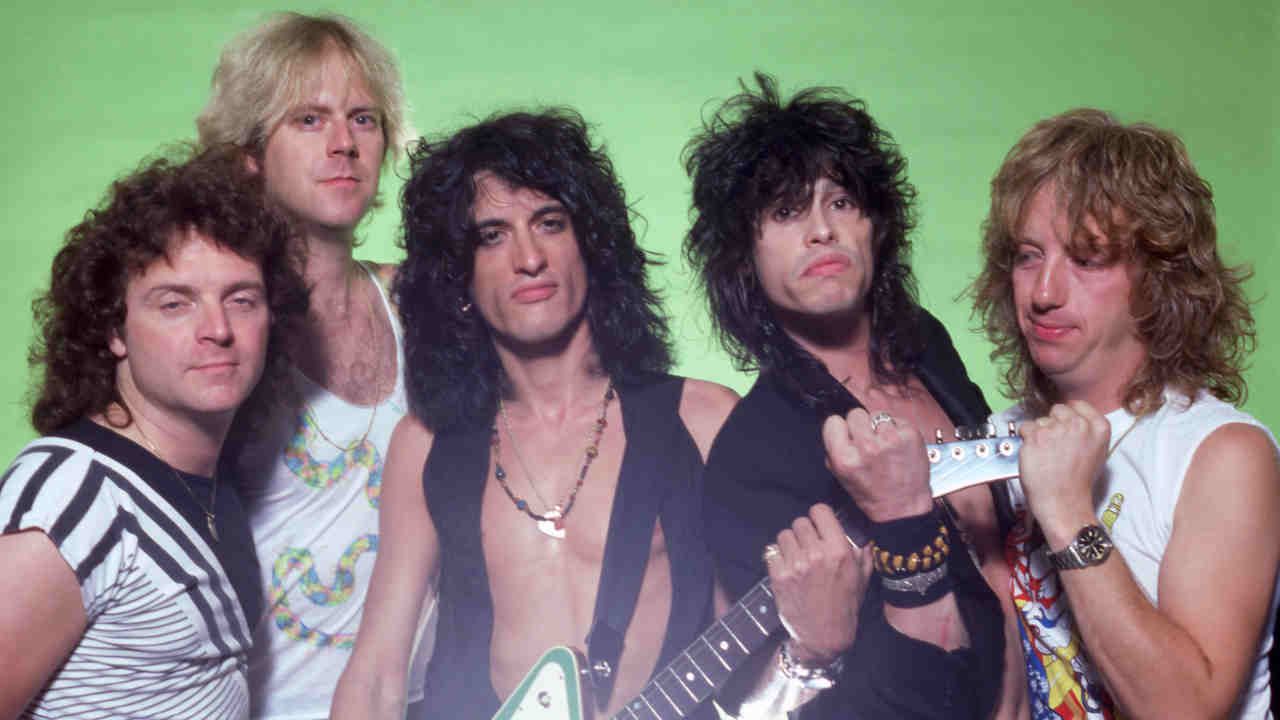
It’s January 1980 and Aerosmith are playing Reefer Head Woman from their new Night In The Ruts album at the Civic Centre in Maine. It’s a sold-out show, but singer Steven Tyler doesn’t care.
Frustrated at having no cocaine to counteract the intoxicating effects of all the booze he’s swallowed since waking – rounded off by two double martinis gulped minutes before taking the stage – he gives up and pretends to pass out. Throwing himself to the stage he fakes a seizure, twitching his leg to make it look authentic.
Such is his level of chemical dependency and alcoholic intoxication, this is the best idea he can come up with to avoid the indignity of playing a gig just plain old-fashioned drunk.
To this point in the tour Aerosmith have just about been getting away with it. Though with guitarist Joe Perry no longer in the band – replaced by JP-lookalike Jimmy Crespo – they are a shadow of their former selves. They’ve played shows where the singer has frequently forgotten his lines, and, when not at the mic has just sat on the drum riser, too unsteady to stand, much less move about.
Tonight it’s worse. The band stop playing, and Tyler is carried from the stage, a faker and a fuck-up.
Elsewhere in early 1980, Perry is touring with his original Joe Perry Project. The guitarist had left Aerosmith the previous year, midway through recording A Night In The Ruts, the “dysfunctional depression” that was crippling Aerosmith forcing him out of his own band. But now his new outfit faces ruin because singer Ralph Morman has turned into an out-of-control drunk.
“One night he showed up in a wild state of inebriation,” Perry recalls in his autobiography Rocks. “I hauled off and decked him.”
There’s an irony to his complaints. Perry was not in good shape himself: a barely functioning drunk addicted to snorting heroin. Career-wise, The Joe Perry Project’s Let The Music Do The Talking album had been well reviewed, but was poorly promoted by Columbia and wasn’t troubling the charts. The gigs, though good, were small-scale. This was a problem – because Aerosmith’s co-manager David Krebs had not long since told Joe he personally owed $180,000 in room service charges and helpfully suggested that a solo album might be a good way to pay the bill.
For Aerosmith and for Joe Perry, however, things are going to get worse before they get any better.
Aerosmith’s Steven Tyler (left) and Joe Perry (Image credit: MpiRock/MediaPunch via Getty Images)
The 1980s began less than four years after Aerosmith’s fourth album Rocks had shipped platinum upon release, rising to No.3 on the Billboard Hot 100. Hindsight suggests that Rocks, the multi-platinum follow-up to the multi-platinum Toys In The Attic, was where the ‘first career’ of Aerosmith peaked. Afterwards, their decline and fall would be as marked and meteoric as their rise had been.
After Tyler’s fake seizure, Aerosmith cancelled a week’s worth of dates – thereby falling a little further – then resumed and limped on to the end of the tour, and more drink- and drug-induced lethargy. When they reconvened, work on a proposed next album was painfully slow. Then that faltering progress all but ground to a halt after Tyler badly injured himself in a motorcycle crash. Silently but inevitably, poverty crept up and was soon crippling them all.
Bassist Tom Hamilton: “For two years, the album we were working on – Rock In A Hard Pace – was always two months away. It was hard times, we [Tom and his wife Terri] sold our house and moved into a condo…”
Drummer Joey Kramer: “It was rough. There was no money. I was on the balls of my ass. I spent everything I had… until, finally, nothing.”
Steven Tyler with Joe Perry‘s replacement Jimmy Crespo (Image credit: Ebet Roberts/Redferns)
Guitarist Brad Whitford: “No money, no income, all my savings going to alimony and mortgages. Sold my guitars… sold my house…”
Eventually Whitford could stand it no more, and quit. Aerosmith were down to just three original members, Tyler plus the rhythm section of Hamilton and Kramer.
As Perry’s marriage to fellow drug addict Elyssa continued to falter and debts mounted, he released the second Project album, I’ve Got The Rock’N’Rolls Again (featuring new vocalist Charlie Farren) in 1981. Whitford, meanwhile, hooked up with Ted Nugent’s singer Derek St Holmes to release the eponymous Whitford-St Holmes the same year. They toured briefly, but their record didn’t sell well.
On the recommendation of producer Jack Douglas, Aerosmith recruited Rick Dufay to play on Whitford’s side of the stage. It seemed like a good idea at the time, even though Dufay boasted to the singer that he had escaped from a “loony bin” having jumped out of a window and broken his legs…
The older, wiser and sober Tyler now reckons Dufay was “out of his mind”. Back then, though, the singer barely cared.
When the tour ended he “got deeper and deeper into drugs”, hanging out with and scoring heroin off his friend Richie Supa (with whom he’d co-written a live favourite called Chip Away The Stone). Somehow, stoned and hallucinating, he eventually managed to write enough lyrics to finish Rock In A Hard Place in time for release in August 1982. Good in parts, but a long way from former glories, it wasn’t a record that suggested the epic amount of time spent on it had been a wise investment. A Gold sales award – ending a string of Platinum hits for Aerosmith – and a Billboard chart peak of No.32 confirmed this.
Eventually, Tyler admitted to himself he needed help. He first tried detoxing at the Good Samaritan Hospital in New York in 1983 but, as he admitted in his 2011 biography Does The Noise In My Head Bother You?: “One of the reasons I wanted to go to Good Samaritan was that I heard they did
tests on heroin… I thought: ‘Can I be one of the guinea pigs?’”
(Image credit: Ebet Roberts/Redferns)
By then, Aerosmith’s Krebs was hiring psychiatrists to meet Tyler and report back with their thoughts. Domestically, Tyler’s fights with his wife of 12 years, Cyrinda, had turned physical and violent. Once, as she prepared to drive off, he jumped on her car and smashed the windscreen.
Tyler: “Cocaine insanity! She got out of the car and a violent, uncontrollable fight erupted. We were punching and scratching, and we fell over and rolled on the ground…”
For Perry, domestic life was no sweeter. Elyssa continued to spend money extravagantly, as if he were still a member of the 70s Aerosmith.
He recalled: “I was on the verge of losing my house. I was fucked up from drinking. I thought I was at the bottom, but every day that bottom kept getting deeper and darker.”
Sometimes, though,, rock bottom can become a solid foundation on which to build a new life.
Joe Perry fronting The Joe Perry Project in 1980 (Image credit: Gary Gershoff/Getty Images)
That new life – or “second career” as the five original, once-again-Platinum-selling members of Aerosmith are wont to describe it – was still a way up the road.
Perry was taking any gigs he could to earn cash – sometimes supporting the likes of Heart and the J Geils Band, always travelling in a van and staying in cheap hotels to keep costs low. Back home, he took the life-changing decision to walk out on Elyssa, after six-and-a-half years together – but paid a heavy price in the battle for access to their infant son Adrian.
He was happy to play with the Project, but the debts he faced weren’t going away. One good thing was happening in the guitarist’s life, though. He had hooked up with a new manager, Tim Collins, who became “the only steady force in my life”.
The deal was sealed after Perry tested Collins’ commitment by emptying a drawer in which he kept his unopened mail: mostly bills, IRS claims and foreclosure notices threatening repossession of his home, but also some unsigned death threats (presumably from drug dealers he owed money) and royalty cheques worth thousands of dollars. Collins took them away in a grocery bag and came back a week later offering to pay off “a big portion” of the guitarist’s debts, no strings attached.
Asked why, Collins simply reasoned: “I figure I need to do this to win your trust. I believe in your talent. I believe your best years are ahead of you. I want to manage you.”
One of his first moves was to negotiate Perry out of his deal with Columbia and get him a new one with MCA. Perry disbanded the old Project and hired a new one (fronted by singer Cowboy Mach Bell) on smaller salaries to record their third album, Once A Rocker, Always A Rocker, in 1983. It wasn’t as good as the first two, but the band got to open for ZZ Top on some of their US Eliminator tour. The headline gigs they were playing, though, Perry says, “were getting smaller and smaller”.
He did persuade Whitford to join the line-up, however, and the rhythm guitarist stayed for a month. Kramer later played drums at a few dates, too. Much more significantly, though, Perry was about to meet his soulmate, who was discovered when the Project were about to make a video for their last chance at a hit, a song called Black Velvet Pants.
Perry: “Tim Collins had a bunch of books sent over by talent agencies, I thumbed through half-heartedly until I came to a picture that stopped me in my tracks – a headshot of a beautiful blonde called Billie Montgomery. There was a look in her eyes that got to me, heart and soul. I had to meet her.”
When he did meet her, it was love at first sight. And their relationship would endure long after the video shoot had wrapped, to this day.
Steven Tyler and Aerosmith bassist Tom Hamilton being interviewed on MTV in 1982 (Image credit: Gary Gershoff/Getty Images)
Aerosmith, meanwhile, were in trouble. They were playing bigger venues than the Project but, as Tyler has admitted, the tour for Rock In A Hard Place was “a disaster”.
Tyler: “By 1983 I had no money and no future except getting further into the pit. Back in 1976, when I read stories about guys who lost everything and blew a million bucks snorting all they had, I used to say: ‘That’ll never happen to me.’ But in the end, I blew $20 million.”
In addition, he came to admit that he was missing his buddy: “During the years that Joe and I were broken up I realised I wasn’t half the musician I thought I was without him.”
The two had kept in touch, though.
Perry: “I’d occasionally call Steven, or he’d call me… ‘How’re things going?’ Great, I’d lie. How about you? ‘Great!’ he’d lie… The bullshit flew thick and fast.”
Tyler: “I went to see the Joe Perry Project perform at the Bottom Line, then Joe came to the Worcester Centrum in the spring of 1983 to see an Aerosmith concert. We did a few lines of heroin in the dressing room – just for old times’ sake…”
The heroin took its toll on Tyler, who collapsed on stage in front of 14,000 people… and although it had been Tyler’s wife Cyrinda who supplied the drug, Perry took the blame.
“It’s just like the old days, Joe,” Tom Hamilton told him angrily. “You’re no good for this band. Look what you did! Why don’t you just stay the fuck away from us?”
Yet the idea of a reunion persisted.
In early 1984, Tyler and Perry met with Tim Collins and, despite some initial friction, Tyler – by then living in a hotel on $20 a day – agreed the original line-up should get together for a meeting at the only place available: Tom Hamilton’s house.
Perry: “If you want to put it on the IQ meter, Tom is a really smart guy, but I think he had just been more conservative with his money and watched what was going on. Also, he didn’t have to go through a divorce. He’s the one who’s been married the longest among us.
“Any professional who has to go through a divorce, the finances are going to take a real hit. It’s one of those things in life, it isn’t peculiar to rock’n’roll. If you’re making a lot of money, they take a lot of money.”
Once it became apparent that Joe would only rejoin the band on the condition it cut all ties with Leber-Krebs Management and joined him with Tim Collins, they set about discussing a way forward and naming a scapegoat for all their problems. They settled on David Krebs.
Perry: “The main influence that the drugs will have had was that we were partying too much and didn’t notice the kind of money we were spending or take care of the decisions we were making – I don’t think we could have spent that much on drugs! And it’s not like we all had three houses and 16 Maseratis. We all had one house and a couple of nice cars, and that was it.
“I look back and just think we were taken advantage of, maybe in some quasi-illegal ways. You just have to do the numbers in your head: all those years we were selling out so many arenas, so many times. So to sit there and be told that the band’s kitty was empty, I mean – did they do something illegal? I don’t think so. We couldn’t prove anything. Was it immoral? Yeah!
Joe Perry and Steven Tyler post-reunion in 1984 (Image credit: Richard E. Aaron/Redferns)
“They weren’t taking care of us in terms of taxes and things like that. I should have been more on top of it but that was my own naïveté. There was a lot of money there, just lying on the table, and people took it because they could. That is the story. I can’t prove anything – but I was constantly asking for accountings and things like that, but it was kinda tough to get the rest of the band to lock up.”
While the reunion idea was left hanging, a third party was about to plant a crucial seed. Alice Cooper was looking for a new guitarist, and his manager Shep Gordon called Collins to sound out JP. Seeing no long-term future for the Project, Perry jumped at the chance and went to Gordon’s county pile to meet and jam with Alice. The next day, while Alice played golf, Perry called Tyler to gloat.
At the time Tyler pretended not to care but deep down he was incensed. His book suggests he remembers the incident differently to Perry, but says that he later called him back. “Are you seriously going to be his guitar player? What the fuck?” the singer wrote. “That’s the dumbest thing I ever heard! Just stop. The shit’s over. Why don’t you just come back with Aerosmith?”
Well, since Tyler had asked so nicely, how could Joe refuse? Within months, the Toxic Twins would reunite and the crazy train would be back on the rails.
Additional quotes: Rocks: My Life In And Out Of Aerosmith by Joe Perry, Does The Noise In My Head Bother You? by Steven Tyler and Walk This Way – The Authorised Biography Of Aerosmith by Stephen Davis.
