

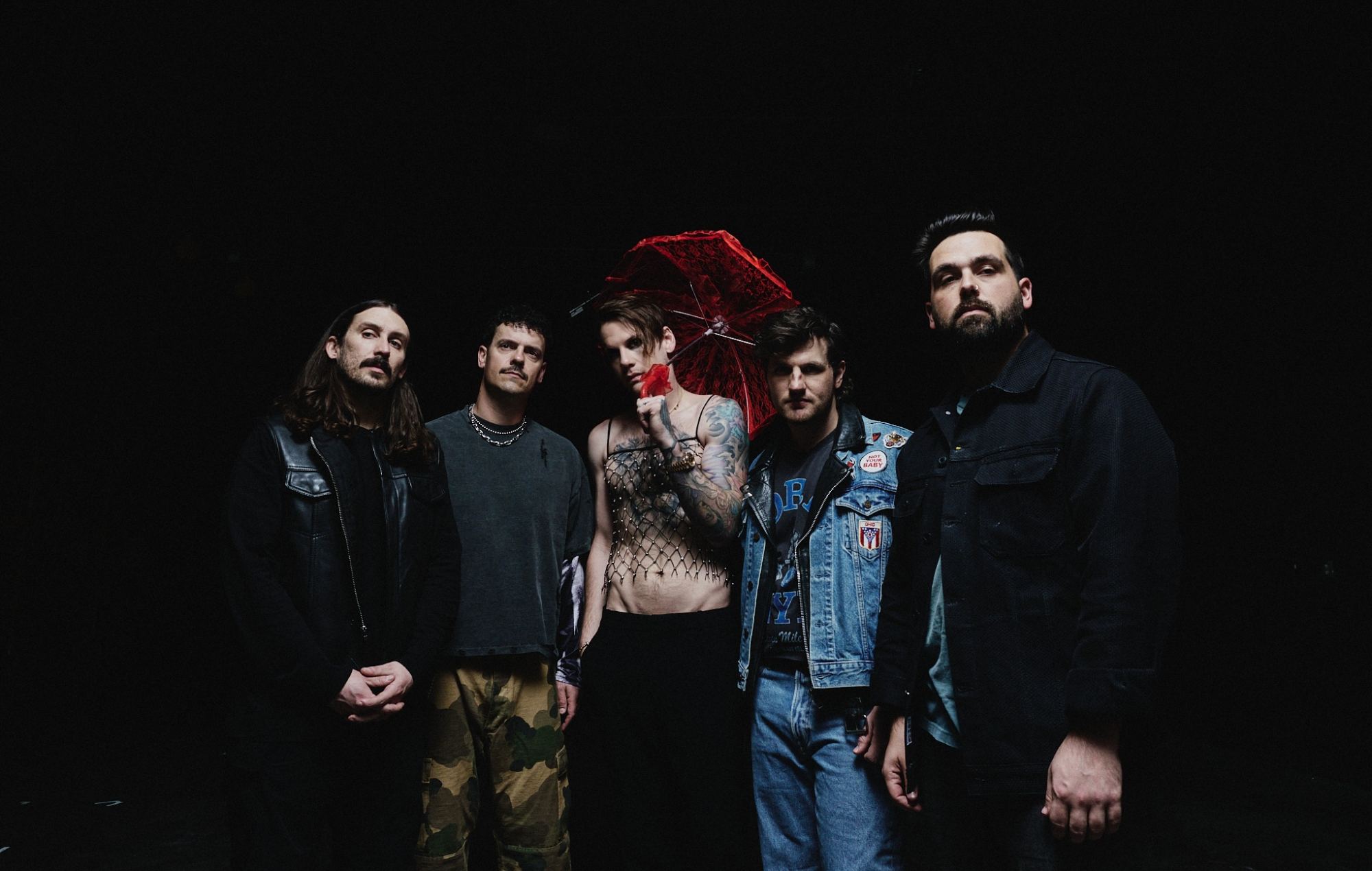
Beartooth frontman Caleb Shomo has spoken to NME about the band’s new album ‘Pure Ecstasy’, feeling more comfortable in his own skin and finding the “inner strength” to choose the path of joy after coming out.
Tomorrow (Friday August 28), the metalcore outfit formed in Columbus, Ohio will share their sixth album – their first release with Fearless Records. Previewed by singles ‘Free’, ‘Eyes Closed’, ‘Bullshit’ and title track ‘Pure Ecstasy’, the record also features co-writing and production from former Bring Me The Horizon member Jordan Fish.
After Shomo started Beartooth in 2012, the band’s blend of menacing post-hardcore riffs with stadium-sized choruses helped solidify their status as heavy music mainstays. Lyrically, debut album ‘Disgusting’ through to 2020’s fourth LP ‘Below’ were brutally honest portrayals of Shomo’s battles with low mental health. Previous record ‘The Surface’ (2023) shifted to cautious manifestations of self-love, while Beartooth began to infuse pop sensibilities into the heaviness, as Shomo told NME of his desire to “let that part of me out more” at the time.
Beartooth, 2026. Credit: Ashley Osborn
Although it’s still packed with chunky riff-work and shattering breakdowns, parts of ‘Pure Ecstasy’ push Beartooth’s sound further into pop-metal territory, and Shomo let NME in on the album’s sonic touchpoints. “I’ve been listening to a lot more soul – Al Green, Aretha Franklin – and one of the biggest influences was Prince,” he revealed. “On the metal side, I’ve been obsessed with thrash and Metallica records, and you hear that all over the riffs.
“The first Beartooth stuff was a lot more influenced by hardcore bands like Every Time I Die, Stray From The Path and The Chariot, whereas I’ve been really into metal [recently],” he continued. “Then of course, I love pop, and ‘I Made It’ is very heavily influenced by ‘Man In The Mirror’ and late 80s/early ’90s Michael Jackson. You start with the darkest, heaviest song on the record, sonically, and then you end with the poppiest, brightest song. It’s that ultimate separation of emotions, with no middle ground, that I was trying to convey.”
Upon unveiling powerful lead single ‘Free’ in February, Shomo took himself offline after he was subjected to some disgusting homophobic comments regarding his appearance in the music video. After returning to social media and announcing the album alongside UK headline shows, Shomo shared a statement in which he came out as a “proudly gay man”.
He told fans: “There’s been a lot of speculation surrounding my personal life as of late, and I feel compelled to set the record straight before it affects those I love any further.”
Check out the rest of our interview below, where Shomo revealed why he told the world about the context to this album, how Fish “reminded [him] what Beartooth is”, and the overriding elation that ultimately emanates from ‘Pure Ecstasy’.
NME: Hi Caleb. What was it that prompted you to come back online and then publicly share that statement about your sexuality?
Caleb Shomo: “I hit this point in my life where I realised, ‘This is probably going to get out into the world, one way or another,’ and I wanted to get ahead of it and say it on my own terms. There’s a lot of other reasons, but really, at the end of the day, it was something I needed to do for myself. I want to be who I am and not have to worry about it, and I felt it was probably gonna give me a little bit of peace of mind to rip off that band-aid.
“I understand it was not a very unusual situation of a coming out, but [it was], somewhat, in my life; the religious thing [Shomo was raised as a Christian], I’ve been married for a long time. In short, it was just time. I had been open with a lot of people close to me for a long time. I wanted to get it off my chest. And it felt great.”
How have you found it navigating the public-facing element and pressures of being in the middle of an album cycle, with so much going on personally?
“It always has been very important for me to protect my personal life and keep that separate from the art, which is a funny thing, because Beartooth is the most personal thing that I do in my life. With this record, it’s such an important part of the context, what I was going through.
“Historically, I’ve always been very open about the songs. Doing interviews, I wasn’t out yet, and I could feel myself watering things down, not telling the whole truth, and it got tiring. I was like, ‘Why am I scared of opening up about this one, when I wasn’t scared of opening up about depression or being suicidal?’ I tried to follow the moment to the best of my ability.”
Beartooth, 2026. Credit: Ashley Osborn
With the end of your marriage, as well, you’d imagine your day-to-day life now looks quite different. In both a musical and personal sense, have you had the support network you’ve needed around you during this whole period?
“[Since I started] telling people what’s going on with me, I’ve made a lot of progress and feel a lot more comfortable in my own skin. But it is inherently a scary thing – you don’t know how people are going to react. Did they expect this? Working with Jordan, I continued to feel more and more encouraged. “He reminded me what Beartooth really is, from more of a fan’s perspective, objectively. When you’re this close to it, it’s easy to put it on a pedestal and [forget] the root point. Jordan really helped me feel less afraid of talking about what I’m going through.
“When this record was being made, nothing else would really have been true to talk about. It was, by far, the biggest thing going on in my life that I needed to process and work through. This whole process has taught me how much I need to be leaning on and letting good people into my life. It’s super easy to shut everybody off and hole up, but I don’t think I would have made it through this period of my life, had I done that. Everybody in my inner circle helped me understand that, at the end of the day, what do I need to be afraid of?”
You open the album with the lyric “Sick and disgusting this aggressive disease / Never discussing what a word of it means”, referencing your first three albums. Has making this record helped you finally make sense of the subject matter on those albums?
“It’s a statement to myself that I’m ready to truly open up. When I look back, [I was] chasing some form of self-love and self-understanding, but a lot of those records are about the reality of being stuck and completely lost, not being ready to deal with the real place these things are coming from. This is what’s been fuelling my reason to write all those earlier records.”
How do you feel about the reality of having to play those old songs forever?
“These songs mean so many different things to people, and I’ve learned how to honour that and let that be the driving force. That lens really helps me get through those songs and experience them from a place of joy. I will say, rehearsing for the first shows since I had come out to anybody, we played ‘Disease’, and I couldn’t get through it. I was a mess, I broke down. Same with ‘Might Love Myself’, ‘Riptide’.”
‘Might Love Myself’ feels like the first time you broadly acknowledged, in your music, that self-love was a possibility. But on your debut, in amongst everything you were struggling with, there was a flicker of hope: “I have one life to live / And I want true happiness”. What would you now say to 19-year-old Caleb?
“I’ve learned over and over in this life that time is the only thing that can heal. I needed to grow from that point to get to where I am now, and had I given up, that wouldn’t have happened. Be patient. Give yourself time, grace and stay on the path. Don’t bow out of the path. If you continue to say yes to your internal compass, do the work and really try to grow, you have no idea where it’s gonna take you. The only way out is through.”
Beartooth, 2026. Credit: Ashley Osborn
You sing “I just can’t buy this shit you’re selling” and reference God on ‘Sorry’. Is the message of not apologising for who you are directed at your Christian upbringing?
“As much as [religion] hasn’t necessarily been a part of my life in practice for quite some time, that song is about me realising the hold it subconsciously had on me for so long. Not just religion – there are a lot of other ‘Fuck you’’s in there too! But it was a statement to let that stuff go and really accept who I am. As much as I’ve tried being self-deprecating, ignoring all of these different things, sometimes you’ve got to say ‘fuck you’ and move on.”
But ultimately, the album is called ‘Pure Ecstasy’. What is giving you that FEELING that prompted you to declare and immortalise that feeling through an album title?
“That choice was almost a form of manifestation. The record is about complete extremes: either the pure ecstasy, elation and freedom that has come with finally being able to open up about who I am, or the fact that it was the single most difficult period of time that I’ve personally gone through. Which side am I going to give the ultimate power? ‘I am a complete mess and my life is exploding,’ or the fact that I’m finally dealing with things I’ve somehow found the inner strength to deal with – and the joy that’s given me?
“That was the choice I made. That gives me a better chance of looking back on this as an essential part of discovering this joy that you’re going to be able to hold onto till you’re dead. Already, in hindsight, I made the right call.”
‘Pure Ecstasy’ is released August 28 via Fearless Records. Beartooth will tour the UK and Europe this autumn. Visit here for tickets and information.
SEPTEMBER
17 – myticket Jahrhunderthalle, Frankfurt
18 – Rudolf Weber Arena, Oberhausen
19 – Swiss Life Hall, Hannover
21 – Ancienne Belgique, Brussels
22 – 013, Tilburg
24 – SaSaZu, Prague
25 – Uber Eats Music Hall, Berlin
26 – Zenith, Munich
27 – Gasometer, Vienna
29 – Fabrique, Milan
30 – Halle 622, Zurich
OCTOBER
1 – Elysée Montmartre, Paris
3 – O2 Academy Brixton, London
5 – O2 Academy Leeds, Leeds
6 – Barrowland Ballroom, Glasgow
The post Beartooth’s Caleb Shomo tells us how he finally learned to love himself: “Be patient. Give yourself time, grace and stay on the path” appeared first on NME.