
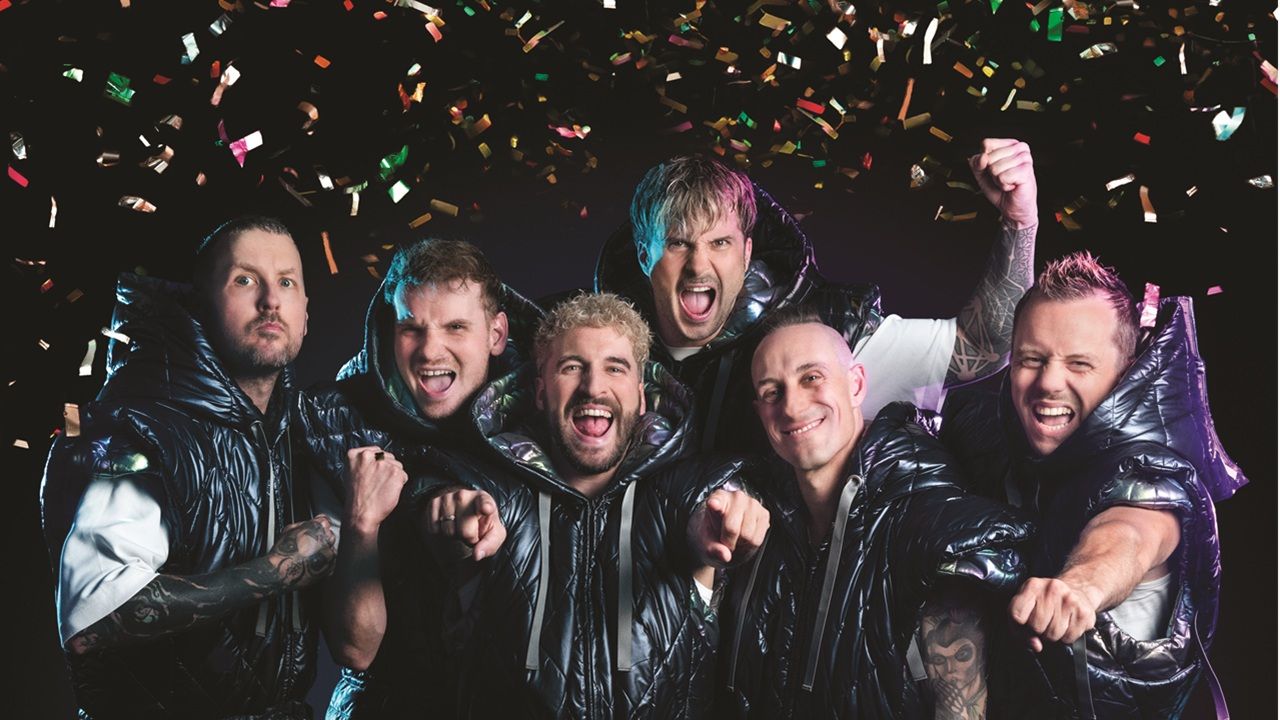
A mysterious pink box is making its way across Los Angeles. It travels through the skies above Santa Monica by pigeon, interrupts a sandwich for Nekrogoblikon’s John Goblikon, and is lost down the subway by comedian, actor and metal musician Brian Posehn, before inexplicably landing in a taxi with Dexter Holland, frontman of The Offspring.
Moments later, Dexter and Electric Callboy open the box with great anticipation. Is this going to be a ‘What’s in the briefcase?’ Pulp Fiction moment? No… It’s Electric Callboy in miniature, dressed in flamenco-style shirts with thick moustaches and gelled coiffes. Shaking their hips enticingly, co-vocalists Kevin Ratajczak and Nico Sallach utter the immortal line from The Offspring’s 1998 banger, Pretty Fly For A White Guy: ‘Uno, dos, tres, cuatro, cinco, cinco, seis!’ If any of this sounds… odd, rest assured it’s all completely in line with what we’ve come to expect from Electric Callboy.
We love the combination of metal and techno
Nico Sallach
The video for Let The Good Times Roll, the latest single from the German electrocore band’s upcoming album, Tanzneid, is the latest in a long line of wacky music videos that have won the hearts of metalheads everywhere. The band have just kicked off their European festival season with two massive shows at Germany’s Rock Im Park and Rock Am Ring, and played a tremendous main stage set at Download festival.
Tanzneid is their seventh album since forming in 2010, but their second since 2022’s Tekkno turned them into one of the biggest success stories and most beloved bands in modern metal. Since then, they’ve made a name for themselves for their ridiculous, inventive music videos, which have almost all gone viral. Babymetal collab Ratatata was voted the best song of 2025 by Hammer readers, while their gigs have become legendary half-rave half-mosh blowouts. To take the party further, Tanzneid feels like it’s been written to capture the energy of those rabid, day-glo live shows.
“We love the combination of metal and techno that gave Tekkno its name,” explains Nico.
He and Kevin have dialled in, all smiles and high spirits, from backstage at Heavy Week-End festival in France, where Electric Callboy are headlining the final night at the Zénith du Grand Nancy outdoor amphitheatre.
“Tanzneid is an evolution of Tekkno. We wanted to go a bit deeper into that and force the Tekkno vibe even more.”
Let The Good Times Roll is pure summer – a riff on The Offspring’s 2021 song, Let The Bad Times Roll. More of a tribute than a cover, Dexter even sings on the track. It’s a multigenerational crossover that captures the spirit of both bands.
“When we knew that Dexter would be on the song, we put little Easter eggs in it,” Kevin says of the Pretty Fly For A White Guy reference.
They met Dexter and Offspring guitarist Noodles two years ago, at Belgium’s Graspop festival.
“They told their crew to tell our crew that they wanted to talk to us that day, and we actually thought that they wanted to tell us that we did something wrong,” remembers Nico. “But they just wanted to tell us that they like our music!”
In 2010, Kevin Ratajczak was living a double life. He was 24, and working as a car salesman for Mercedes-Benz in Castrop-Rauxel, the German town where he grew up – clean-shaven, suit, tie, the whole nine yards, and he quite liked it.
“I love cars,” he says. “That is my other passion.”
Not only did he enjoy the job, he was good at it. Who knew the skillset needed to entice people into a moshpit isn’t that much different to persuading them to drop tens of thousands of Euros on a new Mercedes-Benz?
“I can find a connection to nearly every person on this planet, so I was a good salesperson,” he explains.
His colleagues knew him as “the friendly student who doesn’t do any harm”. Little did they know that Salesman Kevin had just formed a metalcore band, known back then as Eskimo Callboy. On weekends, the rest of the band would pick him up from work and drive to play gigs at local youth centres. He struggled to keep the two existences separate.
“These freaked-out guys with the Sprinter van would park up with loud music, opening the doors, beer cans rolling out. I would take off my suit and get out the building, trying [to ensure] nobody saw them.”
He had wanted to perform from an early age. Pushing his way into the front of his family’s camcorder home movies, he describes himself as “the annoying kid, the kid that’s a little bit too much”. In school plays, he was always the “guy that freaked out onstage and had no problems with embarrassing stuff”.
Joey Jordison had this huge drum set-up where he was lifted in the air and was circling around. I’d never experienced something like it.
Kevin Ratajczak
This is the Kevin that Electric Callboy fans know, the all-round goofball and hedonist whose roars contrast with Nico’s clean vocals, but there’s a surprising side to him they don’t usually see. One that’s more sensible and “rational” than you might expect from a man whose day job involves conducting mass raves in garish outfits and wigs.
“My character has got a bit more polarising,” he explains. “Onstage, I’m way over the top, and it’s me, it’s not that I’m playing a role. But it’s an exaggerated version of myself.”
When Kevin’s not on tour, he prefers a quiet life. He still lives in Castrop-Rauxel, and has a wife and two children, along with a small circle of friends.
“I’m very homebound,” he confesses. “I need my family.”
Born into a working-class family, he grew up with his sister, while his mother was a housewife and his dad was an electrician. His dad was into classic rock and had a vast record collection, through which Kevin discovered bands such as Led Zeppelin, Toto and Deep Purple, with the latter’s Made In Japan 1972 double live album proving particularly formative.
“My father was passionate, and he transferred that passion to me.”
As a teenager, Kevin started going to local thrash and death metal gigs, but the real lightbulb moment came on January 26, 2002, when Slipknot rolled into the neighbouring town of Essen on their Iowa World Tour.
“That was a show when Joey Jordison had this huge drum set-up where he was lifted in the air and was circling around,” he remembers, with a sense of wonder. “I’d never experienced something like it.”
It didn’t take long for him to join a band himself. In 2008, he became the keyboardist and backing vocalist for Her Smile In Grief, the metalcore band of Electric Callboy guitarists Daniel Haniß and Pascal Schillo. After their singer left in 2010, they advertised for a new vocalist on MySpace, eventually finding Sebastian ‘Sushi’ Biesler, and rebranding themselves as Eskimo Callboy.
“We all came together in short pants,” Kevin grins. “We felt like summer inside our bodies!”
It wasn’t long before he quit his day job to do the band full-time. Quickly, Callboy became the linchpin of the German metalcore scene.
“Being authentic is very important,” Kevin says. “We had our music, but we also showed our personality. We had some vlogs out. We just drove around town, talked to the people, and I think we were one of the first bands that did it that way. We hosted some gigs and invited bands from other cities, so the whole scene grew. That was a cool time.”
He fondly describes the early days as free and hedonistic, driving from gig to gig, getting wasted and sleeping on floors. The music they were making sounded like a party, influenced by larger-than-life scene bands of the time, such as Attack Attack!, Asking Alexandria and Bring Me The Horizon.
“We wanted to be hard, but we didn’t want to be black and serious,” he explains. “We wanted to be bright and funny.”
(Image credit: Ben Gibson)
It’s not surprising that Nico Sallach ended up in a party band too. In his 20s, the singer threw weekly house bashes in the cheap, cramped flat he shared with his best mate, until one time it got completely out of hand.
“At its peak, we had 80 people in this tiny flat. People that we didn’t know were ringing the doorbell,” he says, likening the situation to the 2012 film Project X, where a party spirals into chaos. “People started smoking everywhere and didn’t use an ashtray. They treated our flat like shit. I wanted to go to bed, and there were drinks and liquids that I couldn’t identify all over my bed!” He laughs. “Very good memories, even if it doesn’t sound like it.”
Much like his bandmate, Nico craved the spotlight from a young age. The first instrument he picked up was the drums, but he quickly realised he wasn’t suited to it. He wanted to be up front.
“Sitting there in the back, I didn’t feel it,” he smiles. “After a couple of years I recognised that singing is way cooler.”
As a kid, he was the hyperactive “class clown” – the guy who was always “trying to make anybody laugh, even in situations where you just should have shut up”. At school, so as not to be “too infectious” (read: disruptive), he was seated on a separate table from his classmates, for his own good, he says, as well as theirs.
“That was more or less my life as a young kid, but it never changed,” he says of his hyperactivity. “I just learned how to deal with it.”
He grew up in Essen, a town close to Düsseldorf, only 30 minutes from Kevin’s hometown, Castrop-Rauxel, and was introduced to rock by his dad, who had been the singer in a prog band. There was a healthy local music scene, and teenage Nico would spend his time watching emo and metal bands at various youth centres, sometimes taking in several gigs in one weekend.
“It wasn’t even about the music. It was about being there, being connected to other people,” he explains. “I made a lot of friends during that time that I still have.”
Having people in front of you singing along to the songs that you have written was the best thing on Earth
Nico Sallach
On June 28, 2008, he attended Linkin Park’s Projekt Revolution tour in Düsseldorf, which included HIM and Pharrell Williams’ N.E.R.D. on the line-up – and that was it. He knew what he wanted to do with his life.
“It changed me,” he says. “[Late Linkin Park vocalist] Chester was and still is one of my biggest idols.”
Nico was in a few bands before joining Electric Callboy. The first, metalcore outfit Through Your Veins, was “basically trial and error”.
“We didn’t play many concerts,” he says. “But when we quit, I knew that I’d never want to stop.”
In 2012, he joined To The Rats And Wolves, whose genre-hopping sound wasn’t a million miles away from Electric Callboy’s sound today, albeit much less refined. Two years later, To The Rats And Wolves supported Callboy on tour.
“We gained our first fans,” he smiles. “Having people in front of you singing along to the songs that you have written was the best thing on Earth.”
For the five years before joining Callboy, Nico worked as a nurse, first in the geriatric department at his local hospital, and then in the Intensive Care Unit. He reckons there’s not as big a jump as you might imagine between the two professions: taking care of people is still part of his job.
“We get messages from people that are like, ‘I’m having the toughest time right now, and whenever I see you live, I feel way better afterwards,’” he says.
Even so, working on the Intensive Care Unit was tough.
“In the end, it was really hard for me to deal with, because I’ve seen too much. It’s not as rewarding as you might think,” he admits. “Even if I hadn’t joined Electric Callboy, I would have searched for another job.”
In 2020, it seemed like To The Rats And Wolves and Callboy were on a parallel crash course, their futures intertwined by something larger than fate. That year, both bands disintegrated. Callboy were five albums in, their momentum had plateaued, and relationships between vocalist Sushi and the others had completely broken down.
“In the end, it was just toxic,” Kevin says today. “Five people had one opinion, and then one was totally going against it. It took all the fun away, it took all the passion away.”
They recorded one last album together, 2019’s patchy Rehab, a record Kevin now brands as “soulless”. But when Sushi finally left in 2020, Kevin faced a reckoning: “I quit my job, I quit everything. The band was my world, my dream.”
As luck would have it, they had found themselves in the market for a new singer just as Nico was searching for a new band. Having stayed friends with the Callboy guys since supporting them with To The Rats And Wolves, he auditioned for the job, submitting a video of himself singing Callboy cut Prism, far and away the best track on Rehab. After joining them for a couple of rehearsals, Nico had a good feeling about it.
“It felt pretty natural and felt right. I was driving home and I remember looking at my wife like, ‘Yeah, I’m probably going to do it.’”
It’s hard to believe now, looking at them finishing each other’s sentences, completely at ease in each other’s company, but, for Kevin, the choice wasn’t as immediately obvious.
“Not from the beginning,” he admits. “I knew Nico, but didn’t know him [as well as some of the others in the band]. It was a sad situation where we were coming from. I wasn’t sure a new singer was gonna work.”
He went over to Nico’s house, and the two hung out.
“We talked about being onstage, and that’s when we actually got to know each other.”
After that, things fell into place pretty much immediately; it was like a switch had been flipped.
“It was the same feeling we had had when we started the band,” Kevin smiles. “No responsibilities, nothing in our heads, just working, just doing what we love.”
Whenever I did something in my life, I’d call my dad. I can’t call my dad, so in the end, being successful means being sad.
Kevin Ratajczak
The first song the new line-up wrote together was Hypa Hypa, a garish party anthem that blended 80s synths with aggressive breakdowns, and which immediately went viral.
“Hypa Hypa was created within one or two days; it was very fast,” recalls Kevin. “And that was the time when we were sure: let’s do this together.”
In 2021, amid the neon, laugh-a-minute momentum, Kevin received a call from his sister: his father had passed away suddenly at the age of 61. He dealt with his grief privately.
“To be honest, it was hard,” he says. “My first reaction whenever I did something in my life, when I achieved something, was to call my dad. I can’t call my dad, so in the end, being successful means being sad. That’s one thing that I have been suffering from, but it’s getting better and better. It’s a journey.”
Not long after the release of Hypa Hypa, the band changed their name to Electric Callboy, and released a spate of personality-packed singles. Their live shows grew with every tour, and the band had a clear camaraderie that made their gigs seem more like a wild night out with thousands of new mates. So, it was a shock when drummer David Friedrich left in April of last year. (Currently, ex-Sum 41 drummer Frank Zummo is behind the EC kit.)
In a candid post on Instagram almost a year after his departure, David revealed how much the band’s rapid success had impacted his mental health, admitting: “As the venues got bigger, I felt smaller inside.” Did it come as a shock?
“I think the main problem is we didn’t talk much,” says Nico. “Over the last months, he started driving on his own, and slowly but constantly separated himself from us.”
Despite trying to reach out, they haven’t spoken to David since he left. “I just hope that he’s feeling better.”
(Image credit: Ben Gibson)
A lot is riding on Electric Callboy’s new album, Tanzneid. In the four years since releasing Tekkno, they have kept busy by drip-feeding singles, including a cover of Cascada’s 2005 Eurodance anthem, Everytime We Touch (the video saw them dancing in satin shirts at a country manor) and playing to bigger and bigger crowds. But the success of Tanzneid will determine just how big things can get. Right now, Electric Callboy are one of metal’s hottest bands, and a stumble would be disastrous.
“The pressure during the last three months of recording pushed us to the limit,” admits Nico. “Writing an album that is successful as Tekkno… you can’t force it, you can’t plan it.”
“It’s not good for your creativity,” adds Kevin. “You want to be free of all those expectations.”
They needn’t worry. Tanzneid will easily satisfy the fans who enjoy both the serious and silly sides of Electric Callboy’s songwriting.
“We wanted to go a bit rougher and harsher,” said Nico, referring to songs such as dark rager Heartclub, and The Savior, which combines hard beats and classic 80s metal riffery. On the other side of the coin, the silliest moment by far is The Way You Are, a 90s boy band ballad in the vein of Backstreet Boys, which implodes in a cacophony of pig squeals, blastbeats and Lorna Shore-esque apocalyptic synthwork. It’s reminiscent of Hurrikan, a track on Tekkno which mashed German schlager music with deathcore, and is destined to become a moment in future sets.
“We are fans of Backstreet Boys,” laughs Kevin. “There were so many great songs coming out of that era.”
Footage from their sets at Rock Im Park and Rock Am Ring, filmed by a drone, has landed on social media. We comment on the size of the crowd – a sea of ravers and moshers as far as the eye can see, all united in joy. It’s a scene that underlines how far Electric Callboy have come, and hints at how far they could still go.
“There are always goals that you want to reach,” says Nico. “All our tours are arena tours right now, which is unbelievable, but playing in a stadium once, that’d be crazy.”
Or maybe it’s not so crazy at all. Surely only a fool would bet against them.
“Everything that’s going on at this point is so much more than we could process,” says Kevin, who is still trying to wrap his head around how big his band has become. “Last night, I was sitting on the bus, checking social media, and I was like, ‘Wow, that was us onstage… That was me!”
Tanzneid is out now via Century Media. Electric Callboy tour the UK in January 2027 and headline Bloodstock Open Air on August 7 2027.