

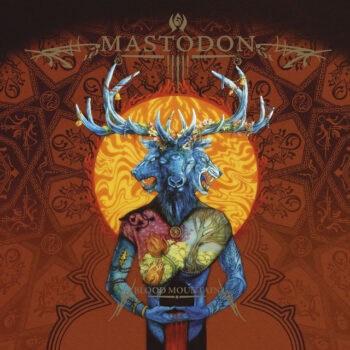
A year ago to the day, the metal community tragically lost Brent Hinds. Three weeks from now, metalheads can observe a joyous anniversary involving Hinds: Blood Mountain turns 20. The convergence of these anniversaries must be disorienting for the remaining members of Mastodon, who recently released a tribute to their fallen brother. In the video, Brann Dailor, Bill Kelliher, and Troy Sanders narrate the rise and fall of their camaraderie with Hinds, culminating in a public dispute after his dismissal from the band. Watching old studio footage of his deceased bandmate recording Blood Mountain, however, puts Dailor in a happier mood; he claims Hinds was reaching the height of his creative powers on album three.1 I snagged a copy of Blood Mountain from Best Buy the day it dropped, and it quickly presaged for me the metal giant Mastodon could become. Only now can I appreciate the giant within the giant.
Like most Mastodon fans, I eagerly anticipated Blood Mountain. The “March of the Fire Ants” video on Headbanger’s Ball introduced me to the band, and Leviathan convinced me that these Atlantans were running perpendicular to the New Wave of American Heavy Metal (NWOAHM) they were lumped into. Signing to Reprise Records put major pressure on the band, which they mitigated by keeping Matt Bayles behind the board.2 Mastodon ended up following Leviathan with another concept album, this time with originality: a protagonist ascends the titular mountain to crown its peak with a crystal skull, facing physical, psychological, and mythical tribulations along the way.3 Upon finally hearing it, Blood Mountain struck me as a step up for the band. Kelliher’s off-kilter guitar work felt more consistent, Sanders’s bass choices felt more impactful, and Dailor’s drum-kit clinic felt more purposive. But the album also struck me as structurally similar to Leviathan. An early lyric in “The Wolf is Loose”—when a screaming Hinds likens the protagonist’s predicament to ‘the belly of the whale’—seemed to confirm this similitude.
It was obvious, however, that Blood Mountain’s vocals separated it from previous outings. A making-of documentary shows Hinds exhausted by the lengthier recording process yet energized by the unique blending of his voice with Sanders’s.4 If “The Wolf is Loose” and “Crystal Skull” loosely mimic Leviathan’s raucous opening, Mastodon distinguish Blood Mountain’s one-two punch through Hinds’s voice, shifting between scathing snarls, creepy whispers, and soulful croons. On melodic centerpiece “Colony of Birchmen,” Hinds warbles eerie verses and belts a powerful post-chorus with posthumously poignant lyrics (‘Gone away / My heart’s gone away / Taking everything’). And “This Mortal Soil,” the prog-rock curveball, contains one of Hinds’s most moving choruses. The NWOAHM left me callous to the harsh/clean vocals formula, and Hinds himself jokes that Mastodon sold out with their singsongy major label premiere. Despite my NWOAHM skepticism, Blood Mountain didn’t strike me as vocally formulaic. Hinds’s voice in particular gave Mastodon a weirdo quality that had the band riding its own wave.
Hinds is primarily a guitarist, though, and Blood Mountain contains some of his most expressive playing. He does, of course, lay down tasty solos (“Crystal Skull,” “Colony of Birchmen”). But for my money, Blood Mountain soars when Hinds adds melodic color to kinetic jams with Kelliher, Sanders, and Dailor. The frenetic bridge in “Capillarian Crest” comes to mind, as does freak-out instrumental “Bladecatcher.” Closer “Pendulous Skin” shows Hinds at his most singular on Blood Mountain, guitar-wise. He cites Led Zeppelin as an influence, and it’s hard not to hear the song’s roving acoustic chords as Stairwavian, its solo as Pagean. With “Pendulous Skin,” it’s almost as if the rest of Mastodon handed off Blood Mountain to Hinds, confident he could craft a classic conclusion.5
Blood Mountain stands as a transition between the sludgsterpiece of Leviathan and the more palatable Mastodon to come. Calling it simply a ‘transition album,’ however, would be unjust. Standing tall on its own, Blood Mountain showed me something familiar yet new in 2006—in hindsight, Hinds was responsible for much of this invigorating novelty. Indeed, the album’s classic- and prog-rock flashes excited me for the band’s future. Speaking of the future, Mastodon will be releasing Marrow Deep, their first album without Hinds, a week from now. Today is the day to mourn the loss of a metal giant, and August 28th will be the day to see what Mastodon can create without this giant. September 12th, however, will be the day to celebrate Hinds’s giant contributions: to one of Mastodon’s finest albums and to metaldom more broadly.
The post Yer Metal Is Olde: Mastodon – Blood Mountain appeared first on Angry Metal Guy.