

All I know is that when I’m with you
all the lines they seem to blur
I meant it when I said we were through
But my heart isn’t so sure
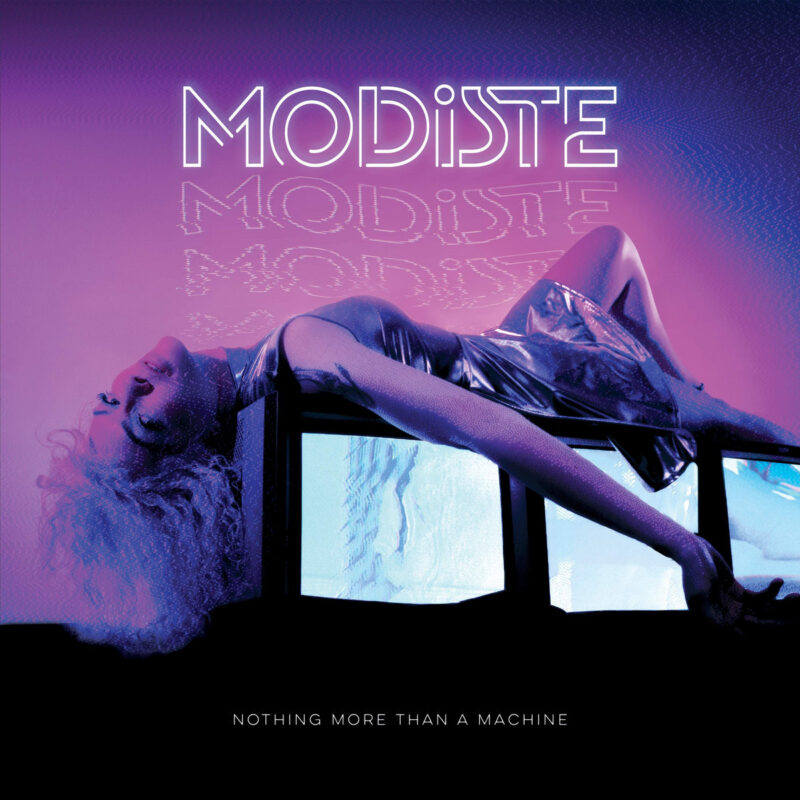
MODISTE could have built Nothing More Than a Machine inside a laptop, but the Louisville trio instead surrounds itself with analogue synthesizers, drum machines, and digital instruments from the 80s and 90s – machines with temperaments, imperfect memories, and knobs that invite somebody to reach out and make a decision.
“Using these old machines is a small personal rebellion against convenience culture and all the small ways technology is sterilizing the creative process. Also, they’re just more fun. They’re unpredictable and wobbly and alive and have a certain warmth and texture that you just can’t replicate,” vocalist Sydney Sleadd says.
Those influences are easy enough to hear. Depeche Mode, Siouxsie and the Banshees, Book of Love, New Order, Metric, The Motels, Tennis, Weyes Blood, and Strange Boutique all provide useful coordinates at different moments, although MODISTE’s strongest songs are the ones where those references begin to blur together. Sleadd’s voice supplies a recognizable center, Stein approaches synthesizers with the curiosity of someone who enjoys their peculiarities, and Stallings introduces enough guitar to keep the electronic arrangements physically grounded. That sense of play gives the album much of its character.
Nightmare opens as though the closing credits of a 1987 prime-time drama have suddenly become an invitation, with broad synthesizer chords, bright melodic flourishes, and the faint suggestion that something romantic and vaguely dangerous is waiting around the next corner. As an instrumental, it establishes the album’s affection for period equipment without turning the record into an exercise in museum preservation. There is too much movement in the arrangement, and too much pleasure in the tones themselves, for that.
Breaking My Own Heart brings Sleadd forward with a song about the exhausting arithmetic of wanting somebody who disappears whenever intimacy becomes possible. The verses maintain a cool exterior while the chorus gives her considerably more room, allowing the vocal to stretch across the arrangement as frustration turns into self-preservation. Beneath her, the electronics maintain an elegant tension between pop immediacy and emotional unease. The song understands how desire can survive well beyond the point at which common sense has packed its bags.
On Blur, Dennis Stein’s synthesizers rise and recede while Kyle Stallings sends guitar through the open spaces, leaving Sleadd room to sing with poise, attraction, and wary self-knowledge. “We wanted Blur to have this ebb and flow that tapped into the feeling of not being able to pull away even when something isn’t good for you,” says Sleadd. The arrangement follows that idea closely. Synth lines swell and withdraw, the guitar adds an occasional flash of abrasion, and Sleadd sounds increasingly aware that recognition offers very little protection against repetition. The chorus catches the contradiction beautifully, with certainty dissolving beneath attraction.
My Love heads into power-ballad territory with complete confidence. Sleadd leans into the emotional scale of the song, while the arrangement allows the chords to widen around her rather than crowding every available space. Its euphoric bridge provides one of the album’s most openly romantic moments, the kind of passage designed for a singer to look toward the back of the room and hold the note a little longer than expected.
The instrumental Nightmare Part 2 then clears the air. Its spacious electronic architecture brings Jean-Michel Jarre to mind, particularly in the way melody and atmosphere are allowed to develop patiently across repeating figures. Where the opening Nightmare feels connected to television themes and eighties synth-pop drama, its sequel reaches toward something more expansive and cinematic, giving the album a useful midpoint before the songs return to their various romantic complications.
Shadows finds MODISTE at its most theatrical. “Shadows delves into themes of longing, forbidden love, repressed desire, and surrender,” says Sleadd. “We wanted it to feel like a slow descent, similar to giving into temptation, with the synths and rhythm building a kind of hypnotic gravity around the words.”
The song carries that descent in its pacing. Sleadd sings as though every warning has already been received, considered, and quietly placed to one side. Desire becomes a question of reputation, restraint, and the private thrill of crossing a line while knowing precisely where it was drawn. Shame gets powdered, perfumed, and sent onto the dance floor with a couple of spritzes of Tabu. Beneath the drama, the band keeps a firm hand on the arrangement, allowing the tension to accumulate without burying the lyric beneath excess.
Age of the Andy brings one of the record’s strongest rhythmic turns, with a backbeat that carries some of Depeche Mode’s physical economy while Sleadd delivers one of her most assured performances. The keyboards have a harder edge here, and Stallings’ guitar adds pressure around the beat rather than competing with it. The result suits MODISTE particularly well: stylish, muscular synth-pop with enough space for the vocal personality to remain at the center.
Besotted returns to the scale of a power ballad, though its emotional engine is a struggle over desire and control. Sleadd understands that these songs become more interesting when love comes with leverage, pride, hesitation, and the possibility of somebody losing the upper hand. The larger arrangement gives those tensions room to breathe, making the track feel less like a declaration than an extended negotiation between two people who know exactly how much power attraction can surrender.
“In creating this record, we really discovered how well we worked together and how much we enjoy working together. We’re each pulling from different influences but there’s an overarching shared vision that is the glue of this project,” Stallings says.
Listen to Nothing More Than a Machine below, and order the album here.
Nothing More Than A Machine by MODISTE
Their ambitions extend to the stage. “We’re really trying to create a full experience at our live show that allows everyone, including us, a reprieve from the day to day grind. While it’s a lot of work to pack out these big TVs, lights, and all of our stage production, it’s worth it to build an immersive world for people to come live in for a night,” Stein says.
Nothing More Than a Machine earns its title through an affectionate contradiction. MODISTE loves machines because they can misbehave, drift, surprise, and require touch. Across the album, those machines become partners in songs about people behaving much the same way: losing control, guarding themselves badly, making familiar mistakes, and occasionally finding something beautiful in the trouble.
Follow MODISTE:
Website
Instagram
Spotify
YouTube
The post Louisville Synthpop Trio Modiste’s “Nothing More Than a Machine” Finds the Human Heart Inside Vintage Synths appeared first on Post-Punk.com.