
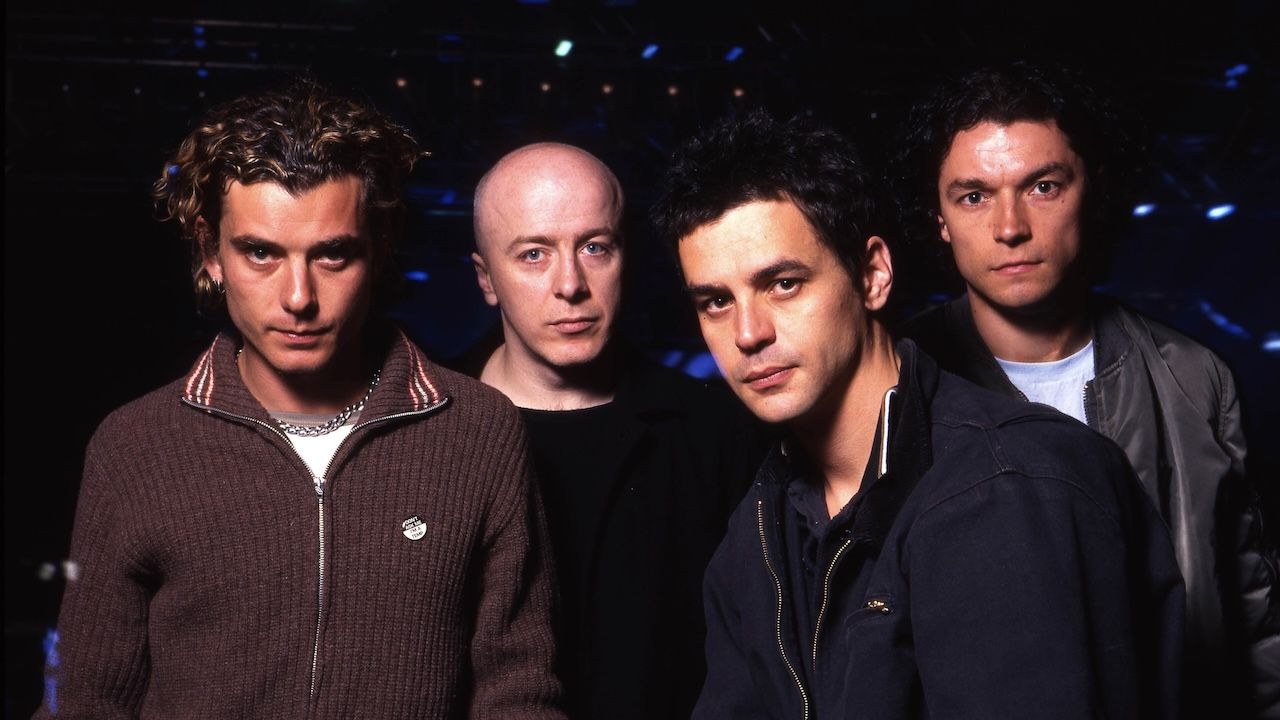
One day in 1993, George Michael’s former manager Rob Kahane received a tip from a producer friend at London radio station GLR about a band called Bush who were receiving unusually enthusiastic support from listeners for a demo track, titled Honky Manchild, that had been aired on alternative/indie DJ Gary Crowley’s show. None of Kahane’s many contacts in the British music industry seemed to care about the London quartet, or even be aware of the band’s existence, so the Los Angeles-based music industry veteran, and former talent scout, flew to the UK to see Bush for himself. When he walked into the band’s rehearsal space in Harlesden, the quartet were playing a Pixies-esque song called Everything Zen: before he exited the studio later that day Kahane had offered the band a record deal with his newly-created label Trauma.
“It was my one shot,” Bush frontman Gavin Rossdale told Classic Rock in 2025. “People told me not to sign to them. But I just took that chance. Mostly because I didn’t have any other options.”
The title of Everything Zen was deeply sarcastic, for at the time, Rossdale was far from happy with his lot in life, and very far from chilled. As a teenager, Rossdale had already taken a shot at fame with his previous band, Midnight (also featuring his best friend Sacha Puttnam, son of Oscar-winning film producer David Puttnam), but interest in that band quickly dissipated, and no-one wanted to know his new band. One day, Rossdale was flicking through the pages of English music magazine NME when he saw an interview with Brett Anderson, frontman of Suede,. and David Bowie, with Bowie praising Anderson for his songwriting.
“Around that time, Suede were massive,” Rossdale later recalled to Rock Sound. “They’re a brilliant band, and I was jealous… At the time I was writing Everything Zen and feeling like Suede were winning because they were more successful than us.”
Reading the interview prompted a seething Rossdale to write the lyrics “Mickey Mouse has grown up a cow / Dave’s on sale again“, the first line a direct steal from Bowie’s Life On Mars, the second a twist on Bowie’s lyric “Lennon’s on sale again” from the same song, rewritten to express his frustration that Bowie was cosying up to British guitar music’s new stars.
“It’s stupidly bitter,” Rossdale admitted, revealing that at the time he was “floundering… working on building sites and doing jobs to earn 50 pounds a day just so that I could live.”
Rossdale’s lyrics for Everything Zen didn’t just borrow from Bowie: Bushy’s frontman also referenced Tom Waits’ Rain Dogs, Allen Ginsberg’s controversial 1956 poem Howl, and Jane’s Addiction’s album track Ted, Just Admit It…, with the line “There’s no sex in your violence.”
“I was thinking about where I was living and where I had grown up, and some of the more violent aspects of that life and of those kids,” Rossdale told SongFacts in 2017. “I really hated that violence growing up. I was a little bit lost and didn’t know where I was going, what I was doing, and I was committed to music, with no chance of having any success. I had been struggling for years. And that line, ‘sex and violence’. that is a common thread through art. I just decided to put it in the context of, ‘There’s no sex in your violence.’ It’s sort of a personal belief, a personal mantra.”
Elsehere, with the lines “As you search for your demigod /And you fake with a saint” Rossdale was having a pop at who “espouse spiritual values and lean certain ways and then they behave like douchebags in another area of their lives”.
This was not a feel-good anthem, but for many, the sense of disillusionment and despair in Rossdale’s complaints was relatable.
“It’s a complete mental health song,” Rossdale said in 2024. “I’ve always been attuned to that because I care. I care about my friends, I care about my family, and I care about myself.”
Bush’s debut album should have been released in the summer of 1994, but the label’s distributor, Disney-bankrolled Hollywood Records, rejected it. Interscope then stepped in. Ahead of Christmas, 1994, Rob Kahane sent slipped a cassette of the album to LA radio station KROQ,and a DJ named Jed The Fish selected Everything Zen as his ‘Catch Of The Day’ pick. Soon Everything Zen was on rotation, playlisted for 12-spins-a-day: Other stations across America picked up on the buzz, and began to follow suit. And in January ’95, Sixteen Stone sold 50,000 copies. By April 1997, it had sold six million copies in the US.
Bush’s success put noses out of joint at every level of the English music industry – “We were shunned by a lot of people,” Rossdale recalled to Classic Rock. “The stench of success was horrible for a lot of people” – but soon enough, they could no longer be ignored.
“We’ve been the victims of a lot of backbiting in Britain,” guitarist Nigel Pulsford told Q magazine. “What I’d like to see instead is a community of encouragement like the scene at the Speakeasy in the ’60s where The Beatles, The Stones and The Who would all meet up on a friendly basis. Networks like that help music to move on…But there again, hey, who cares? This is all I could ever have hoped for and more. I’m completely fulfilled.”