

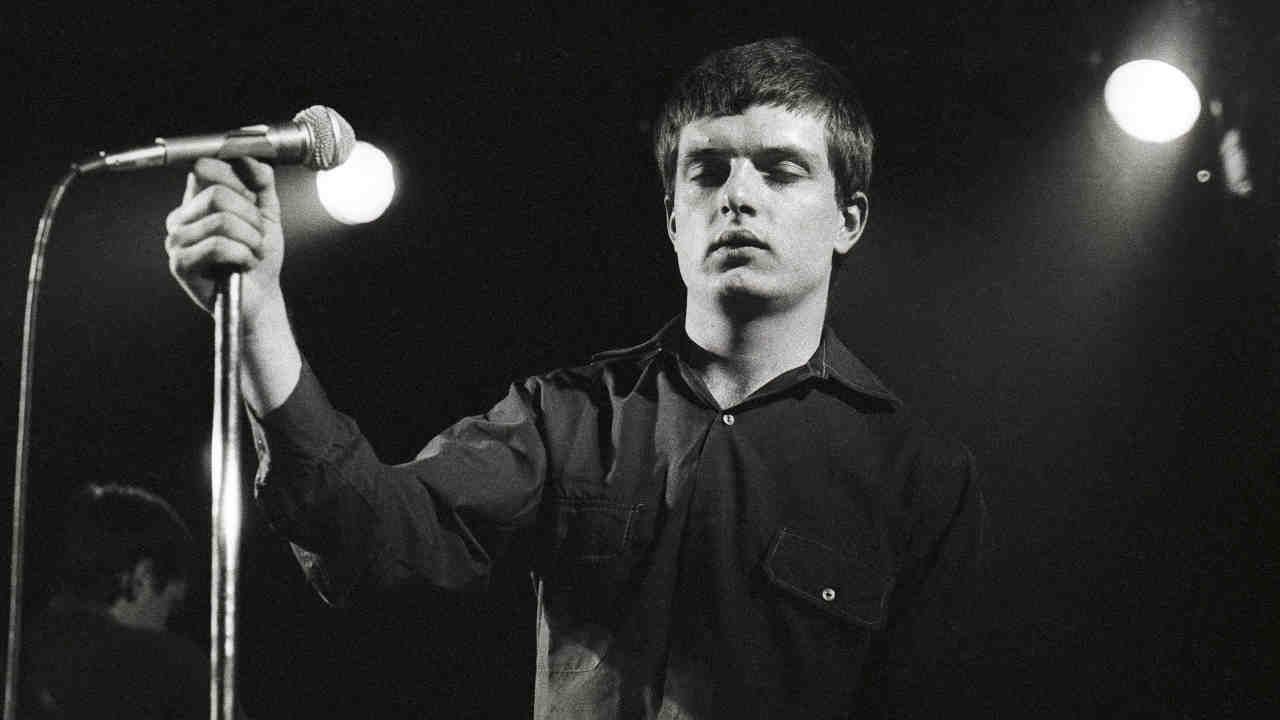
At the point in their career when they recorded Love Will Tear Us Apart, Joy Division were one of the most vital new bands in the country.
Fronted by charismatic singer Ian Curtis, their charged and foreboding soundscapes were the work of intensely driven young men inspired by the Sex Pistols to create a new rock music of fearsome power – and meaning – out of post-industrial pre-gentrification Manchester’s urban decay.
On their 1979 debut album Unknown Pleasures the one-time outsiders of Manchester punk had, through hard work and a crucial relationship with maverick producer Martin Hannett, defined a compelling and audacious landscape of apocalyptic dread.
In the months that followed Unknown Pleasures, Joy Division had moved on even further. One of the songs they wrote was , Love Will Tear Us Apart, which signalled a major shift in their sound, with Bernard Sumner’s previously abrasive guitar replaced by svelte keyboards, all the better to gild Peter Hook’s haunted, memorable bass melody line.
Joy Division’s Ian Curtis in 1980 (Image credit: Chris Mills/Redferns)
“It came from the dirty streets of Salford,” says Hook. “It’s a thing that I still wonder about: where does any music
come from? The part of your brain when you write music that’s unconscious?
“It was written on the bass and drums and then Bernard put the keyboard on it. I was just playing around with a riff and Ian spotted the melody,” Hook continues. “He jumped on it and goes: ‘That’s good, that’s good… Now put some drums on.’
“It was the way we always wrote. Ian didn’t write the music but he could spot it. We’d jam, he’d sit there and pick out the bits he thought were good.”
The band’s working process was open-ended, primitive and combustible.
“Strange as it may seem, there wasn’t tape recorders in those days so everything was in your head,” says Hook. “That was one of the wonderful things about Joy Division: we didn’t have tapes of us rehearsing the songs, they only existed when you put the four people together.”
The decisive factor in shaping Love Will Tear Us Apart came from Hannett, who arranged the elements to highlight Curtis’s exacting but resigned baritone. Arranged for mounting effect, with its swooping and soaring, it creates an indelible imprint.
(Image credit: Rob Verhorst/Redferns)
“It was a funny song for us because it was quite poppy, a contrast to the rest of the Joy Division stuff,” Hook says. “We weren’t that struck with it. The ones that were our favourites were ballsy and angsty, like [earlier songs] Shadowplay or Transmission, because you could hide behind the song. Love Will Tear Us Apart was fragile and a lot lighter. We knew it was good but not great.”
Curtis insisted that his lyrics were open to interpretation, but his words to Love Will Tear Us Apart may have been partly inspired by his crumbling marriage to his wife Deborah: ‘Why is the bedroom so cold? You’ve turned away on your side/Is my timing that flawed? Our respect runs so dry,’ he sang in a rich croon. Tony Wilson, head of Joy Division’s label Factory Records, reportedly gifted Curtis a set of Frank Sinatra albums, which is thought to have influenced his vocals.
“Tony and Martin Hannett seemed to think it was a good idea for Ian to sound like Frank Sinatra,” says Hook. “We laughed at the idea. We were young punks full of fire, the last thing we wanted to be was subtle.
“That was Martin Hannett’s doing, something I thought would be impossible to do,” continues the bassist. “But it’s the subtlety that makes it last. Bernard and I would just have done it balls-out, legs akimbo like Status Quo, and probably would have fucked it up in the process. Martin gave us a depth that 20-year-old kids couldn’t have got on their own.”
(Image credit: Chris Mills/Redferns)
Capturing that subtlety was easier said than done. The band recorded a version of Love Will Tear Us Apart at Penine Studios in Oldham in January 1980. But Hannett wasn’t happy.
“I couldn’t understand why he was constantly remixing it – four or five times in different studios,” says Hook. “I remember getting phone calls at 3am – I had to get down to the studio immediately because Martin was remixing Love Will Tear Us Apart again. He was obsessed with it.
“Martin sensed it was a song that was going to last forever and wanted to make
it really special. We recorded a lot of versions of the song, because back then nothing was too much trouble.”
Hannett was right, but Curtis wouldn’t live to witness its impact at the time and subsequently. The singer had epilepsy, and would sometimes have fits onstage. But he kept his feelings about his condition – and the turbulence of his personal life – guarded, choosing to obliquely explore them in his lyrics.
“We never talked about our music, we just got on with it, we didn’t analyse it,” says Hook. “It’s only when you read his lyrics you realise… If anyone had done that they would have steamed in straight away. But we didn’t, we just used to go by what Ian told us, and he always told us he was fine.”
It turned out that he was anything but fine. In the early hours of May 18, 1980, Ian Curtis took his own life, hanging himself in the kitchen of the house he owned with Deborah. He was 23.
Love Will Tear Us Apart was released as a posthumous standalone single in the UK a month later, giving Joy Division their first Top 20 hit. It was followed in July 1980 by the band’s second and final album, Closer. His surviving bandmates would reconvene as the more keyboard-orientated New Order, with Bernard Sumner stepping up as singer.
Curtis’ death robbed the world of a remarkable, magnetic talent. His gravestone bears five simple words: Love Will Tear Us Apart.
Originally published in Classic Rock issue 119 (June 2008)