

There are hits, and then there are mega-hits like Bonnie Tyler’s ‘Total Eclipse Of The Heart’. Written and produced by the king of kitchen-sink rock, the late Jim Steinman, who made the inspired decision to pair Tyler’s high-drama rasp with a hauntingly pure counterpoint from backing singer Rory Dodd (“turn around, bright eyes“), this quintessentially ’80s power ballad has proved incredibly durable. Back in January, it surpassed a billion streams on Spotify, matching the billion views its surreal music video achieved on YouTube three years earlier.
Tyler, who has died aged 75 following a short illness, said she would “never get tired of singing it” because “everyone can’t wait to sing it”. She was probably alluding to its pivotal place in her live set – she never stopped touring, and played her final headline shows earlier this year – but also, perhaps, to its status as a karaoke staple. Matching Tyler’s melodramatic singing style is a tall order rarely attempted sober. Her voice “sounds ravaged, like it’s been through a lot”, Steinman said in 1983. “It’s what rock’n’roll is all about.”
A proud Welshwoman, Tyler was born Gaynor Hopkins on June 8, 1951 in Skewen, a village near Swansea, and raised Protestant by her coal miner father and homemaker mother. After leaving school at 16, she found work in a local grocery store, but supplemented her income by singing in local nightclubs. “I was doing everybody else’s hits then,” she recalled in 2013. “We had different nights – one night we’d do blues, one night we’d do pop or country, and on a Sunday people used to do ballroom dancing.” This eclectic apprenticeship proved formative, though Tyler would always call herself “a rock girl at heart”.
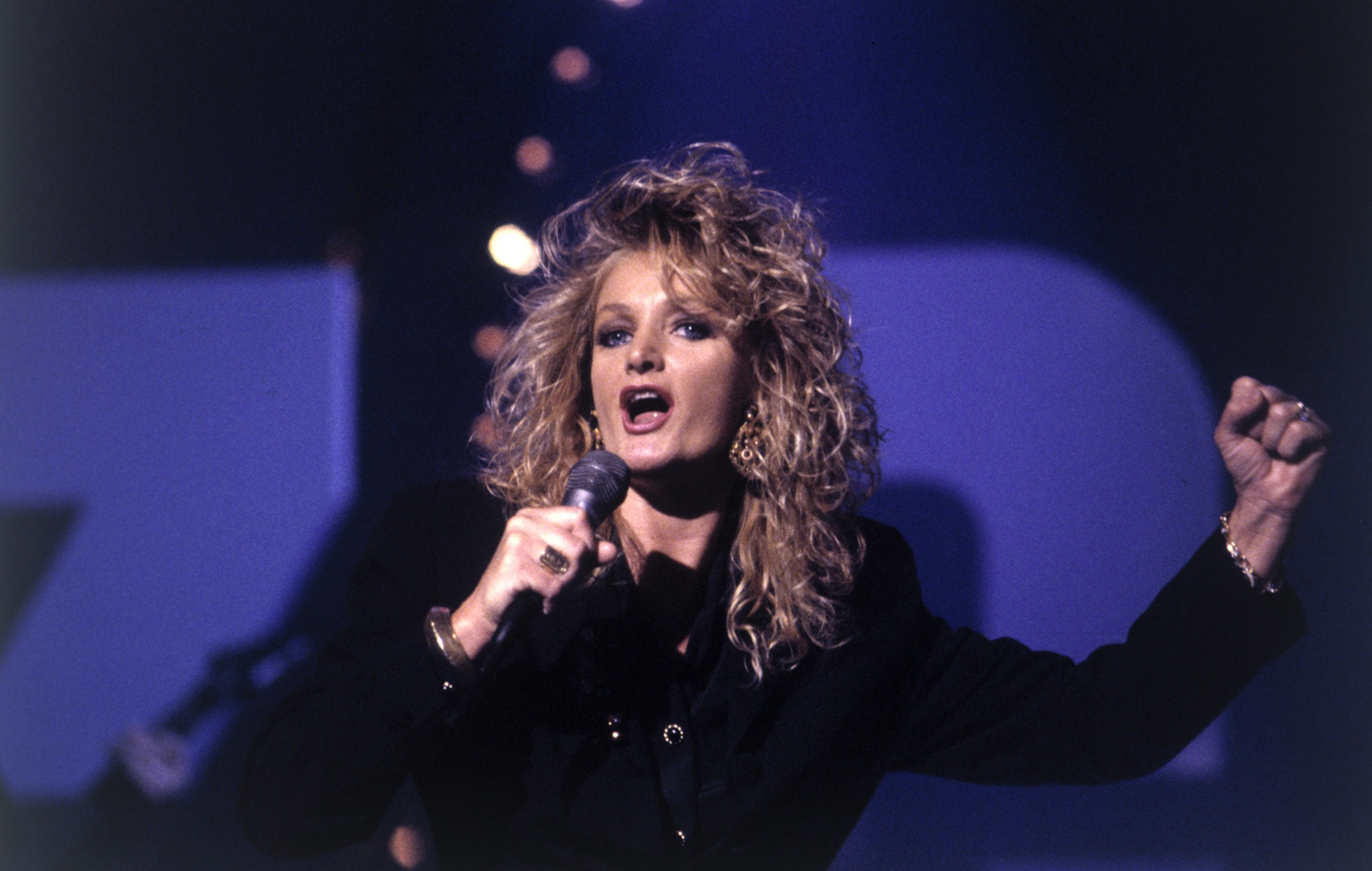
Bonnie Tyler performing at Montreux Rock Festival in Switzerland in 1986. Credit: David Redfern/Redferns/Getty Images
After seven years on the South Wales circuit, she was spotted singing in Swansea by a talent scout, Roger Bell, who invited her to London to cut demos. A major label deal with RCA followed, but only after she changed her stage name to something more marketable. She’d spent her nightclub years performing as Shereen Davis, primarily to avoid confusion with fellow Welsh singer Mary Hopkins, but at this point she restyled herself Bonnie Tyler after sifting through a newspaper for name possibilities.
Her lovely, country-flecked debut single ‘My! My! Honeycomb’ failed to chart in 1976, but she cracked the UK Top Ten with its evocative follow-up, ‘Lost In France’, an affecting vignette about a Brit whose holiday romance grows roots. “And I looked round for a telephone, to say, ‘Baby I won’t be home’,” Tyler sang in a voice that was markedly less raspy than the one she later became known for.
Following the release of her debut album, 1977’s ‘The World Starts Tonight’, Tyler underwent surgery to remove nodules on her vocal cords. When she screamed in frustration during a particularly painful point in her recovery, it permanently altered her vocal tone. “I now sounded like a female Rod Stewart,” Tyler quipped, making a comparison that stuck and always served her well.
Tyler’s new, gravelly voice added grit and drama to her 1977 single ‘It’s A Heartache’, a country lament that became her first success in the US while topping the charts from Australia to Argentina. For several years, Tyler struggled to find an equally undeniable follow-up, though 1979’s campy disco banger ‘(The World Is Full Of) Married Men’ cracked the UK Top 40. Then, after she rode out her RCA deal and signed with another major, CBS, she hit on the ingenious idea to contact Steinman, who had written and produced Meat Loaf’s 1979 rock blockbuster ‘Bat Out of Hell’.
Steinman initially turned her down, but after being won over by Tyler’s rock-oriented demos, he wrote ‘Total Eclipse Of The Heart’, a self-described “Wagnerian-like onslaught of sound and emotion”, as a “showpiece” for her voice. It stormed to Number One in the US and UK and helped Tyler’s fifth album, ‘Faster Than The Speed Of Night’, which mixed Steinman originals with savvy cover versions, to become the most successful of her career. In 1984, she was nominated for a BRIT Award and two Grammys.
That year, Steinman supplied Tyler with her second signature hit, the gloriously overwrought barnstormer ‘Holding Out For A Hero’, which she recorded for the movie Footloose. If Tyler’s rasp was her trademark, this synthy hit highlighted her secret weapon: a winning sincerity that could sell lyrics like “it’s gonna take a Superman to sweep me off my feet“. In reality, Tyler and Robert Sullivan, her husband of 53 years who survives her, were a tight-knit team who enjoyed a comfortable life in South Wales and the Algarve region of Portugal, where she died after a spell in hospital.
Bonnie Tyler performing in Madrid. Spain in 2024. Credit: Aldara Zarraoa/Redferns/Getty Images
Thereafter, Tyler’s albums tended to sell better in Europe than her native UK – 1991’s slick pop-rock collection ‘Bitterblue’ topped the Austrian charts – but she was too game and memorable to surrender the spotlight. In 2003, she reimagined ‘Total Eclipse Of The Heart’ as a vaguely bilingual duet with French singer Kareen Antonn: ‘Si Demain… (Turn Around)’ duly topped the charts in France, proving that it’s always possible to make a ludicrous song slightly more ludicrous.
Then in 2013, she agreed to represent the UK at Eurovision with the wistful toe-tapper ‘Believe In Me’, which finished in a disappointing though not disastrous 19th position. A lesser singer could have been eclipsed by her biggest hit, but Bonnie Tyler was too distinctive, both in her gravelly vocal style and glamorous yet grounded persona, to let this happen. Her 18th and final album, released 2021, was titled ‘The Best Is Yet To Come’; as she liked to point out in interviews, she was a “working-class girl who never stopped working”. Sleep well, bright eyes.
The post Bonnie Tyler, 1951–2026: raspy-voiced Welshwoman who captured “what rock’n’roll is all about” appeared first on NME.