
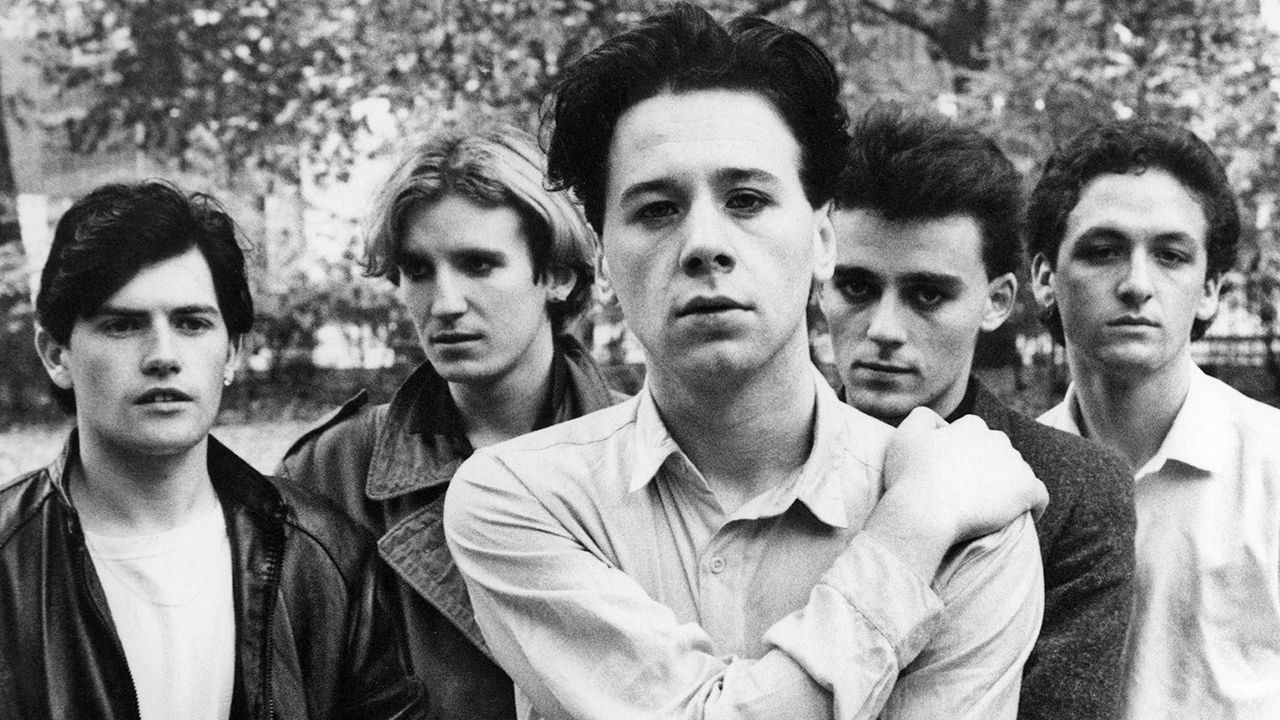
For many, they’re forever tied to the shallow sheen of 80s arena rock and The Breakfast Club – but they had an inventive side waiting to be discovered. In 2012 we asked: how prog were Simple Minds?
They may have emerged during a period synonymous with synthpop and the New Romantics, but Simple Minds have always possessed serious prog credentials. Early reviews made great play of their use of keyboards – verboten after punk – with many in the music press suggesting they had more in common with the prog brigade than they did the spiky-topped hordes.
They toured with Peter Gabriel in 1980, at the ex Genesis singer’s invitation, and later recorded a version of his song Biko. Their first three albums were produced by John Leckie, tape operator on Syd Barrett’s Barrett and balance engineer on Pink Floyd’s Meddle and Wish You Were Here. Their fourth and fifth albums – originally conceived as a double – were produced by Steve Hillage, bearded member of pothead pixies Gong and a man known for his noodling guitar work and penchant for wearing a tea cosy for a hat.
And that’s without mentioning the latterday Minds, aka the mullet years, when frontman Jim Kerr assumed the persona of a seer and the music became even more marked by ostentation and pomp. Some have even drawn parallels between their 1989’s Belfast Child and Dave Gilmour-era Pink Floyd. How prog were Simple Minds? Very prog.
“Were people surprised when I got involved?” wonders Hillage of producing Sons And Fascination and Sister Feelings Call in 1981. “No. It made sense for them and it made sense for me. One thing we had in common was a shared love of German psychedelic music – bands like Neu! and Can, with a side order of Kraftwerk.”
Had he been listening to Simple Minds prior to working with them? “Yeah, I’d been following them,” he says. “I was particularly into [third album] Empires And Dance and tracks like Celebrate. I’d heard them being played in clubs but I didn’t actually get to see them live until March 1981 when I saw them play Tiffany’s in Glasgow. I thought they were brilliant – an interesting combination of rock and trance and this dark futuristic thing.”
Could they, with their keyboards-dominated sound, have existed a decade earlier, during the prog age? “It wasn’t like a Rick Wakeman or Keith Emerson style of keyboards, Mick MacNeil’s background was in traditional Scottish bands and he created these original lines that made his synths sound like bagpipes. He did pioneering work with sequencers and arpeggiators. There was maybe a Pink Floyd element to what he did, but it was a lot more like Giorgio Moroder or Chic.
“Promised You A Miracle [their 1982 breakthrough single] was more influenced by Diana Ross’ Upside Down [written by Chic] than anyone prog. I’d say their prog tendencies became apparent through their love of Genesis – Abacab was a favourite when I worked with them – and of Peter Gabriel. That said, considering they started out as a punk band in the wonderfully named Johnny & The Self Abusers, musicianship was a thing they were proud to have as a frontline quality.”
Jim Kerr remembers growing up in Glasgow in the early 70s with prog bands forming a crucial part of his soundtrack. “[Guitarist] Charlie Burchill and I lived in the same street on a housing estate. We lived in a tower block and for some reason our flat was the one where everyone listened to music. I had a lot of older friends, and through them I got into Genesis, Yes and Van der Graaf Generator.
“A playlist for a typical night would include Yessongs, Jethro Tull, Stooges, Stevie Wonder and Van der Graaf – but bigger than all of them would be Hawkwind. They were a cosmic biker band; the missing link between hippie, prog and punk.
“I saw Yes on the Yessongs tour. I didn’t relate to them emotionally, but I did when I saw Gabriel with Genesis doing Foxtrot. He had a Clockwork Orange, Malcolm McDowell edge, whereas Yes – I loved the bass and the rhythms, but once Wakeman started going off his head on all that classical stuff, I couldn’t relate to that.”
Kerr’s immersion in the records of Genesis, Kevin Ayers, Roy Harper and Pink Floyd gives the lie to the idea that those bands made music for prissy middle-class students. It was a soundtrack to working-class life. “Well, there was fuck-all else,” argues Kerr. “This was before punk, and the only bands coming to town to play gigs were people like Ayers and Harper and Genesis. It appealed to me: they were inventing their own world.”
It was clear soon after forming Johnny & The Self Abusers in 1977 that Kerr would incorporate what he’d learned from prog and Krautrock musicians, as well as from David Bowie and Brian Eno’s work in Berlin and the proto-electro of Moroder. The sudden availability of cheap synthesisers made the switch to a more electronic approach inevitable.
Hillage describes Simple Minds as the “the fulcrum” – of prog, post-punk, funk, synthpop, electronica and art rock. “I think the blend was pretty equal,” Kerr reflects, “especially after Mel Gaynor [drums] joined in 1982. He could be as heavy as John Bonham, but he could groove like hell.”
Simple Minds’ use of prog keyboard textures on their first two albums, Life In A Day and Real To Real Cacophony, both 1979, wasn’t entirely unique. There were other punk and post-punk bands moving in that direction, such as Wire, XTC and Magazine. In fact, Simple Minds would sign to Virgin and chose Leckie as studio collaborator because that was XTC and Magazine’s label and he was their producer. And yet there was some residual embarrassment about the path they were pursuing.
“In our first interview with NME we uttered the word ‘Genesis’ and I remember thinking, ‘What did we say that for?’” he laughs. “But Magazine were first. When Howard Devoto left Buzzcocks and came back with [Magazine’s debut single] Shot By Both Sides it was like, ‘Fuck, these guys can all play!’ We hadn’t heard keyboard solos since Rick Wakeman. The same goes for XTC. Those bands had great imagination and needed to know how to play, and Simple Minds did as well.”
After what Kerr regards as a disappointing debut album – which he felt was in the shadow of Joy Division’s Unknown Pleasures – came Real To Real Cacophony, a far more successful move towards the sort of Teutonic electro dance music he had in mind. Empires And Dance (1980) was “one last throw of the dice” to achieve a breakthrough. Job done: Gabriel invited the band to support him on tour in Europe… but it wasn’t plain sailing.
“We got slaughtered every night by the audiences,” Kerr recalls. “Mind you, so did Gabriel – there were a lot of Genesis fans out there who didn’t want to hear Games Without Frontiers. But we were growing in stature night by night. We didn’t see Gabriel much – he was in hotels, we were in a van – but just seeing him play was enough. We couldn’t wait for him to get onstage, not just to see him perform but so we could raid his dressing room for food!
“But Peter showed us there was nothing to be afraid of in big venues; that music could get across. That’s what happens when you grow up with Floyd and Yes – you’re not intimidated by size.”
Simple Minds’ music was becoming increasingly trance-like, with repetitive grooves and propulsive electronic rhythms that nodded to the motorik pulse-beats of krautrock. Sessions were narcotically enhanced: “There were a million joints, with Nepalese balls first thing in morning.”
(Image credit: Press)
Viewed from this perspective, there’s a certain logic in the band hooking up for their next recordings with Hillage. In the wake of acid house in the late 80s, Hillage would re-emerged with an ambient techno project, System 7. “We had an image of the pixie hat and that whole thing,” laughs Kerr, “but when we met him he’d changed. He looked like Robert Fripp, with short hair and a suit. We did one track with him, The American, and it was great. We were in sync. He related to our energy; our streetsiness. We were Glasgow housing estate boys – but we had that cosmic thing from the music we grew up with, and he loved it.”
Hillage says the fit between the 60s casualty and Glasgow upstarts was tighter than people imagined. “I was into funk and disco on my late 70s solo albums,” he says. “I wasn’t just doing big guitar solos. So where I was heading and where the Minds were – there wasn’t much of a gulf.”
He remembers the sessions for Sons And Fascination and Sister Feelings Call as “creatively exciting, if sometimes a bit chaotic.” There was, if anything, a surfeit of ideas, hence the two albums. “Right from the beginning I knew they were groundbreaking and important records,” he says. “This was my first major high-profile project, so it was a steep learning curve. But it was a wonderful experience and it helped me sustain my activities as a producer to this day.”
The apotheosis of the Minds’ shimmering neo-prog adventurism was 1982’s New Gold Dream (81-82-83-84), produced by Peter Walsh. Their most experimental effort, complete with quasi-religious cover art, also proved their commercial breakthrough; and along with being a big influence on U2 and their producer Daniel Lanois, it was also popular in prog circles.
“Peter Hamill came to our gigs because he loved what we were doing. So did Dave Gilmour and Phil Collins,” Kerr says proudly. It was a glorious period in British music: you could have a successful album with compositions that, as Kerr puts it, “threw out the rulebook and didn’t give a fuck.”
Although Simple Minds arguably peaked artistically with New Gold Dream, and their halcyon days were the early ones, it was after 1982 that the band became world-beaters, second only to U2 in the stadium behemoth stakes. In the wake of their Live Aid performance and the global success of Don’t You (Forget About Me), the Minds began releasing regular No 1 albums and playing the amphitheatres of their childhood heroes Gabriel, Genesis and Floyd.
But from a prog perspective, the early 80s remain their shining moment. Now they’re about to recreate that moment with Hillage as they work together on their 16th album [Big Music was released in 2014]. Talk about back to the future.
Kerr considers: “The last time we worked with him was in 1981 and Britain was on fire, with riots in Brixton and Toxteth. Lo and behold, for our first sessions [in late summer 2011] all this shit is going on in Tottenham while we work with Hillage on a krautrock riff! Everything changes, everything stays the same!”