
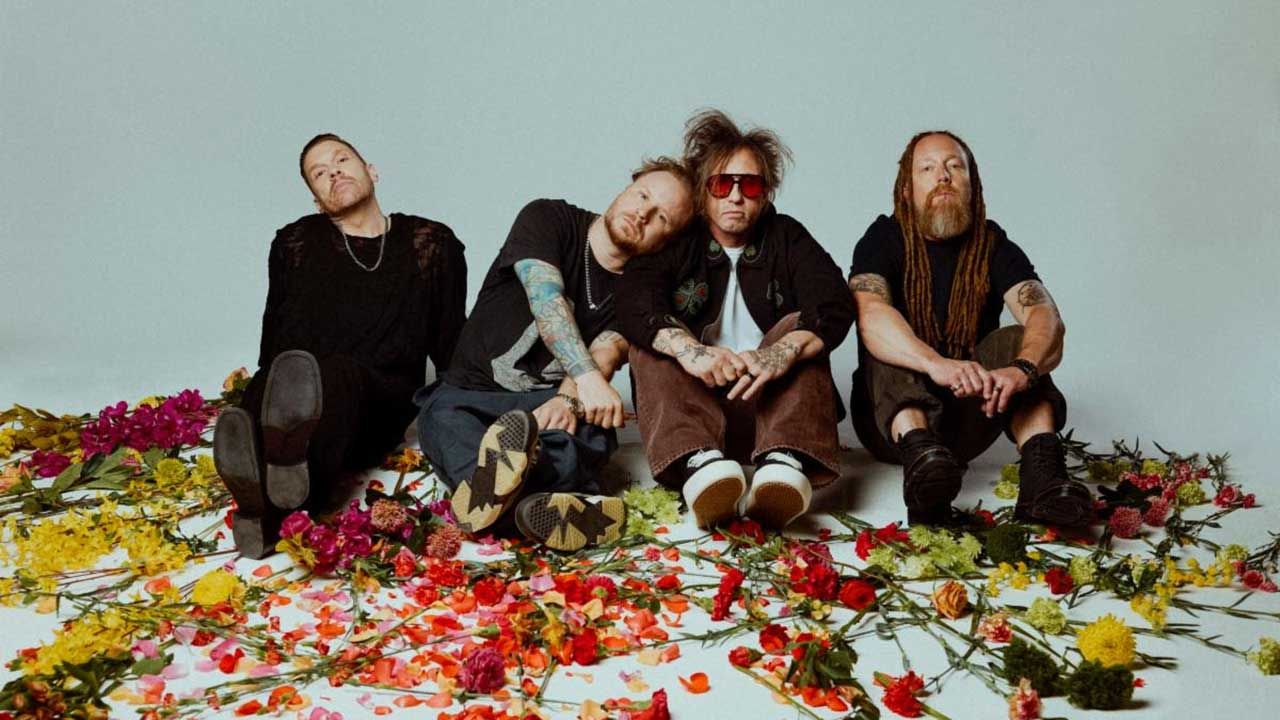
Check Shinedown’s vital signs in 2026, and everything suggests a band in rude health. The Florida alt.rockers have been out there killing it for a quarter of a century. They’re now set to release their eighth album – the cunningly titled EI8HT, loaded with 18 original songs – and surely about to boost their lifetime tally of 22 Billboard chart-topping singles. Contrast that, frontman Brent Smith says with a smile, with the doomy projections and media apathy of the band’s early days.
“Nothing was ever handed to us,” he says. “When we started in 2001, I thought to myself: ‘We’re going to be on MTV and the cover of Rolling Stone.’ That was not the case. Maybe they thought that would make me cower in a corner or give up. It did the opposite. I used it as fuel, man. My job starts when you tell me: ‘No.’”
If you don’t read between the lines (and there’s no pressure to do so; Shinedown have always been a band that are feasible to enjoy through your hair, feet and fists, with your brain as an optional extra), then EI8HT feels like another uncomplicated, escapist, chest-pounding triumph. The long-settled line-up of Smith, guitarist Zach Myers, bassist Eric Bass and drummer Barry Kerch have always been strong on hooks that hit a stadium’s back wall, and that knack is represented on incoming anthems like Dance, Kid, Dance and Burning Down The Disco.
“There’s something about what we do that resonates with people,” the frontman says of Shinedown’s mass appeal Stateside, underlined by record sales of more than 10 million. “I will never, for the life of me, necessarily understand why that is, but I don’t question it. I just hold on tight and ride.”
But the new record’s near-two-year genesis wasn’t necessarily joyous, he counters.
“There is an immense amount of emotional real estate on this album. There’s been a lot of loss in the band. Eric lost his dad and aunt. His wife lost her sister. I lost my granny, my mom. When loved ones pass away, our instinct is to say: ‘I’m so sorry for your loss.’ But a song like Three Six Five is about how they may be physically gone but their spirit will never leave you. It’s not that they’re gone, they’re everywhere. They’ve transcended.”
Meanwhile, the singer adds that it was difficult to stop culture wars, actual wars and big tech dripping into his headspace (while staying discreet on his own political stripes).
“We’re in a situation right now where there’s a lot of people trying to flex their power,” he says. “But you’re never gonna outrun karma. You’re going to pay for it here. Or you’re going to pay for it in the next life. I know some people might look at that and be like: ‘Well what if there’s nothing after this?’ And I just say to them: ‘You’re not gonna get out that easy.’”
All of this context swirled around the band as they set to work in the barn studio on Bass’s South Carolina property.
“Eric is probably a bass player last, more like a Swiss Army knife,” Smith says proudly. “He’s mixed, produced and engineered the last three albums. It’s astonishing to watch this man work. You’re talking eighteen-hour days, no sleep, months at a time. He’s a mad scientist. You don’t know which Eric you’re gonna get on any given day.
“There’s a little bit of One Flew Over The Cuckoo’s Nest. The studio looks all nice and put together, but then you leave for twenty-four hours, come back, and it’s like a tornado hit it. He’s pulling out pedals, keyboards, stuff you didn’t even know he had. He’s searching for something, going down the rabbit hole…”
EI8HT doesn’t sound over-produced, though? Smith shakes his head.
“Everybody had to play through all the songs; we didn’t want cut ’n’ paste or computer surgery. It’s just gonna sound robotic. We might as well be an AI band if we do that. So we doubled down. When you open up the record case, there’s a stamp we created that says: ‘100% human – no AI used in the making of this record’. Y’know, like Rage Against The Machine wrote back in the day: ‘All sounds made by guitar, bass, drums and vocals’.”
It doesn’t take much of a nudge of Smith for him to let rip at Silicon Valley.
“Developers of AI in the music sphere think people are sheep, and they’re finding out they’re not. They’re like: ‘This is the way of the future and everybody’s gonna listen to robots.’ And it’s like: ‘Yeah, man, nobody likes it.’ AI music is a novelty at best. And I may get some hate for this. But I don’t care.
“Because here’s the reality: there is something about when you put human beings in a room and they start pushing air. You’re never gonna replace drums, bass, guitar, badass vocals and a killer song. And by the way, I need to remind people of something about AI: you can always go over to the wall and unplug it.”
Brent Smith (Image credit: Ebru Yildiz)
Rant over, he gets back to EI8HT.
“I guess you could say we were a bit Buddhist, philosophy-wise, on this record. Buddhists believe you should leave imperfection in art. That you’ve lost the humanity if you make it perfect.”
Shinedown are big on humanity. Powered by an eerie, electro-rock pulse with shades of Depeche Mode, Imposter finds Smith questioning why modern teenagers seek to numb themselves (“I’ve met so many young people over our career. You’ll be talking to a fourteen-year-old who’s addicted to drugs, y’know?”).
Machine Gun’s driving pop-punk gives a voice to his and Bass’s grandfathers in WWII. “They both had a similar story. They called out to the universe, like: ‘I’ll do my duty and complete the mission, but if you can get me out of this mess and back to the woman I love, I’ll be a good man.’ We wrote it from the position of what they were going through in the trenches. So that’s where that line ‘Instead of you, I’m holding a machine gun’ comes from. Both of them survived, and when they got home the first thing they did was marry their significant other, our grandmothers.”
Other songs seem to pull 48-year-old Smith himself back to a simpler time. On the edgy, cinematic Deep End, he explains: “I’m transported back to opening night at the movie theatre, Brandon Lee in The Crow [1994]”. The hazy, golden swirl of Young Again reconnects with his childhood as a “handful, a troublemaker, growing up in the eighties, before cell phones, when you could just take off and you were gone, man”
Eric Bass (2009), Barry Kerch (2012) and Zach Myers (2009) onstage (Image credit: Eric Bass, Zach Myers : Barry Brecheisen/WireImage | Barry Kerch: Chelsea Lauren/FilmMagic)
Smith’s Southern roots, meanwhile, are saluted subtly in the music.
“Searchlight is dipping a toe into country. That song reminded me of growing up in East Tennessee. I sang it with a different conviction to songs like Back To The Living, which is more soulful. I’m singing a bit more from my roots – R&B, Otis Redding, Billie Holiday, Al Green, Sam Cooke, Etta James…”
Perhaps. But as if to reaffirm their early alt.metal piss and vinegar, there’s also the seething Safe And Sound.
“Some comments are like: ‘I didn’t know they still had this in them.’ Which I find interesting,” Smith says of the fan response. “Some of them are like: ‘I thought Shinedown were a pop band.’ And then other people are like: ‘I thought they were more of a metal band’ Or: ‘I thought they were an alt. band.’ Here’s the reality of it: Shinedown is everyone’s band.”
Dizzy might prick up your ears too. The singer bills the wistful-slash-euphoric anthem as a salute to a lifelong comrade (“It’s about your best friend, your ride-or-die”). But lines like ‘I swear I didn’t smoke and I’m off the wine’ will remind long-term fans of Smith’s unravelling in the early post-millennium. He has said cocaine, alcohol and opioid painkiller OxyContin were all dark backdrops to 2003’s Leave A Whisper and 2005’s Us And Them.
“Why did it call to me?” he wonders out loud. “Because it felt good. It wasn’t about wanting to be inspired or be creative or anything. I did it because I was curious. And when I did it, I found: ‘Oh, this makes me feel good. I wonder what that will make me feel like.’”
Shinedown are such a tight unit. How did your bandmates deal with your addictions?
“They saved my life. Without question. They never judged me. I’ll never forget Barry looking at me at my lowest and him being like: ‘Dude, I’m not a cop. I’m not here to arrest you or take you in. I just don’t want to watch you die. Please, whatever I got to do, man, I’ll do it. Just don’t leave me. Don’t leave us. We have no idea why you’re torturing yourself like this, but please, you have to stop.’”
Smith credits his then-newborn son (now 18) for the decisive push towards sobriety. “I’d just turned thirty, and that’s when I realised it was no longer about me. Like, I’m no good to this child if I’m dead. We don’t know when it’s our time. I could have a freak accident, act of God, whatever. But I do have control of whether I’m gonna do that line, drink that bottle, smoke that rock. I do have a choice in regards to that. I can stop that.”
Smith piled on the weight when he kicked his habit (in an interview with the LA Times, he recalled his heart “falling on the floor” when, during a 2009 performance on Today, the show’s hosts likened his appearance to Meat Loaf). These days the singer looks sharp and battle-ready.
“I’ll be transparent,’ he says. “I had to change my lifestyle about a decade ago, because I just wasn’t going to be able to keep up with the way I wanted to be on stage. I did a lot of research about diet, nutrition, exercise, supplementation, all these different things where people are like: ‘Oh, it’s all hocus pocus.’ I just recently started doing yoga four days a week. Back in the day, people were like [rolls eyes]. But when you start getting older, the most crucial thing you need to be is flexible. You have to work that shit out, dude. You can’t be stagnant.”
Outwardly, Smith is a machine. But has he buried that troubled individual for good?
“Oh, he’s with me every single day,” he says. “I’m not talking about schizophrenia. But I am, and forever will be, an addict and an alcoholic. He’s in here [taps head]. He’s very, very far in the back of my subconscious. But there are days I wake up that he can get loud, and I have to tell him: ‘Not today, man.’ That’s the only thing in my life that I have to do one day at a time. I have to remember: ‘I didn’t do drugs today, I didn’t drink today. But I have no idea what I’ll do tomorrow.’ So it’s never like: ‘I’m good. I can forget about it.’ Because at any given moment he could pick the lock and get out of the cage.”
Right now, with a killer new album in the can and November’s UK arena dates testament to a band making steady inroads overseas, you’d bet on Smith’s Dr Jekyll winning out over his Mr Hyde.
“I’m not surprised we’ve made it to an eighth album, but I’m very grateful,” he says. “And there’s a statement I keep in the front of my mind. In my worst throes of addiction, I had a friend of mine tell me: ‘Dude, you focus on wanting to be this hardcore individual, on wanting to be punk-rock. But that other guy. He’s not trying to have fun with you, he’s trying to end you. And I’m telling you right now, man, when you’re clean, sober and locked in, that’s when you’re at your most dangerous.’”
EI8HT is out now on Atlantic Records.