
In 2001, this writer joined Deftones for two Spanish dates in support of their album, White Pony. As winners of a shiny new Grammy and a busy touring schedule to look forward to, life was good for the Sacramento five-piece. Well, more or less…
“One of the first shows I went to was Depeche Mode, on the Violator tour,” says Deftones vocalist Chino Moreno. ”I was only 14, but at that age gigs are overwhelming.”
We’re sitting in an ice-cold dressing room in the Polideportivo Anoeta venue in San Sebastián, a city on the coast of Northern Spain. Either the heating is broken or the building is staffed entirely by tauntauns. Shorts were a bad idea.
This evening, Deftones – Stephen Carpenter (guitar), Chi Cheng (bass), Abe Cunningham (drums) and Frank Delgado (turntables) – will play before a few thousand fans on the fourth European date of their Back to School tour. That’s all to come, but right now, the only thing on Moreno’s mind is how Basildon’s most famous sons impacted his life.
“Dave Gahan was bigger than life and captivated the crowd and the way he held himself onstage was mind-blowing,” he continues. “I think I was influenced by his persona – not so much his movement – but the way he made audiences think he was suave and cool at the same time. I want to convey that emotion.”
It wasn’t just electro-pop bands that caught the teenage Moreno’s attention. Nosey neighbours may have caught him aping the gladioli-waving, hearing-aid-sporting vocalist Morrissey on the steps of his home.
“I used to hold a broom handle like a microphone stand and sing songs by The Smiths,” he admits. “I did Shoplifters Of The World Unite and other Smiths stuff. I wouldn’t actually sing them because I had my headphones on, but I’d pretend I was Morrissey. That’s the beauty of being onstage now – I can appreciate what the crowd must feel, because I felt that too.”
Let’s go back 24 hours or so. The band have just checked out of their hotel in Madrid and are making their way to their tour bus. It’s a short hop to La Riviera, the venue for tonight’s show. Capacity: 2,500.
(Image credit: Peter Pakvis/Redferns)
While having a mooch around their plush tour bus, it’s easy to see why bands – and our hosts in particular – will kill time with some pot, a few beers and some more pot. There’s also a library of films to watch: GI Jane, Mission: Impossible, Days of Thunder and every movie Will Smith has ever made.
“It’s always the same shit,” says the singer, with a hint of disdain. “Every bus in Europe has the same shit. Will Smith’s movies, too. People must think he’s cool shit or something. I just cannot stand his shitty movies. I hate them.”
“I like them,” says Carpenter, pointedly ignoring his friend and taking a drag on his spliff. “Doesn’t matter to me anyway.”
Moreno doesn’t hate everything Will Smith has done. His mood lightens when he talks about Smith’s ’90s sitcom The Fresh Prince Of Bel-Air.
“That was the cool shit,” he says. “Carlton was funny. He just wanted to be English so bad. I mean, he wore a necktie.”
As we arrive at La Riviera, it begins to rain on the early bird fans who’ve queued along the driveway since breakfast. Once indoors, the band dump their bags and feast on noodles and chicken satay. It’s good stuff and a far cry from the food they’d eat while living hand-to-mouth on tour.
“We used to get a $5 per diem on tour, and I always used to go to this place that you could get a burrito for a buck,” says Carpenter. “I’d get two of those and a 40oz bottle of beer and make that last all day. It’s all I’d eat. Burrito and beer before the show and a burrito after the show. We did that for a long time. We had it bad.”
He pushes the remaining food around on his plate, before adding: “On one tour, all we’d eat were ramen noodles and get headaches from eating them so much.”
And how is today’s freshly-prepared lunch?
“The food in Europe sucks,” he shrugs. “Especially when you’ve got Mad Cow disease and Foot and Mouth disease. That shit is non-stop. If I have to eat bread, butter or cheese again, I’ll go crazy. I can’t believe that there’s no Taco Bell restaurants in Europe. We’d have Mexican food every day.”
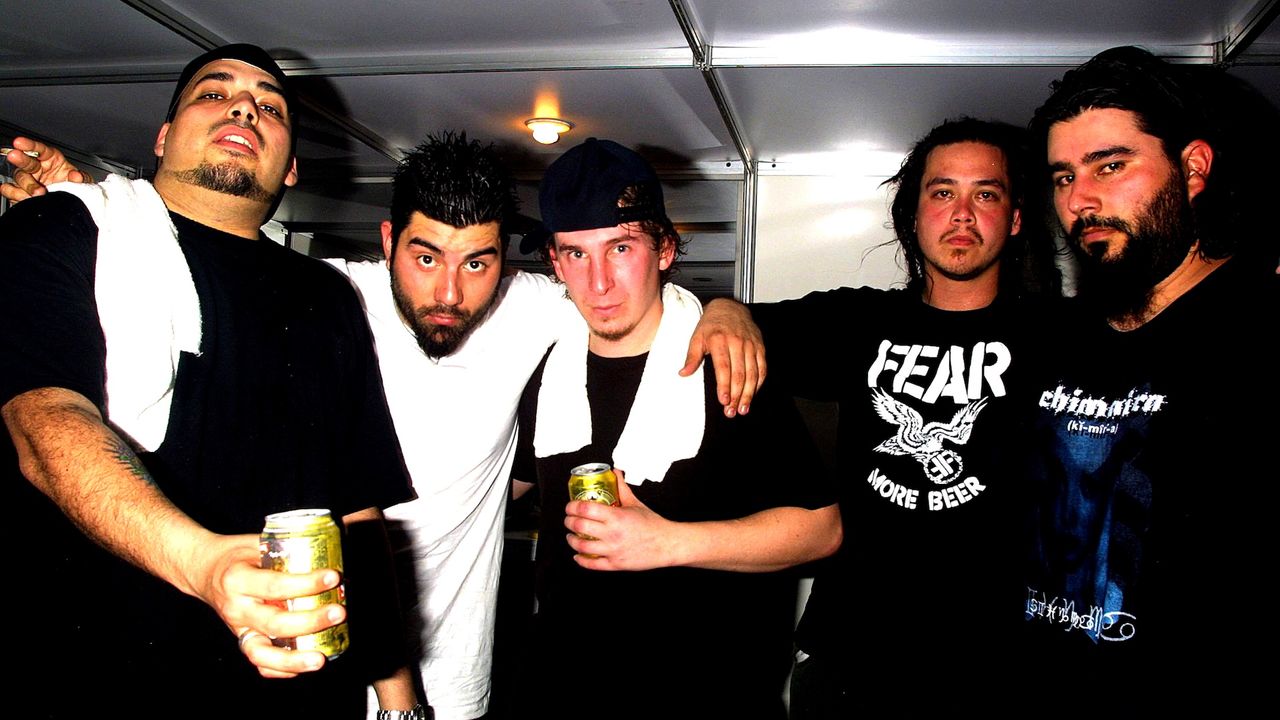
Deftones circa 2001 (Image credit: Christina Radish/Redferns)
Following their meal – which was delicious, actually – the band attend to the first real business of the day: soundcheck.
The scene where Spinal Tap get hopelessly trapped in a maze of Cleveland corridors may as well have been set in this huge building. After getting our bearings, we find our way into the main room, which looks like the set of The Flintstones. The darkened, dome-shaped room is decorated with boulders, palm trees and small fountains, but this moment of spa-like tranquillity is shattered by Carpenter sound-checking his rig.
Before the doors open, Moreno walks off to do the first of many interviews about their latest album White Pony. But first things first, though, as he gets a little marijuana from his guitarist. His first interviewer, a feisty lad from Spanish telly, is quickly placated by the herb’s sweet, potent smell.
Along the corridor is Chi Cheng, quietly chatting to a member of their crew about the logistics of tonight’s show. He often runs his hands over his cropped hair. In the name of journalism, I needed to know more.
I cut my hair short because I heard Metallica were auditioning for bass players. They still didn’t give me the gig.
Chi Cheng
When asked why exactly he cut his long dreadlocks off, he replies quietly: “Personal reasons. I’ve had long hair longer than most of our fans have been alive. 16 years! I just needed a change.”
He waits a moment and grins.
“I cut my hair short because I heard Metallica were auditioning for bass players,” he deadpans. “They still didn’t give me the gig. And Rage Against The Machine didn’t like the way I sang, so no chance there either.”
While the band are on something of a successful streak – picking up a Grammy for ‘Best Metal Performance’ for Elite – the band are keen to distance themselves from the nu metal label. It’s odd, given it’s a genre that they helped birth with Korn.
“I knew that both our bands were doing shit that had never been heard before,” says Moreno, returning from his Spanish press duties for the day. “You could see it in people’s faces when we played shows like that. You’d stare at the crowd and people were in awe of Korn. I certainly felt it the first time we saw them play.”
“One of our first shows with them was a club in Los Angeles called The Dragonfly,” he remembers. “I never knew what they looked like. We were unloading our gear and me and Steph were arguing outside of the club and I went to throw my skateboard at him as hard as I could. I didn’t realise that Jonathan (Davis, Korn frontman) was standing watching us at the time. He said that was his first memory of me. He said, ‘I thought you were a mean motherfucker!’.”
What were your first impressions of Korn?
“They were so intense, man,” he remembers. “I couldn’t believe it, because Jonathan was really quiet all day and was just sitting on his own, twisting his dreads. They had a force I can’t even begin to describe.”
Cheng says that their formative years were especially tough. Long before Deftones experienced their first flush of success, their typical audience would be two men and a dog called Juan.
“Well, Juan supported us from the start and helped sell merchandise,” laughs the bassist. “The two guys bothered me a lot, but that dog, man, he was cool. I think the energy that you put into a show should be the same, whether it’s in front of that dog or a few thousand people. It should affect you one way or another. If you can make the dog’s concert-going experience feel special, then that’s what matters.”
Deftones with their Grammy for Best Metal Performance backstage at the 43rd Annual Grammy Awards at Staples Center in Los Angeles on February 21, 2001. (Image credit: Scott Gries/ImageDirect)
The influence of Deftones’ 1995 Adrenaline debut – together with Korn’s self-titled album – runs through the DNA of many new bands today.
“I had an inkling when all these bands starting popping up doing what we were doing, we were onto something,” says the bassist. “I take it as a compliment that people dug what we did. I could choose to hate bands who copy what we do, but I choose not to because it’s cool. I embrace it.”
Several hours go by and one-by-one, the band begin to change into sports gear. Don’t worry, they’re not about to unveil a new Nike-rock look before their Spanish fans this evening. They’re actually preparing for a quick workout with Mike Heatlie, the short-but-tough personal trainer who has been employed to help keep them fit on this European run of shows. The band do look fitter, but that’s not to say that they’re all ecstatic with their new exercise regimen. Cunningham, for example, has the look of a broken man.
“Mike’s been keeping us in shape, but last night he took away our beer,” says the drummer. ”So we have five or six cases of beer a night that are remaining unopened. It sucks.”
While his bandmates are put through their paces by their personal trainer, Chino – back in his baggy jeans and a crisp white t-shirt – relaxes and looks back on the band’s early shows in the Sacramento area.
“They were insane,” he smiles. “People didn’t get what we were doing, but by the time we’d finished, they dug us, you know what I’m saying? But as for this fitness shit, when I first started singing for the Deftones, I was this 150-pound, wiry bastard who threw himself all over the stage. We’re getting older and it’s harder to maintain that energy as much, but the attitude is still there, I think.”
“We are feeling more energetic these days,” he adds. “It doesn’t come easy, that’s all.”
When I first started singing for the Deftones, I was this 150-pound, wiry bastard who threw himself all over the stage.
Chino Moreno
The crew have completed the change over from their support act, Linkin Park, and their tour manager pokes his head around the door and says it’s time to play. The stage is a short walk away from their dressing room and they’re already a few bars into opener Engine No. 9 before you can say “cerveza”.
Their set is a carefully curated mix of songs from their three albums, front-loaded with songs that ensure the venue’s barrier security are busy for much of the set: My Own Summer (Shove It), Be Quiet and Drive (Far Away), Around The Fur, and Feiticeira. The pace and power don’t let up until they begin Teenager, a delicate White Pony track which allows Cunningham and Cheng a few minutes to take a breather and crack open a beer.
The artwork for Deftones’ 2000 album White Pony (Image credit: Maverick)
“This is a chance to get drunk,” gasps Cheng. “Or at least cool down for a minute.”
The show ends with the volatile power of 7 Words, which includes snippets of Weezer’s Say It Ain’t So and Undone – The Sweater Song. By the time the band make their way into their dressing room, Chino looks absolutely spent. They’ve got an overnight drive to San Sebastián, which will take around four to five hours. At least they’ve got somewhere to sleep and a driver, which is a lot more than they had in the past.
“We’d battle to stay awake,” laughs Cheng. “The trick was to get as drunk as you could straight after the show, so you wouldn’t be able to drive. Everyone just wanted to sleep after we’d played. It’s gotten a hell of a lot easier.”
Can I shock you? Deftones aren’t what you’d call morning people. Or lunchtime people. It’s four in the afternoon and the sun is absolutely beating down outside today’s venue, the Polideportivo Anoeta. Some of the band have only just got up and have made the vaguest of plans to get moving.
Moreno is sleepy and has no plans to explore the coastal city. He casually reveals that he was the victim of a robbery last night.
“Someone stole my belt – as I was wearing it, too,” he says incredulously. “They know I’ve got a problem keeping my pants up as it is. I had to borrow a belt buckle.”
Carpenter appears from out of nowhere and begins to laugh at his bandmate’s bad luck.
“It happens a lot – the punters keep stealing Chino’s clothes,” he chuckles, then pauses with mock seriousness. “That’s fucking rude.”
Carpenter laughs.
“I would never go into the crowd and just take someone’s shit,” counters Moreno. “I understand if they want something of mine as a memento…”
Carpenter laughs some more.
The tension between Moreno and Carpenter is palpable. Their creative friction loomed large in the studio while making White Pony, and they’ve clearly checked it with their luggage at LAX and brought it all the way to Europe.
In the red corner, and standing at six feet tall in his socks, is Camillo Wong Moreno. Offstage, he appears shy yet laid back. In the blue corner, we have Stephen Carpenter, height unknown. Judging by our recent interactions, he’s a man who treats interviews with the enthusiasm of someone cleaning up cat vomit. He also has a confident manner and a sense of humour that could rub certain people up the wrong way (certain people, in this case, who may have been the victim of a belt theft).
If a grudge is going to escalate, you might as well sock each other out and get it over with.
Chi Cheng
“We still fight now,” says Moreno. “But man, we used to fight a lot when we first started. Over the silliest shit, too. Once, somebody threw a toilet roll on the stage and I think the idea was for it to unravel mid-air. It didn’t do that though. It ended up smacking me right in the middle of the face. It hurt, man. When I came offstage, I was so pissed off, and Stephen was just laughing at me the whole time. I mean, I’d be the same in a similar situation. But he turned his video camera on me and I just went for him.”
As for bassist Cheng, a man who pummels his bass like it was caught breaking into his home, radiates an air of calm offstage. He explains that the band have an easy method when it comes to dealing with intra-band tensions.
“If a grudge is going to escalate, you might as well sock each other out and get it over with,” he explains. “But that’s not to say if someone’s having problems on the road, we’ll ignore him. We want that son of a bitch to really hurt so we make it worse for him. Saying that, we’re a pretty good support system. We’re like brothers.”
Frank Delgado, on the other hand, is quieter than a church mouse. The DJ joined the Deftones full-time after the recording of Around the Fur, and as a result, he’s nowhere near as jaded when it comes to touring.
“From what I’ve learned, touring can either kill you or you can turn it to your advantage,” he offers between drags on a cigarette. “Right now, I’m stuck in-between.”
To stay sane on the road, Delgado is something of a culture vulture and will make a point of seeing the sights in every city they pass through.
“I like to stay fit, too,” he adds. “If I was at home, I’d just be flipping through the channels on TV. But we normally kill time by drinking beer and smoking hash. We’ve been watching a lot of Ali G, too. He’s funny, man.”
Hash consumption is a Deftones’ ritual. Carpenter points out that it’s merely something to do to pass the time.
“Bands who are on the road do drugs,” he shrugs. “What else is there to do? Sit around and read a book? That’s boring.”
“How about getting high and reading a book?” asks Moreno.
Bands who are on the road do drugs. What else is there to do? Sit around and read a book? That’s boring.
Stephen Carpenter
“When you get high, you want to go put some music on and go to sleep,” Carpenter responds. “Who’d reach for a book? If that sounds bad, don’t pay any attention to it, because we like to talk a lot of shit.”
Pre-show, there’s a party-like atmosphere in their dressing room. Cunningham – who’s customised his t-shirt with ‘80s-style scissored side vents – high-fives his bandmates and crew, while treating everyone to ‘Faderade’ cocktails – that’s Gatorade and vodka, if you’re not into mixology. The dressing room stereo blasts out the anthem Sister Christian by AOR titans Night Ranger. The vibe is immaculate.
“I think people have a misconception about what life on the road is really like,” says Cheng over the music and chatter. “But it’s the same as any occupational life. You can choose to enjoy it or you can choose to not enjoy it. We do both, at times. And at the moment, we’re having an absolute blast.”