
No truth shall outlive what my doctrine suppresses,
I am the king and the world is my chess.
Power prefers a board to play its game. From a throne, people become pieces, borders become squares, and death becomes strategy. The tyrant’s fantasy is to see the world from above, where lives can be moved, exchanged, or sacrificed without consequence. Yet every game contains the possibility of reversal: the pieces may recognize the hand directing them, and the king may discover that control was only ever temporary.
Ony Godfrey stages that fantasy as an ornate nightmare in The World Is My Chess. The Chinese-Indonesian artist’s new single formally introduces what Godfrey calls Baroque Synthpop: a collision of modern electronic pop and Baroque composition that recalls Falco’s imperious theatricality while drawing explicitly from the gothic, aristocratic language of Visual Kei.
And with any song daring to declare itself Baroque, the harpsichord does not sit politely at the edge of the production. It provides the song’s gilded architecture, its sharp notes circling gothic organ tones, dramatic synthesizers, and a rigid electronic pulse. Ornate melodic turns recall the harmonic movement of Baroque composition, while Japanese pop-inspired chord changes give the song an immediate, sweeping sense of drama.
Godfrey’s vocal performance occupies the space between pop hook, royal proclamation, and theatrical monologue. Each verse tightens the ruler’s grip, building toward a chorus that presents humanity as a collection of expendable pieces. The result is regal without sounding refined, grand without offering comfort: palace music for a regime already beginning to rot from within.
At the center of The World Is My Chess stands a corrupt king who turns devotion, propaganda, fear, and violence into instruments of rule. Truth is suppressed because thought itself presents a threat; loyalty is manufactured through spectacle; and human beings matter only according to their usefulness on the board.
Rather than celebrating the fantasy of absolute power, the song follows it toward self-destruction. The king’s obsession with control gradually produces the conditions of revolt. Everybody sacrificed to preserve the crown becomes another ghost surrounding it, while paranoia transforms the ruler’s gilded state into a prison of suspicion.
“This song is a continuation of my activism for the proletariat liberation and also the beginning of my new musical and visual direction,” Godfrey says.
That direction draws from the theatrical elegance of Visual Kei artists such as Malice Mizer and Kaya, alongside the intricate structures and dramatic harmonic movement of Johann Sebastian Bach. Godfrey does not treat those influences as opposing histories. Classical grandeur and electronic pop become parts of the same spectacle, each capable of expressing beauty, vanity, violence, and decay.
The accompanying video opens beneath the glow of a crystal chandelier before descending into a feverish royal pageant. A helmeted knight charges through a spectral landscape, pieces gather across a chessboard, and distant castles rise through mist and digital distortion. These images establish a kingdom governed as much by fantasy as force.
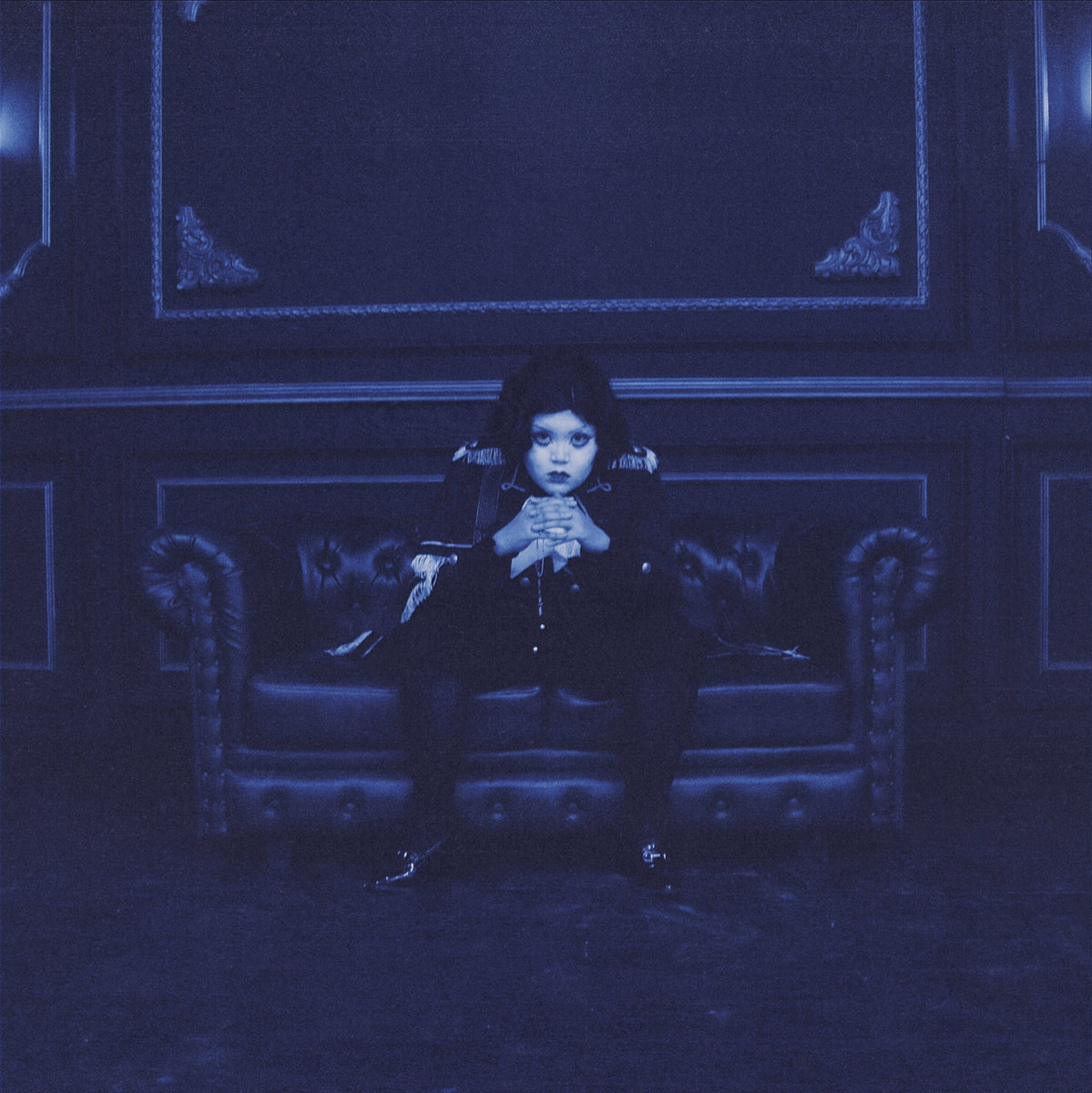
Godfrey embodies its ruler inside a dark, wood-panelled chamber, dressed in a black military-style coat with gold epaulettes and a severe white cravat. Porcelain makeup and dramatically extended black eyes transform the face into an aristocratic mask. Seated in an ornate chair or standing to issue commands toward the camera, Godfrey plays the monarch as someone who has mistaken performance for divinity.
The clip’s Tanbi Kei influence is evident in its emphasis on cultivated beauty, elaborate costume, and aristocratic theatricality. But the elegance never appears stable. Ghosted exposures split Godfrey into several competing figures, animation scratches across the image, and sudden floods of light make the chamber feel as though it is being consumed from within.
Chess pieces recur as instruments of command and omens of collapse. They advance beneath disembodied hands, appear against towering architecture, and eventually stand before fire. Castles, courtly figures, and burning tableaux flicker through degraded textures like fragments recovered from the ruins of an empire.
As the song approaches its final move, the king’s composure begins to falter. The gestures remain imperious, but the shadows grow heavier and the surrounding imagery less obedient. The board no longer resembles a system under perfect control; it has become a record of every life displaced to sustain the throne.
The video was produced through Static Studio, founded by Godfrey’s former Camlann bandmate Fauzan Pratama. Pratama handled editing and animation with assistance from former Camlann videographer Hanan Bagas, bringing the song’s collision of monarchical grandeur, digital instability, and political collapse into visual form.
The collaboration marks a creative reunion while establishing a markedly different world from the artists’ earlier work together. Here, Visual Kei pageantry, classical symbolism, revolutionary politics, and modern electronic production are arranged as parts of a single theatrical manifesto.
Watch the video for The World Is My Chess below:
Written by Wiony Sunarjo, composed by Muhammad Agung Pratama and Arif Suhardi, and mixed and mastered by David Novotny, “The World Is My Chess” is out now through Militia of Godfrey on all major streaming platforms.
Listen to “The World Is My Chess” via Spotify, or below, and order the single here.
The World Is My Chess by Ony Godfrey
Follow Ony Godfrey:
Spotify
Bandcamp
Instagram
Facebook
YouTube
TikTok
The post Ony Godfrey Reigns Over a Gilded Game in Video for Baroque Synthpop Proclamation “The World Is My Chess” appeared first on Post-Punk.com.