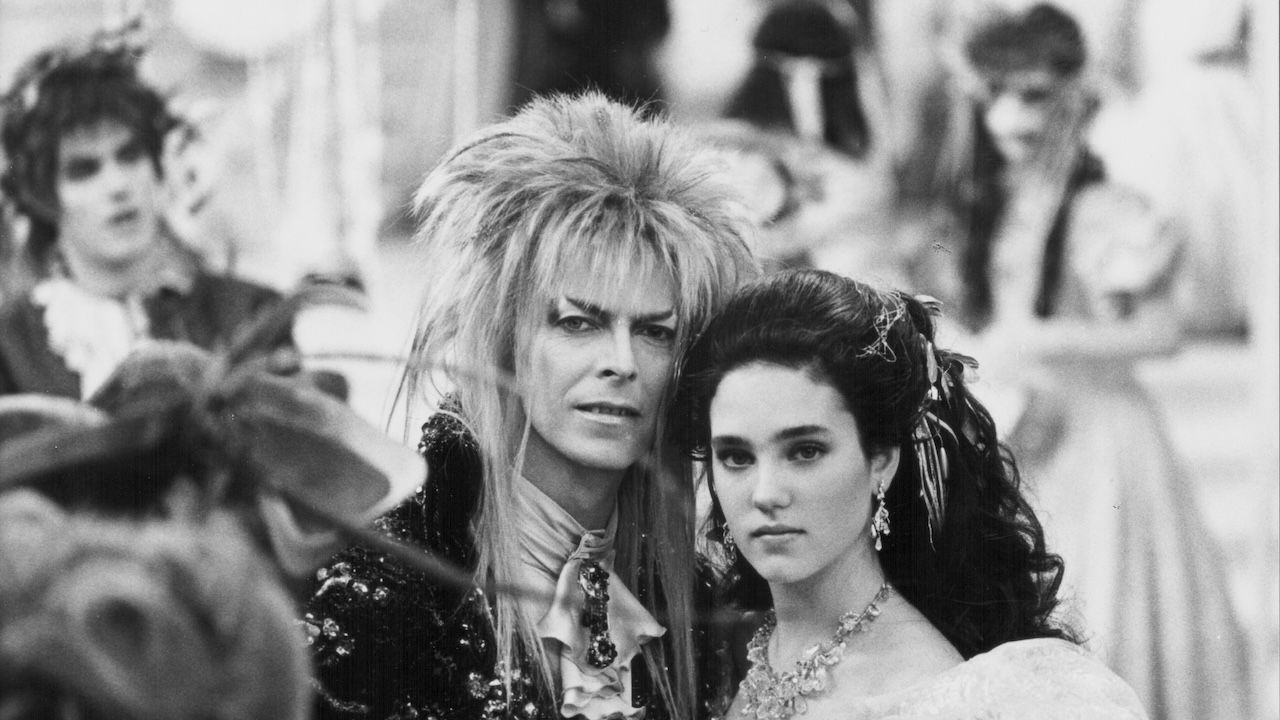
On June 23, 1986, four days before the film opened in US cinemas, the soundtrack to Muppets creator Jim Henson’s dark fantasy Labyrinth was shared with the world. The album featured an excellent synth-heavy score by South African composer Trevor Jones, who had collaborated with Henson and conceptual designer Brian Froud on 1982’s Dark Crystal, but the USP for rock music fans was that it also featured five new original songs by David Bowie, who had been cast in the key role of Jareth, the film’s enigmatic, puckish king of the goblins, whose minions had ‘borrowed’ a human baby from the fictional Williams family.
Bowie, by this point in his career, had already proven that he was a versatile and accomplished actor, having demonstrated his range on the ‘silver screen’ with starring roles in sci-fi drama The Man Who Fell To Earth and in World War II drama Merry Christmas, Mr Lawrence, in addition to performing as Joseph Merrick in an acclaimed stage production of The Elephant Man on Broadway. Working with Henson offered the creatively restless star another opportunity for reinvention.
“Jim Henson set up a meeting with me while I was doing my 1983 [Serious Moonlight] tour in the States, and he outlined the basic concept for Labyrinth and showed me some of Brian Froud’s artwork,” the singer recalled in a 1986 interview with US entertainment magazine Movieline. “I’d always wanted to be involved in the music-writing aspect of a movie that would appeal to children of all ages, as well as everyone else, and I must say that Jim gave me a completely free hand with it. The script itself was terribly amusing without being vicious or spiteful or bloody, and it also had a lot more heart than many other special effects movies. So I was pretty well hooked from the beginning.”
Having a Hollywood budget didn’t hurt when it came to Bowie’s vision for the soundtrack. Recorded at Atlantic Studios in New York, the album’s gospel-flavoured closing track Underground featured backing vocals from Chaka Khan, Luther Vandross and Whitney Houston’s mother Cissy among others, and guitar from electric blues legend Albert Collins. Chilly Down, described by Bowie as a “little swamp-type number” voiced by actors Richard Bodkin, Charles Augins, Kevin Clash, and Danny John-Jules aka forest dwelling creatures The Fire Gang, was recorded at Abbey Road. But utilising deluxe studios and crack musicians didn’t necessarily mean that everything went exactly as Bowie had planned.
“Dance Magic [its title later changed to Magic Dance] gave me a bit of a problem,” the singer explained in a TV interview promoting the film. “It’s a song for the Goblin King and the baby. In the recording studio the baby I picked – one of the backing singers, Diva [Gray], had this cute little baby, and couldn’t put two gurgles together! And it wouldn’t work for me. I mean it just wouldn’t go; I kicked it, I did everything to make it scream, and it really buttoned its lip. So I ended up doing the gurgles, I’m the baby on that track as well.”
It should be stressed here that Bowie was joking about kicking the infant.
Magic Dance also features a spoken word intro lifted word for word from dialogue between Cary Grant and Shirley Temple in the 1947 film Bachelor Night (also known as The Bachelor and the Bobby-Soxer.
Originally envisaged as a single to promote the film, As The World Falls Down, was described by Bowie as “the prettiest tune in the movie”. Written to soundtrack a dream sequence in which the Goblin King dances with teenager Sarah (Jennifer Connelly) at a masquerade ball, it’s the most tender song on the record. “Jim [Henson] wanted something which was fairly old-fashioned in its sentiments,” Bowie explained. For reasons never fully made public, the planned release of the single, and its accompanying video, was shelved for years, making it something of a hidden gem.
The last of the five Bowie songs on the album was his personal favourite, Within You.
“I had to write something that sounded like stone walls and crumbling power,” he revealed in Labyrinth: The Ultimate Visual History. “The overall effect, with Jim’s visuals, is, I think, very tragic and slightly disturbing.”
The Labyrinth soundtrack album charted in the UK at number 38, and in the US at number 68. Not Bowie’s biggest success then, but as he opted never to perform any of the songs from the album live, wanting them to remain forever within the film’s own world, the album retains a special place in the hearts of fans.