

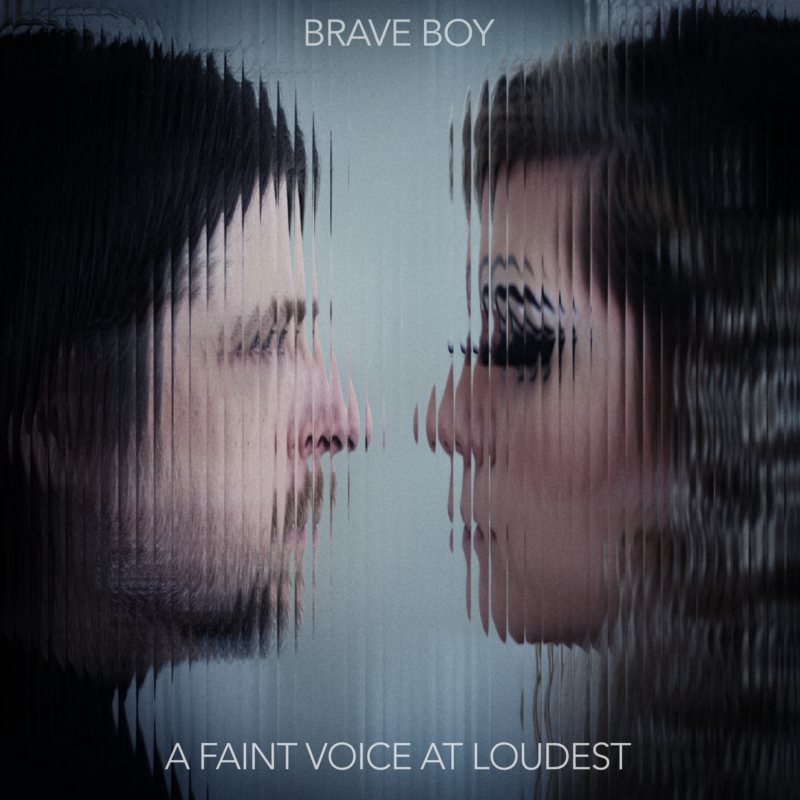
A faint voice, in Samuel Beckett’s Company, calls from the edge and urges the body toward the plunge. Brave Boy takes their name from that suspended instant, and on A Faint Voice at Loudest, the Wichita duo of Mary Harrison and Eric Harrison treat the pop song as a similar precipice: a place where desire, dread, memory, and self-recognition gather before the fall.
The record began, by their account, as a “10 songs in 10 days” exercise, a private discipline against hesitation, sounding like a suite of sleek, strange rooms, each one lit by DX7 glass, LinnDrum snap, saturated bass, and guitars. Brave Boy may move within the weather systems of post-punk, dream pop, synthpop, and the softer outskirts of sophisti-pop, but their best moments come from the pressure placed between those languages. The guitars carry Johnny Marr-like filigree, the rhythms recall the disciplined body music of 1980s R&B and electro-boogie, and the synths suggest a world where Cocteau Twins, The Blue Nile, New Order, Prince, Choir Boy, and Jam & Lewis productions all share a midnight-train platform.
At the centre is Mary Harrison’s voice, a dramatic instrument with glam edges and a theatrical reach that never collapses into camp. She sings as though the room is both stage and confession booth, pushing Brave Boy’s songs toward emotional theatre without losing their pop intelligence. Eric Harrison’s production surrounds her with movement rather than murk: chorused guitars, bright mallet tones, and basslines that keep the album’s feet on the floor even when its eyes are fixed somewhere above the ceiling.
There is a pleasing contradiction in the phrase Eric uses for the record, “hidden haze under the funk.” It explains much of A Faint Voice at Loudest. These songs seep upward through the grooves in a peculiar charge: intimacy trying to speak through distance, romance distorted by expectation, gender and identity viewed through a cracked mirror.
The brightest passages bubble and burst with almost garden-like light. One can picture fireflies, lanterns, and a twilight game of pursuit, yet beneath that delicate surface the music keeps pressing forward with urgent physicality. Mary’s voice holds firm inside the glow, tender and commanding, while Eric’s guitars and synths flare, vanish, and return in altered shapes. Vulnerability can have a backbeat, and that the faintest voice sometimes travels furthest when the body is already moving.
“We started this album almost accidentally,” the band reflects. “It began as a challenge to write quickly and stop overthinking everything, but somewhere in the process it became the most honest thing we’ve ever made. A lot of the record deals with emotional distance, identity, memory, and trying to connect through noise. Sonically, we wanted it to feel dreamy and atmospheric, but still move physically. There’s a lot more funk and R&B underneath it than people probably expect.”
On I Saw You There, the room is already dead before desire arrives: another party, another drink, another little social defeat, until one figure cuts through the fog and turns vacancy into fixation. Walk Away answers that rush with rupture, taking the language of obedience, rules, and romantic exhaustion and twisting it into escape; the command becomes a door, and heartbreak becomes the hand that opens it.
Oh Me, Oh Life moves through loneliness, failed speech, and the bruised search for meaning before finding a thin but stubborn thread of renewal in love and connection. Drifting sinks deeper into the body’s private undertow, where anxiety, memory, and emotional depletion pull the speaker from the present, leaving another person’s touch as the last rope back to shore.
On Take Back the Nite, devotion curdles into desperation as a lover tries to drag someone back from addiction, absence, and self-erasure through intimacy, need, and sheer force of feeling. With You turns romance into a locked room of recursive arguments and blurred selves, where both parties know the bond is bad for them and still cannot quite cut the cord.
Feels So Real treats transformation not as triumph but as tremor: the old self breaking open, the new one uncertain, and love left to answer whether it can survive the change. Be a Brave Boy closes on a more brutal inheritance, tracing how childhood shame, parental command, and forced courage can become an inner voice that follows a person into adulthood, still speaking, still wounding.
Listen to A Faint Voice at Loudest below.
Follow Brave Boy:
Website
Instagram
Facebook
Spotify
YouTube
The post “This Strangeness I Feel” — Wichita Synthpop Duo Brave Boy Release “A Faint Voice at Loudest” LP appeared first on Post-Punk.com.