
Wu Lyf have spoken to NME about their long-awaited new album ‘A Wave That Will Never Break’, what brought them back after 15 years, and forging their own path and community outside of Spotify.
After their split in 2012, the beloved Manchester indie heroes made their return last year with a string of live shows and their first new material since 2011’s acclaimed ‘Go Tell Fire To The Mountain’: a debut that along with their mystique and tight-knit bond to their fandom found them cult-like status and a worldwide community. Their star only rose further via one of the most talked-about late night TV performances of this century when they played ‘Heavy Pop’ on Letterman.
By 2012 they started hinting at new material before deciding to call it quits after frontman Ellery Roberts told the world – and his bandmates – that he was “gone” and “feeling empty” via a message online. Their final gigs followed where they told their audience, “Goodbye forever”.
“There’s an aspect of being very youthful and idealistic at 21 when the band had its success and broke,” Roberts told NME last week, looking back on their initial demise. “When the spirit dies and it becomes a performance, it becomes quite an empty experience. Even though there was success and you appreciate the enthusiasm it can bring, if your heart’s not in it and it becomes a destructive thing in your life, then it feels necessary to step away from it.
“Where it was left was quite an abrupt end and traumatising on many levels for everyone involved. There was a lot to reconcile and process, and it took a long time for that to really feel real again. The way that we started just jamming together a few years ago and just really reconnecting as friends, the spirit of it was present.”
Bassist Tom McClung agreed, saying that Wu Lyf had become the antithesis of what they set out to be: “part of the machine that makes everyone do things the same way.”
“That’s part of the reason why we became disillusioned, and we blamed each other for that,” he admitted. “There were resentments that grew. Things come to a head sometimes. If it wasn’t Ellery then it might have been someone else. These things happen. Growing out of that, it can only be a positive thing if you actually make something again.”
He added: “There are so many things to learn from the way that we did things before, and we can only grow from it because we’re not focussing on the negative aspects. Now we can effectuate a change that benefits not only us but our fans. Now more than ever, there’s a need to do this differently – not to benefit ourselves, but to be able to do it at all.”
A Wave That Will Never Break by WU LYF
As well as the frontman going on to form Lost Under Heaven, McClung, drummer Joe Manning, and guitarist Evans Kati then went on to make music under the name Los Porcos, along with three members of the band FAMY. Now, they’re back with ‘A Wave That Will Never Break’. Released last week (Friday April 10), the widescreen and heartfelt record could be their best work to date.
“It’s all kind of surreal,” Roberts told NME. “It’s strange to have ended up doing this after putting it behind me, and the rest of the band was similar. It was the best part of over a decade of life taking its own course, so to be doing it again and to be seeing all of these people that I haven’t seen for 15 years in our community, it’s a strange feeling.
“It’s a full circle moment. Life spirals around itself sometimes.”
Wu Lyf have made their new material available via their newly-designed worldunite.org, also sharing journals, early access to tickets, exclusive merch and fan forums; “creating a space for the work to be experienced as a whole, instead of being encountered in passing” as they shun the likes of Spotify to build on the community they built before their split.
Check out the rest of our interview below, where Roberts and McClung tell us about what brought them back, what’s left to prove, playing the long game, and finding meaning outside of a cold, corporate world.
NME: Hello Wu Lyf. What brought you back? Was it a sense that the world was in need of your utopian model of cottage industry direct connection and engagement?
Tom McClung: “It was more the idea that playing together for the first time sounded good than anything else, then it all grew from there. I don’t think anyone sits down with a masterplan before they start. That develops over time. We want to build something from this foundation that we find quite solid and interesting.”
Ellery Roberts: “Even though media publications have constructed some kind of sense of marketing masterplans with everything we’ve done in the past, my relationship with it is just that we’ve made intuitive decisions based on what feels true and right in the moment.
“I don’t think it’s necessarily about proving anything other than trying to forge a way. An alternative is possible, and you only know that by trying it. We don’t know what will come of our endeavours at this moment in time, but we have all agreed to stand by our choices and see them through.”
Wu Lyf performs on August 7, 2025 in Castelbuono, Italy. (Photo by Roberto Panucci – Corbis/Corbis via Getty Images)
McClung: “When you’re young you’ve got so much to prove, and you don’t really know why. The best stuff comes when you’ve got nothing to prove, and that’s where we’re at now. You can really hear that in the music as well; it’s really not trying to do anything.”
The record breathes with a sense of relief. How would you describe the sound of the album?
Roberts: “I like that. There is sense of relief and an exhalation, rather than a pensive in-breath. There’s something quite accepting in the way that the record flows. From the outset there’s more tension and the songs are more driving, then it gets to its conclusion with a sense of acceptance and acknowledgement that life is life and it is what you make of it.”
McClung: “The record works to all of our strengths rather than trying to do things that we’re less good at. Being 19 or whatever, when you’re making music you’re constantly searching and trying to remedy the things that you can’t do by doing them. Now, we’re far more aware of the things that are going to be far more beneficial to the music. That brings about some kind of authenticity, simply because you’re not trying to do something you can’t do.”
A Wu Lyf fan is more likely to expect a certain energy from you than a sound…
Roberts: “It’s an interesting one, because the record still sounds and feels like Wu Lyf. There’s something very distinct about what Wu Lyf are very much the sum of our parts. It’s just an energy of the four of us playing and writing together that communicates. It’s an honour to be able to be in the midst of something like that, something beyond the individual.”
McClung: “What’s interesting is that we’ve crossed a lot of genre lines and very much got out of the ‘indie guitar pop’ sound that was very much a part of the first record, even if it was backed up by a lot of sub-bass and heavy dynamics. Now we’ve got a lot of cross-genre experimentation and other influences.
“It only sounds like us because somehow there is this personality that comes through that is stronger than the content. I like that with these two records that we’ve put out, we’re now more recognisable by our personality than the type of music we play.”
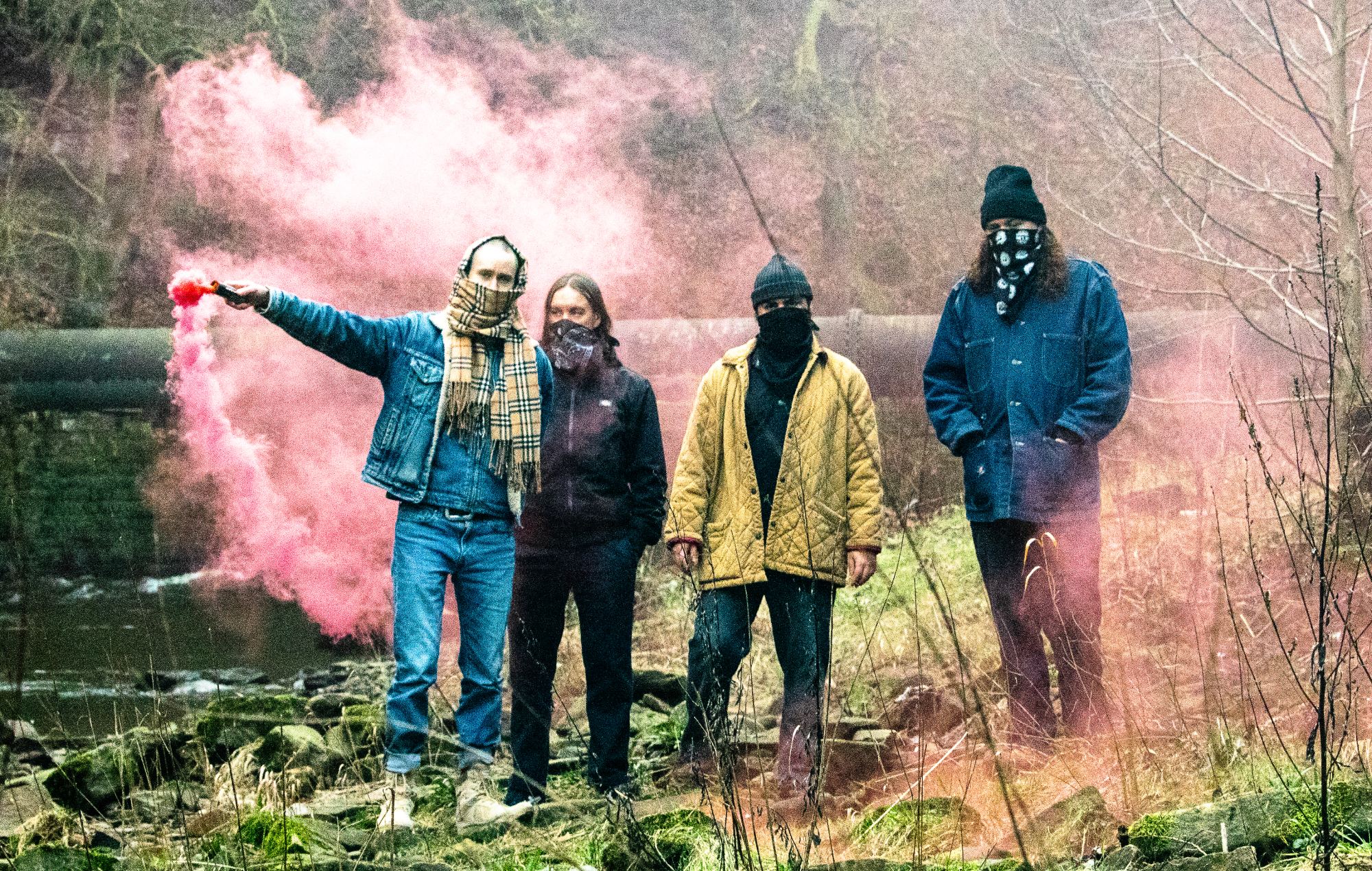
Wu Lyf, 2026. Credit: Sean Miniconi
You’ve shunned conventional ways of getting your music out there in favour of building on your own L Y F (Lucifer Youth Foundation) membership programme to “build a direct relationship with listeners on your own terms”. You described that as “a re-framing of the modern world” rather than an “opt-out”. What did you mean by that?
Roberts: “The whole approach of what we’ve been doing with the membership has been a lot about how much agency we can reclaim from a system that doesn’t serve music. Spotify is not made for musicians – it’s made for a corporation to make money. Instagram isn’t made for musicians to promote and distribute music, and yet we’re all beholden to these systems as the channels to connect while your audience is being mined for data.
“Given the position we were in, we chose to see what it would be like if we opted out in a sense of choosing to do things differently and seeing where it leads. The membership has grown and grown and is really strong. We see far more income from the membership than we ever did from Spotify. The numbers aren’t the same but we just got up to 1,100 subscribers and that’s a monthly income that sustains. I hope it continues to grow. Thus far it’s going to plan.”
What would your advice be to other artists wrestling with the decision to pull out of Spotify and risk losing exposure?
McClung: “Don’t jump into anything that you’re not capable of managing. The whole reason that we can do this isn’t just because we had success in our early career, but because we stopped and a sort of myth grew around the music. When we came back, we had the chance to reinvent ourselves. One forecast that I might have for the music industry is that Spotify is not necessarily going away, but I think that it will become a step in people’s careers as they eventually move towards a centralised form of music distribution.
“Bands will start on Spotify then say, ‘I’m going to migrate everyone over to where I am and we’ll start something’. That’s a more realistic view of how to deal with this whole thing. Now bands just have to live there and it’s such a sad place for music to live. It doesn’t inspire anything or anyone. It’s a perfect place for just consumption, and it’s not even that good for consumption because it just leaves you hungry for more content.”
Roberts: “It’s no place for independent alternative music. Sure, if you’re going to be making commercial plastic-y pop for that middle-of-the-road audience, but if you’re doing something a bit more niche and considered then you’re devaluing yourself by putting it on Spotify. I agree that there aren’t great alternatives unless you have the means to create a platform for yourself, but I think we’re in a shifting time and something will come along. We’re just making the best of our circumstances.”
Ellery James Roberts of Wu Lyf performs on August 7, 2025 in Castelbuono, Italy. (Photo by Roberto Panucci – Corbis/Corbis via Getty Images)
There’s a phrase in your new album artwork: ‘Choose feeling over perfection’. Do you sense that the disposable and superficial nature of online culture means people are striving for or pretending to be something unobtainable and there’s a fear to make mistakes?
Roberts: “There’s something quite destructive out of the way that we make these curated brands out of ourselves, from bands to human beings. The multitude that each person is becomes narrowed into this perfected image. That’s very stifling and suffocating for the human spirit and creativity. I don’t think it’s great for humanity to be siloed into these little squares on Instagram. I accept that it’s part of the culture at the moment.”
McClung: “You think about music back in the day, with Les Paul making the original multi-track recordings, throughout the ‘70s when tape recording was prevalent, you think about how hard it was to make things perfect but people strive for it still. In those little moments where they missed it is where the magic was. As technology tried to get closer and closer to trying to make perfect prevalent, we lost the ability to make mistakes. Now it’s harder to make things imperfect because perfection is built into everything we use.
“I’m not saying that we’re the only people who put mistakes on our new album, but what I like about the scene now is that people are embracing it more and more. You can hear people singing out of tune on new records, you can hear guitars with obvious mistakes. I’m seeing this weird revolution of humanity in music that I’m really connecting to. I see music that moves in that direction connecting with people much more as we dissociate from technology in the alternative spheres.”
You also tell fans to ‘choose the long game’. How do you feel about the future of Wu Lyf?
Roberts: “Nobody knows what the future may hold, but in the process of doing this we’ve really come to respect the quality that Wu Lyf has and the goodness it brings to our lives, how much it means to people. Long may it last, and long may it continue to be a project that gives a sense of freedom, adventure and joy.”
McClung: “Working on the long game is hard, because if you try to plan for the future you’re only going to set yourself up for disappointment because there’s so much shit at every hurdle and hurdles at every step. What we’re trying to do is make things happen for the next 12 months to sustain us, and not think about whether it will end or not. You’ll probably manifest it if you start thinking that way. If you just focus on making sure that everyone is getting paid and that the fans are happy and engaged, that we’re still writing and releasing music, then the rest will take care of itself.
“I always hated when you went to school and they asked, ‘What’s your 10 year plan?’ How can I do that? I don’t know what’s going to happen tomorrow.”
Roberts: “The goal of what we’re doing is to make a sustainable cottage industry, one that’s ethical and aligns to the values and morality that we hold, and that it exists. If you can be selling about 1,500 capacity venues around the world then you can live. Any bigger than that and it starts to become a whole new kettle of fish. More money, more problems. The real long game is to have something that lives and breathes and isn’t forced into being something it isn’t.”
Wu Lyf’s ‘A Wave That Will Never Break’ is out now. The band are touring North America through April and May (visit here for tickets) before a homecoming show in Manchester’s Albert Hall on Saturday June 13 (see tickets and information here).
The post Wu Lyf on doing things their way: “Spotify is not made for musicians – it’s for a corporation to make money” appeared first on NME.