

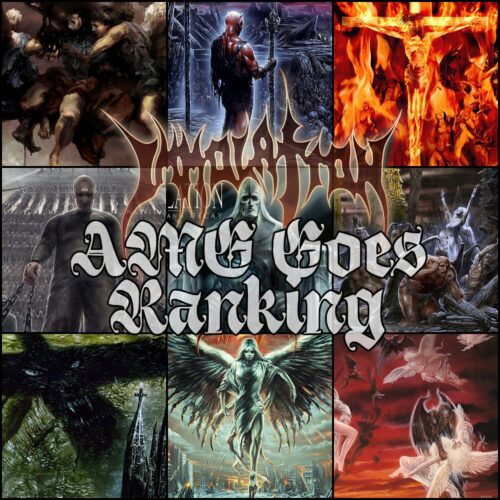
The life of the unpaid, overworked metal reviewer is not an easy one. The reviewing collective at AMG lurches from one new release to the next, errors and n00bs strewn in our wake. But what if, once in a while, the collective paused to take stock and consider the discography of those bands that shaped many a taste? What if multiple aspects of the AMG collective personality shared with the slavering masses their personal rankings of that discography, and what if the rest of the personality used a Google sheet some kind of dark magic to produce an official guide to, and an all-around definitive aggregated ranking of, that band’s entire discography? Well, if that happened, we imagine it would look something like this…
Formed in 1988, Immolation emerged shortly after death metal’s dawn of aggression. Alongside Incantation, Suffocation, and Mortician, Immolation cemented themselves as a cornerstone of New York’s death metal scene in the early 90s. Since then, the band has erected a kingdom of consistency, releasing cut after unholy cut of complex arrangements, unwavering hostility, and anti-religious ruminations about the failures of gods. Key to Immolation’s dependable, high-quality output are mainstays bassist/vocalist Ross Dolan and guitarist Robert Vigna, who have both been with the band since inception. Even Immolation’s other members prove steadfast, with drummer Steve Shalaty searing skins since 2003 and Alex Bouks lending his axe since 2016. Through eleven full-length releases, Immolation has proven that their ability to harness ruin and forge death metal majesty is nigh unparalleled.
With twelfth album Descent arriving soon, staffers old and new clamored to share their opinions on how Immolation’s back catalog stacks up. Unlike rankings mostly prescribed by overwhelming consensus on their highs and lows, Immolation presents a discography with nothing to atone for, providing fertile ground for healthy, well-considered discourse. Without further ado, then, let’s put our ears to the door of a world below and divine these diabolical rankings!
– Grin Reaper
The Rankings
Grin Reaper
In my book, nobody does pure death metal better than Immolation. More consistent than Suffocation and Incantation and more uncompromising than Morbid Angel and Cryptopsy,1 Immolation scoffs at AMG’s Law of Diminishing Recordings™ as they reign atop an unimpeachable discography that lacks a single turd. Seriously. The ‘worst’ album Immolation ever put out still rivals or surpasses the best from most other death metal outfits, and their indomitable march to dismantle the weak and unworthy entrenches them as one of my all-time favorite acts. Jesus wept—Immolation never fucking flinched.
#11. Harnessing Ruin (2005) — Something has to be last, and Harnessing Ruin gets my tap. Songwriting-wise, Immolation drops a strong effort with acerbically grim leads and a rousing introduction to new drummer Steve Shalaty. Guitars supply the album highlights—from the gnarled riffing in “Our Savior Sleeps” and the sludgy sway on “Son of Iniquity” to the scalding solo on “Dead to Me,” Bob Vigna and Bill Taylor sizzle with hell’s fire across Harnessing Ruin. Unfortunately, the album’s production holds it back, and the muffled mix lacks the bite of Unholy Cult. Also, the longest songs cluster at the end, dragging the back half a touch.
#10. Kingdom of Conspiracy (2013) — Kingdom of Conspiracy just ekes ahead of Harnessing Ruin, clocking three minutes briefer despite having one more track. To my ears, Kingdom of Conspiracy features Immolation’s brightest, most modern production. This offers a boon to Dolan’s grating growls and the tormented guitar tandem of Vigna and Taylor, but it also buries the bass and pushes the drums further away from the dead corpse smacks that characterize my favorite Immolation bass drum tones. As one might expect from the bottom end of such an excellent discography, Kingdom of Conspiracy does little wrong, but lacks the heretical heft that defines Immolation’s best material.
#9. Shadows in the Light (2007) — Concluding what I consider Immolation’s middle period, Shadows in the Light chronologically bridges their weakest link, Harnessing Ruin, and powerhouse Nuclear Blast debut, Majesty and Decay. Shadows in the Light drastically improves on Harnessing Ruin’s production, wading out of the former’s forlorn pall and laying down brimstone-tinged bangers like one-two punch “Passion Kill” and “World Agony.” A sense of immediacy pervades Shadows that, while not lacking in the lowest-ranked albums, burns even hotter here, filling its forty minutes with writhing leads and furious drumming that typifies what Immolation does so damned well.
#8. Failures for Gods (1999) — Failures for Gods falling to #8 proves just how potent Immolation’s discography is, as the album would be a crown jewel in countless other discographies. On the surface, Failures for Gods has everything Immolation fans could ask for: punishing grooves, tortured guitars, and vocals that could command the armies of hell. Despite that, Failures for Gods feels like it holds back from the devastating offensive that would launch a year later, instead rehashing rather than progressing what Immolation accomplished on their first two albums. Still, Failures introduced drummer Alex Hernandez, and though his masterstrokes would be heard on Close, songs like “God Made Filth” and “The Devil I Know” heralded the storm to come.
#7. Dawn of Possession (1991) — Pure fucking evil rarely sounds this intoxicating. Steeped in an unpolished production that’s coarse yet clear, Dawn of Possession hooks ears and souls alike, flaying them with its hellish implements. Though it’s Immolation’s most straightforward album, tracks like “Into Everlasting Fire, “Those Left Behind,” and “Immolation” exemplify why suburban mothers clutch their pearls when they happen upon their precious babes listening to death metal. Dawn of Possession was my entry point for Immolation, and it encompasses everything the band offers without guile. I still recommend it for the uninitiated, particularly those who enjoy straight-up OSDM with a side of heresy.
#6. Unholy Cult (2002) — Where Failures for Gods luxuriates in gloomy menace and Close to a World Below reeks of sulfurous damnation, Unholy Cult blurs the line between the two. Starting with a slow build on opener “Of Martyrs and Men,” Unholy Cult careens between ominous drawls and infernal fervor with a substantially improved production over Immolation’s 90s output. “Unholy Cult” remains the second-longest song these death peddlers have penned, and it looms large, rooted in the front half of the album. From there, the tracks rumble and blitz up to closer “Bring Them Down,” a funky barnburner that highlights Dolan’s basswork amidst Immolation’s blazing backdrop.
#5. Majesty and Decay (2010) — Immolation unleashed a juggernaut for their first platter with Nuclear Blast. Blistering, contemplative, and brimming with moldering melody, Majesty and Decay swats with the divine laze of a celestial being, uncoiling at its leisure but devastating in its wrath once roused. Tracks like “A Glorious Epoch” and “The Rapture of Ghosts” toe this line, where beefy chugs pound beneath soaring, anthemic guitars. Meanwhile, the likes of “The Purge” and “A Token of Malice” hit with the force of a thunderclap, unrelenting in their fury. I originally had Majesty and Decay in the same tier as Atonement and Acts of God, but the busy mix and unimaginatively titled “Intro” and “Interlude” hold it back.2
#4. Atonement (2017) — With no song running past the five-minute mark, Atonement exhibits Immolation’s dedication to excising the fat and gristle. Vigna’s crooked leads and crushing riffs mesh perfectly with new guitarist Alex Bouks’ calculated anarchy, and together they synchronize in exquisite harmony. Along with Majesty and Decay, Atonement might be the closest Immolation comes to achieving accessibility. Typically, my favorite straight-up death metal furnishes little room for nuance, and though Immolation doesn’t have a reputation for subtlety, Atonement expertly doles out moments of relief (the end of “When the Jackals Come,” the intro to “Lower”) that almost lull you into safety before the bottom drops out and sends you to hell.
#3. Acts of God (2022) — When I first saw Immolation flaunting fifteen tracks totaling over fifty minutes, I thought their best days were behind them. Bloat is never a good sign, particularly from a band with such a pristine track record. I happily resign to being wrong, though, as Acts of God not only subverted but demolished my expectations. Immolation’s allure lies in the intricacies of their music. Dolan’s patristic admonishment of humanity, Vigna and Bouks’ serpentine noodling, and Shalaty’s tempestuous brutalization of the kit define the band’s sound, yet here the music is more direct and urgent than ever. Rather than missing any beats, Immolation sounds ruinously revitalized.
#2. Here in After (1996) — Though not a significant shift away from Dawn of Possession, Immolation struck nails to gold with Here in After. Compared to later releases, Here in After radiates a few extra degrees of chaos, with deranged soloing that reminds of Slayer’s vision of hell and a slightly more impassioned vocal performance from Dolan. To be clear, his vocals are one of my favorite aspects of Immolation’s sound, and his matter-of-fact, comprehensible gutturals against such malicious metal engenders wonderful drama. The edge to his voice on “Nails to Gold” and “Christ’s Cage” adds a dimension of metaphysical dread that is the chef’s kiss throughout Here in After’s inflamed impiety.
#1. Close to a World Below (2000) — I can’t fathom any other Immolation album topping this blasphemous bonanza than Close to a World Below. Opening with my favorite Immolation track “Higher Coward,” the album bursts forth with an unapologetic eruption of sinuous guitars, vicious growls, and an unyielding onslaught by drummer Alex Hernandez. The drum tones alone deserve a spotlight, but the cataclysmic bombardment of stick on skin violence stops me dead in my tracks anytime one of Close to a World Below’s songs pops up. Immolation distills the essence of what worked so well on previous albums and folds those layers into a perfect performance across eight insidiously immaculate tracks. “Father, You’re Not a Father,” “Unpardonable Sin,” and the closing title track resonate with especially inspired performances, but the entirety of Close to a World Below boils over with the most unhinged and malignant performance of Immolation’s career. Being damned never sounded so Iconic.
Lavender Larcenist
#11. Harnessing Ruin (2005) — Immolation does not have a bad album, but Harnessing Ruin feels like a band chugging along in a bit of an in-between space. The production is muddled here, especially after Unholy Cult and Close to a World Below, but “Our Savior Sleeps” still retains that Immolation heft while “At Mourning’s Twilight” is an inspired closer with an incredible solo at the midpoint. Harnessing Ruin would be the best album of many other bands’ careers, but it is only a lower-tier album for a band as storied as Immolation.
#10. Shadows in the Light (2007) — Shadows in the Light follows Harnessing Ruin in terms of feeling like a band spinning its wheels (as much as a band as talented as Immolation can). Even then, “Passion Kill” is a classic Immolation track with an incredible breakdown that will make a fan out of any listener. “World Agony” follows with a dissonant wailing riff backing as it drops headfirst into a rolling bulldozer of a track. Unfortunately, there isn’t much else to Shadows in the Light that helps it stand out amongst the rest of Immolation’s discography, but it still makes for a solid death metal record with some memorable tracks that have stood the test of time.
#9. Failures for Gods (1999) — Failures for Gods is a solid album that is no slouch in the songwriting department, but it is marred by some truly busted production. Everything feels muddy, oddly loud, and compressed at the same time. “No Jesus, No Beast” is a monster, and the title track features that classic evil tone that becomes so apparent in late-stage Immolation, but the production handicaps this album at every turn. Great songwriting goes a long way, but in a race this tight, poor production brings Failures for Gods low.
#8. Kingdom of Conspiracy (2013) — Kingdom of Conspiracy shaves off a bit of Majesty and Decay’s technicality to its detriment. It is the closest Immolation has come to creating an album that is more groove than tech. As a result, it is probably one of their more approachable records, but it is the weakest of their current era. “Keep the Silence” is a monster of a track, and Kingdom has more than enough material to make it worth a listen. I think this is an album more fans should revisit, and newbies should start with, because it is hooky, heavy, and groovy in ways that will tickle your evil organ.
#7. Dawn of Possession (1991) — Dawn of Possession is an incredible debut from a band that is clearly young and ready to fuck the world up. Robert Vigna’s trademark style is immediately apparent, and Immolation’s blend of groove, dizzying technicality, and evil vibes is on display out of the gate. Craig Smilowski’s drumming is absurd in its rhythm and technical flourishes, but the album lacks the atmosphere that Immolation became famous for later in their career. Dawn of Possession is a fantastic debut that is only brought down by the extent to which its tracks bleed together. Something Immolation struggles with throughout their career.
#6. Here in After (1996) — Here in After sees the band refine their skills and write tighter songs that hit harder while adding just a little dash of that trademark Immolation vibe. The groove is starting to creep in, and tracks like “Christ’s Cage” showcase the band playing with the truly evil tone that pervades their most recent work. Album opener “Nailed to Gold” is a classic for the band, and Here in After is a quintessential Immolation album. Ross Dolan’s vocals have switched from Dawn’s nastier tone to his trademark bellow, and Vigna’s pirouetting shredwork is here to stay. Here in After is Immolation in classic form.
#5. Close to a World Below (2000) — Opening with “Higher Coward”, Close to a World Below starts on a high note and never stops delivering. The production foibles of Failures are ironed out, and Immolation sounds like a band ready to bulldoze society. “Unpardonable Sin” is as heavy as it is frantic with its switches back and forth between dissonant groove and face-melting speed. “Lost Passion” crescendos into trademark Immolation wankery in the best way, but Close to a World Below still suffers from some odd production. Dolan’s vocals feel slightly different track to track, but this is an album with some of Immolation’s best songs to date.
#4. Unholy Cult (2002) — Something about Unholy Cult just clicks for me. “Of Martyrs and Men” is that pure, wonderful, evil shit. After an explosive intro, the track moves into one of Immolation’s most crushing riffs. The title track is a slice of hell in a way the band hasn’t played with since “Christ’s Cage”, an eight-minute epic that is as catchy as it is devastating. Vigna flips from this vibrato-tremolo guitar riff right into an all-out assault and back to massive Immolation grooves without a hitch. Unholy Cult is stuffed with great tracks and feels like a first step towards the second half of Immolation’s career, where atmosphere and groove hold more sway over pure technicality.
#3. Majesty and Decay (2010) — Majesty and Decay is where modern Immolation comes into full form. Part truly diabolical atmosphere, part neutron star heavy, all technical and groovy as hell. “Intro” gives listeners a glimpse into the band’s future. “A Glorious Epoch” has one of the best riffs, basically ever, making for a track that gets my blood boiling without fail. “A Token of Malice” is astounding in its technicality while being a freight train of destruction with Vigna riding shotgun. Majesty and Decay is also the best Immolation has sounded up to this point, where the production finally feels consistent, clear, and absolutely brutal.
#2. Atonement (2017) — Likely an album that will grace the top tier on every list, Atonement feels like the quintessential Immolation album. If I were to introduce the band to anyone, I would probably start here. “When the Jackals Come” is one of the band’s best tracks, and “Lower” is just astounding in how brutal Immolation still is decades later. It also keeps things at a slim and trim forty-four minutes, and album closer “Epiphany” puts a perfect bow on this devil baby. There isn’t a track worth skipping on Atonement, a feat made all the more impressive when it is a band ten albums into their career.
#1. Acts of God (2022) — Where do I start with Acts of God? To me, it is the perfect combination of creativity, groove, technicality, and that evil Immolation sound we have come to know and cherish. As one of Immolation’s longest albums, you would think the well has run dry, but the intro “Abandoned” and interlude “And The Flames Wept” add so much cohesion to the album and drape the entire affair in a veil of depravity. Acts of God features some of Immolation’s biggest and baddest riffs, while also pushing their atmosphere to new heights. Their most evil album, their most creative, and maybe even their heaviest. “Noose of Thorns” is led by a diabolical descending riff that drops into high-pitched tapping that sets the tone so well you can’t help but feel pulled by hell’s destructive currents. “Immoral Stain” is dripping with malice; you can hear it seep into every riff and lyric. “Let the Darkness In” features a bouncing, infectious groove that immediately flips into Vigna’s trademark dissonant wails. Acts of God is Immolation’s magnum opus in every sense, and somehow my favorite album by a band that feels like they can do no wrong.
Mark Z.
Immolation feel like old friends. I discovered them early in my extreme metal journey and was immediately captivated by Bob Vigna’s unconventional riffing style and Ross Dolan’s commanding (and surprisingly comprehensible) growl. No matter what’s happened in the metal scene, it’s always been comforting to know that Immolation have been there, touring relentlessly while consistently delivering their trademark brand of dissonant death metal and never releasing a true dud. In the world of old school death metal, they’re the one band I could always count on. Because of that, they’ll always have a special place in my ever-blackening heart.
#11. Shadows in the Light (2007) — Not a bad album, just a relatively bland one. While there are some inspired ideas, most of the tracks have little of the dark atmosphere or interesting songwriting found on their earlier material. Nonetheless, it’s a testament to Immolation’s quality that even their worst album still has stuff as good as the lumbering grooves of “Passion Kill” or the growl-along catchiness of “World Agony,” which is one of the group’s best songs.
#10. Harnessing Ruin (2005) — Arguably Immolation’s most accessible album, Harnessing Ruin shows them trying to find their place in the mid-2000s death metal scene by writing some more direct songs than usual. Just like with Shadows in the Light, however, this album sags in its back half and lacks the darkness or quality of the first few records. There’s good stuff here, but this record also feels bleak and oddly dated, possibly due to the generic mid-2000s artwork, plain production job, or the misguided use of whispered vocals in “Dead to Me” and “Son of Iniquity.”
#9. Kingdom of Conspiracy (2013) — The fucking drums, man. The drum sound here is borderline overbearing, and given that this record is already pretty fast, the overall experience is a relentless and punishing one that largely crushes nuance beneath the heel of its boot. Fortunately, the riffing is still strong, and the album’s generally fast nature makes the slower, commanding marches of “Keep the Silence” and “All That Awaits Us” hit all the harder.
#8. Majesty and Decay (2010) — After a relatively lackluster era in the mid-2000s, Immolation signed to Nuclear Blast and seemed hell-bent on redemption with Majesty and Decay. Compared to its immediate predecessors, this record has an improved production job, more dynamic songwriting, and a better sense of structure (with the band employing an intro track and interlude for the first time). While the title track’s Gateways to Annihilation vibes make it one of the band’s best slower songs, the album as a whole would be better if some of the weaker tracks were shaved off and a few others were tightened up a bit.
#7. Acts of God (2022) — This is a very good album with two main issues: It’s too long, and it has the misfortune of having to follow up Atonement. Not even an Immolation album needs to be 52 minutes long, and compared to its predecessor, the production is stuffier and the songs aren’t as strong. As a whole, however, this is still a blasphemous good time that maintains a consistently high level of quality throughout, with “The Age of No Light” and “Overtures of the Wicked” being especially powerful cuts.
#6. Unholy Cult (2002) — Immolation’s fifth album represents a bridge between the apocalyptic malevolence of their early material and the polished hostility of their later work. It’s also potentially their most vicious and chaotic release, with the opening track “Of Martyrs and Men” even featuring some borderline-mathcore riffs. While at times tough to untangle, Unholy Cult ultimately succeeds as a 41-minute shrapnel blast of ideas that somehow combines the epic and the violent into an utterly compelling whole.
#5. Failures for Gods (1999) — The start of Immolation’s long partnership with producer Paul Orofino, Failures for Gods is held back a bit by his lack of prior experience with death metal, with the bass drums sounding like bouncing basketballs. Stylistically and structurally, however, this is essentially Here in After Part II, with twisted and brooding compositions that vary between being grandiose and cutthroat. While a bit front-loaded, Failures is still a brilliant record. In a just world, “No Jesus, No Beast” would be the closer at every Immolation show.
#4. Dawn of Possession (1991) — Immolation’s debut essentially gave their death-thrash demo tracks a murkier production job and placed them alongside newer songs that would hint at the band’s dissonance to come. As such, Dawn of Possession is the most traditional death metal album in the band’s catalog while also being one of the most distinct and stylistically diverse. While Bob Vigna would only improve as a songwriter from here, Dawn’s numerous classic tracks and otherworldly sense of blasphemy make it easy to love, warts and all.
#3. Atonement (2017) — How the fuck is this album so good? Late-career albums aren’t supposed to be this good, but this is the rare lightning-strike release where everything hits just right: the production, the songwriting, the performances, and even the cover art (which marks the return of the band’s classic logo). It’s like they found a way to increase the quality of everything while sacrificing nothing, resulting in a record that’s powerful yet understated, hooky yet stuffed with riffs, and listenable yet extreme. It may be slightly front-loaded, but it’s still one of my favorite death metal albums of the 2010s.
#2. Here in After (1996) — Arriving five years after their debut, Here in After shows Immolation truly coming into their own, with Bob Vigna’s dark, dissonant arrangements and Ross Dolan’s menacing, intelligible growl both emerging in full force. The improved songwriting is apparent right from the flawless opener, “Nailed to Gold,” which could be one of the Top 10 death metal songs ever. While the twisted structures that follow are less immediately accessible, it all eventually coalesces into a masterfully crafted whole, demonstrating a keen sense of flow and diversity while exuding a timeless, unheavenly darkness that only Immolation could conjure.
#1. Close to a World Below (2000) — There are certain albums so good that they transcend not only their own band’s discography, but also the rest of their genre. Close to a World Below is one of those albums. Never before or since has an album sounded so much like being in hell, with a suffocating and merciless production job that somehow still allows every note to be heard in all its unholy glory. Drummer Alex Hernandez delivers a once-in-a-career performance that sounds like he’s bashing every part of his kit at once, and Bob Vigna somehow manages to write his catchiest material while still delivering riffs more warped than ever. The record also has one of the best openings of all time, with a sullen voice asking, “Didn’t you say. . . Jesus was coming?” before a blasting onslaught tramples any hope of ever making it to heaven. Fukk it, send me below!
Spicie Forrest
Having begun my metal journey in nü territory, there are holes in my metallic knowledge you could drive a commercial truck through.3 While Immolation has long been a name vaguely known to me, it wasn’t until Atonement that I actually heard any of their music. So, when the call for a ranking came in, I saw an excellent opportunity to dive deeply into a storied discography and see what I’ve been missing.
#11. Harnessing Ruin (2005) — While comparably unremarkable, even the bottom end of this list is still good. The truth is, Immolation has never put out a bad album. With such a consistent base quality, placing albums in a numbered order became a game of sudden death. The nail in the coffin for Harnessing Ruin? The whispering vocals on “Dead to Me” and “Son of Iniquity.”
#10 Unholy Cult (2002) — How the hell do you follow up Close to a World Below? By comparison—and even in isolation—Unholy Cult feels lackluster and unremarkable. I’d likely still recognize most of this as Immolation in a playlist, and it’s still very solid death metal by any measure, but there’s precious little here that demands my attention or elevates it above background music. Additionally, pacing shifts, as on “Reluctant Messiah” and “Bring Them Down,” make it difficult to find a groove or flow through the album.
#9 Failures for Gods (1999) — The first three albums Immolation released are all, more or less, of a piece. Failures for Gods maintains much of the quality from earlier releases, from the searing, whiplash solo work and deep riffage of “No Jesus, No Beast” and “Failures for Gods” to the brooding, intimidating tone of “The Devil I Know.” There’s a bit of staleness that creeps into Failures for Gods, though. Aside from some odd, Spanish-inflected acoustic riffing on the title track, not much here stands out from their earlier work or in retrospect.
#8 Shadows in the Light (2007) — Immolation’s output through the mid-00s is, for me, their least engaging, but Shadows in the Light sees them begin to turn things around toward the high quality they’d been known for in the early years. The percussion on Shadows in the Light caught me by surprise, reminding me mightily of Slipknot’s self-titled. Steve Shalaty’s kit work feels alive and visceral, just itching to incite a riot. This holds especially true on “Passion Kill” and “Breathing the Dark.”
#7 Kingdom of Conspiracy (2013) — Kingdom of Conspiracy is an odd duck in Immolation’s discography. This 2013 release has proven divisive not only for its shift in theme,4 but for its notably clean production, as well. While I do appreciate the clarity and snappiness, it is a tad sterile. Ross Dolan’s vocals are hurt the most by this, making him sound toothless and tired. Highlights like “All That Awaits Us” and “God Complex” still hit hard, but as a whole, Kingdom of Conspiracy just doesn’t have the searing identity of records higher on this list.
#6 Here in After (1996) — Being the sophomore album is a tough break. The pressure’s on, expectations are high. Here in After largely holds the line and even improves on the debut in some ways—the title track and “Christ’s Cage” are absolute powerhouses, wielding the weight of worlds like feathers. That said, Here in After does not feel as compositionally tight or structurally sound as Dawn of Possession. Additionally, much of the solo work feels jarring and a skosh too chaotic for my sensibilities, especially on “Nailed to Gold” and “Burn with Jesus.”
#5 Majesty and Decay (2010) — A continuation of the upward shift in quality from Shadows in the Light, Majesty and Decay sees Immolation beginning to explore the more tempered, measured sound so prevalent in their contemporary output. Some tracks, like “A Thunderous Consequence” and “Power and Shame,” fall flat in their attempts to create atmosphere, but “Divine Code” and “A Glorious Epoch” show exactly how menacing and powerful Immolation can be and truly embody the title of the album.
#4 Dawn of Possession (1991) — This served as the standard by which all else was measured. Apocalyptic and vicious, Immolation’s debut was a revelation. There’s a ferocity on Dawn of Possession that only a young band eager to share their vision can produce. And in so doing, Immolation marred the tapestry forever. Injecting their relentless assault with streaks of virtuosity, Dawn of Possession became the bar not only for the band, but for thousands of inspired musicians in the decades since. Immolation has tweaked and tempered their blueprint in the 35 years since, but the core has always remained.
#3 Acts of God (2022) — I’m normally not a fan of intros, but “Abandoned” sets the stage perfectly for the brutal and utterly savage cudgeling to come. Fully returning to the unchecked hatred for Christians and their gods, Acts of God is contemptuous and caustic in way that hasn’t been heard since Close to a World Below. Most impressive here is Immolation’s success in merging the pomp and circumstance of their modern output with the rage of their early work. While not strictly their best release, Acts of God is a quintessential work, defining the true identity of Immolation.
#2 Close to a World Below (2000) — Already known for their malicious, uncompromising sound, Immolation cranks all the dials to eleven on Close to a World Below. It’s seething, it’s virulent, it’s fucking hostile. If this masterpiece ever lets up, it’s only to parade and mock the mangled corpse of Christ before grabbing a bigger hammer. Every second of this album drips with scorn, from the indictment of “Father, You’re Not a Father,” to the blasphemy of “Unpardonable Sin.” I get chills at the start of “Higher Coward” every fucking time, and they don’t go away until long after “Close to a World Below” fades out.
#1 Atonement (2017) — The first Immolation album I ever heard, Atonement still remains untouched. The imperial confidence and contempt—the sheer power—left me speechless, and I still return to it, nearly ten years later. Atonement is more atmospheric than much of their other work, but the result is a heretofore unknown level of weight and heft, no doubt aided by its more vibrant and textured production. Like the change in the air before a coming storm, Atonement feels like a harbinger of ruin, and at times like the disaster itself. Barns burn on tracks like “Destructive Currents” and “Rise the Heretics,” but Immolation truly shines in patient malevolence. Highlights like “When the Jackals Come,” “Thrown to the Fire,” and “Lower” are in no rush to grind your bones to paste. Atonement is the full realization of what was hinted on Majesty and Decay, and it is breathtaking to behold.
Angry Metal Guy Staff Ranking
Thanks to the dark magic of profane arithmetic, we present the aggregate staff ranking below:
Harnessing Ruin (2005)
Shadows in the Light (2007)
Kingdom of Conspiracy (2013)
Failures for Gods (1999)
Unholy Cult (2002)
Dawn of Possession (1991)
Majesty and Decay (2010)
Here in After (1996)
Acts of God (2022)
Atonement (2017)
Close to a World Below (2000)
For any ignorant, curious, or non-practicing heathens out there that need to bathe in the everlasting fire, look no further than AMG’s Immolation primer:
The post AMG Goes Ranking – Immolation appeared first on Angry Metal Guy.