
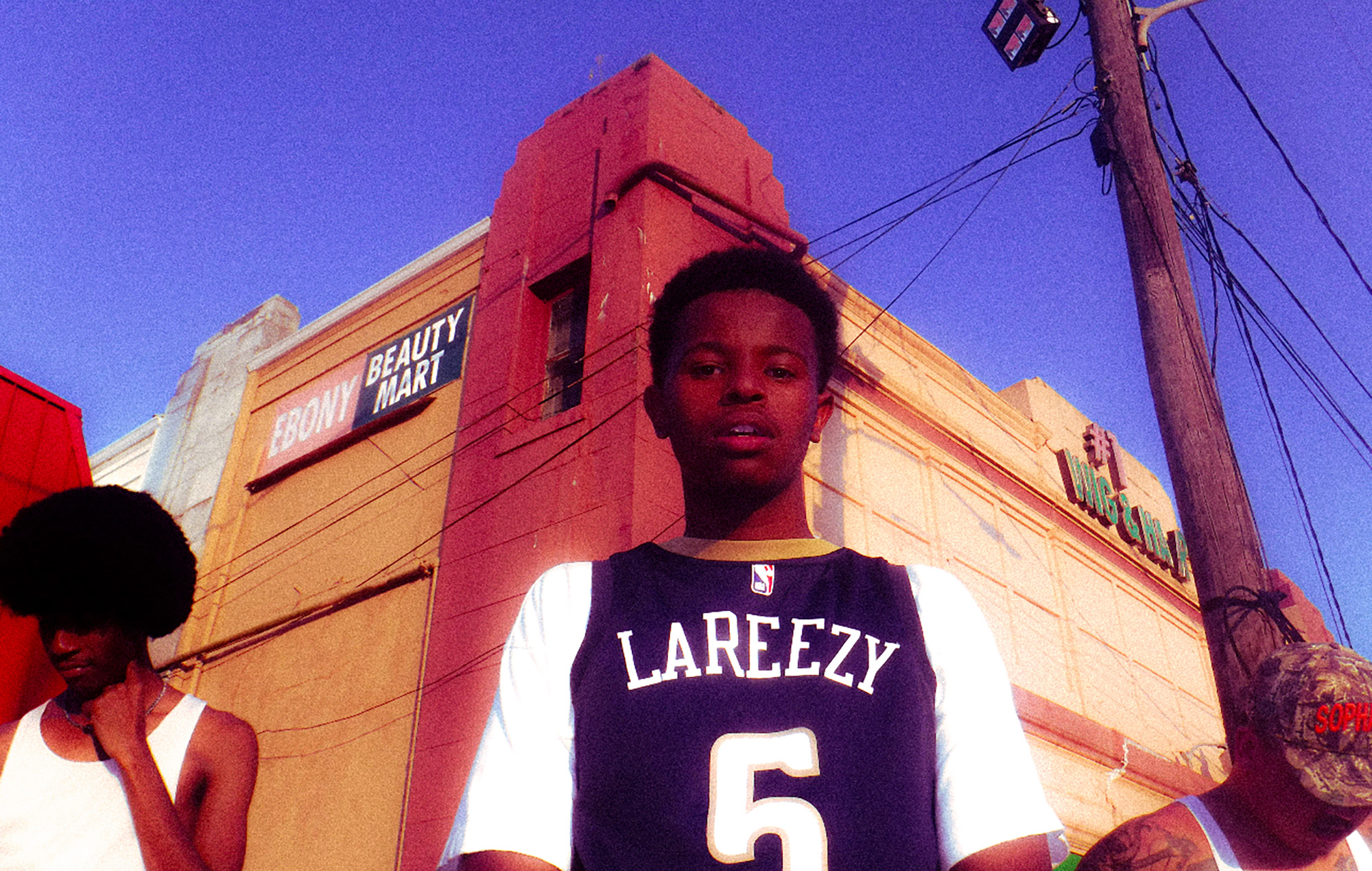
It’s barely minutes into the conversation when La Reezy leans in with a grin and says he’s got something “exclusive” for NME. Asked what first pulled him toward music, he doesn’t start with a verse or a turning point, but a memory: captured in a photo of himself at four years old, beaming in an oversized black jacket and a red SpongeBob tee. “I was dancing around the house like Michael Jackson at that age, and my grandma used to make outfits for me to dress up and dance in,” the New Orleans upstart recounts over a grainy Zoom call. “It’s been written.”
READ MORE: Samara Cyn: in pursuit of freedom and growth in a grim world
Three years on from the TikTok traction he gained with ‘Birth’, a diaristic gut-punch that zeroed in on the instability of his upbringing (“No parent, friend, or blood / Treated my pain like Funyuns crumbs”), the artist born Khayree Salahuddin has gone all-in on ensuring his dreams aren’t “make believe”. What started as internet buzz around the intro to his self-produced EP ‘Reeborn’ has grown into something harder to ignore. After a whirlwind 2025 – four projects, including ‘Pardon Me, I’m Different’ with fellow NOLA native PJ Morton, opening for Little Simz at the Hollywood Palladium, and sharing a bill with Earl Sweatshirt and Clipse at Camp Flog Gnaw – his rise feels undeniable.
With that momentum, it’s easy to see why La Reezy shrugs off reductive labels. Artist, activist, entertainer: he brushes past all of it with the same ease he flips between flows. “My message is always the lead, then it’s whatever my ears are intrigued by,” he says. It sounds offhand, but it’s the engine behind everything he does. One minute he’s in a reflective, conscious pocket that harks back to Talib Kweli, and the next, he’s veering into something more off-kilter and animated, his tone stretching and snapping in a way that nods to Danny Brown. Then, just as quickly, he’s back riding bright, kinetic New Orleans bounce like it’s second nature.
Credit: Press
That push-and-pull is baked into his DNA. On ‘Hungry Flows’, a chipmunk soul-laden cut he confesses he made when he was “flat-out broke, eating nothing but fast food”, he’s unapologetic about his ambition: “Martin Luther had a dream, Kanye West said ‘And I wonder’ / K. Dot wanted to be heard but Reezy ’bout to bring the thunder…” It might read as bravado but plays more like a manifesto, echoing the righteous intensity of Black Star. Yet on tracks like ‘Have Mercy’, he remembers a childhood friend grappling with teenage fatherhood (“Roman is 17 and he’s a dad, damn Roman ain’t have a dad / Maybe that’s why he was mad, the oldest boy was never taught to be a man”), revealing a level of emotional maturity well beyond his 21 years.
He calls himself the “leader of the UTH” and is quick to stress the weight of that role. “I think my words and my concepts come first,” he says. “If that’s activism, then yeah, but it’s really just speaking life into people.” That philosophy has already taken him into spaces far bigger than the usual rap circuit, including performing at the 61st commemoration of Malcolm X in February. Even now, he sounds slightly dazed recounting it. “You learn about that in school, then you’re there, you’re a part of it. It makes you realise this history is still now.”
“Even though it’s one of the hardest things to do, I wanna sound like myself”
That perspective shapes how he sees the wider rap landscape, especially who gets visibility. When a certain streaming giant recently implied that hip-hop is in need of new leaders, Reezy didn’t let it slide. “It just felt discouraging,” he laments. “We’re out here spending our last dime, sacrificing relationships, trying to be great. If you got that big of a platform, use it to shine a light on the people that’s already working instead of saying something for clicks.” It’s a bit like basketball, he thinks. “It’s like saying the [Los Angeles] Lakers need more superstars when you’ve got players on the bench ready to go. Put them in the game.”
Reezy’s criticism hits harder because he’s still very much in the grind himself as an independent rapper, which is why moments like a chance encounter with Kendrick Lamar mean so much. “I didn’t even know what a co-sign was,” he laughs, admitting that he almost “blacked out” upon meeting him at last year’s BET Awards. “He recognised me and said my name, and everything I wanted to say to him went out of the window.” Still, the impact lingered. “It felt like confirmation, like God was telling me that I’m on the right track.”
Credit: Press
Crucially, that track runs straight through New Orleans. When he describes it, his eyes light up, painting his hometown as less a place and more a colourful, unpredictable feeling. “You’ll see a teal house with a red door, then a brown building with purple stairs, and each house has a classic car outside,” he says, highlighting how that visual patchwork mirrors the city’s sound. “We got second lines where a brass band just starts playing and you run outside and dance.” To underline how ever-present the NOLA bounce is, he taps a rhythm on the desk, rapping the line “it’s 7am” as if over a classic Mannie Fresh beat. “I’m like a New Orleans time capsule to the world.”
At the same time, he’s careful not to become a pastiche of what came before. From the city’s knack for turning rhythm into identity, to the legends he nods to on ‘I Look Good’, its lineage is undisputed. But Reezy is more focused on carving out his own voice than mimicking Lil Wayne, Juvenile, Master P, Soulja Slim and other Louisiana legends. “Even though it’s one of the hardest things to do, I wanna sound like myself.”
Part of that individuality comes from an unlikely mix of influences. “NBA YoungBoy was born and raised an hour away from where I live, so his success felt obtainable to me,” he says. Besides the Baton Rouge megastar, there’s also Justin Bieber, whose early superstardom left a lasting impression. “When you’re a kid and you see that level of stardom, it sticks. It makes you believe it’s possible.”
“What if the struggle is part of it? What if that’s why the art hits?”
That belief often clashes with reality, and Reezy doesn’t sugarcoat it. On ‘Ya Feel Me’, he taps into the kind of everyday coping that rarely makes rap’s highlight reel: “Nah, forget that, brother, let’s take a shot from the bottle / And swallow the problems we bottle.” It starts like a casual exchange before landing on something heavier: “These dollars gon’ hold me all week, I ain’t got no dollars for you.”
That tension forms the spine of his upcoming release, which was born from moments where inspiration and circumstance collided. He recalls falling into a YouTube rabbit hole, watching performances by Louis Armstrong and Etta James around the time Sinners was in cinemas, struck by the emotional weight and cultural richness of Black artistry while dealing with some personal financial hardship. “I’m looking around and we’re struggling, but culturally, we’re leading. So I’m like, how does that make sense?” he says. Instead of trying to resolve it, he leaned into the contradiction. “What if the struggle is part of it? What if that’s why the art hits?”
Reezy considers the project some of his most serious work, and after spending several weeks last year crafting it, he felt the need for a reset. “I just wanted to have fun and feel like a kid again,” he admits. That impulse led to last September’s light, bouncy ‘Lareezyana Shakedown’. Its sun-soaked cuts, like the breezy head-nodder ‘Hardhead’, should go over a treat in London at All Points East, where he’ll join the likes of Dijon, Vince Staples and Turnstile at a two-day takeover headlined by Tyler, the Creator.
Away from the booth and the stage, the sacrifices are real. He speaks candidly about having to give up video games – specifically his beloved NBA 2K – to stay focused. “That’s how you connect with your friends, but I can’t be working less than someone like Drake who’s already made it.” He also makes it a point to learn on the job. “Watching Little Simz on tour taught me the value of showing up for your fans, no matter what.”
Five years from now, he sees arena tours and Grammys. Ten years? It’ll be less about accolades and more about growth. “I just want to get better at delivering a message,” he says, laying out his simple but ambitious goal: to make “human music” feel aspirational again. “More people live like me than like these rappers talking about material things, and I think I’m able to shed light on people who just have normal experiences and aren’t living a fantasy.” For now, La Reezy sits in a sweet spot: not quite mainstream, no longer underground, but moving with purpose and momentum. And he’s only just getting started.
The post La Reezy makes hip-hop full of heart and humanity appeared first on NME.