
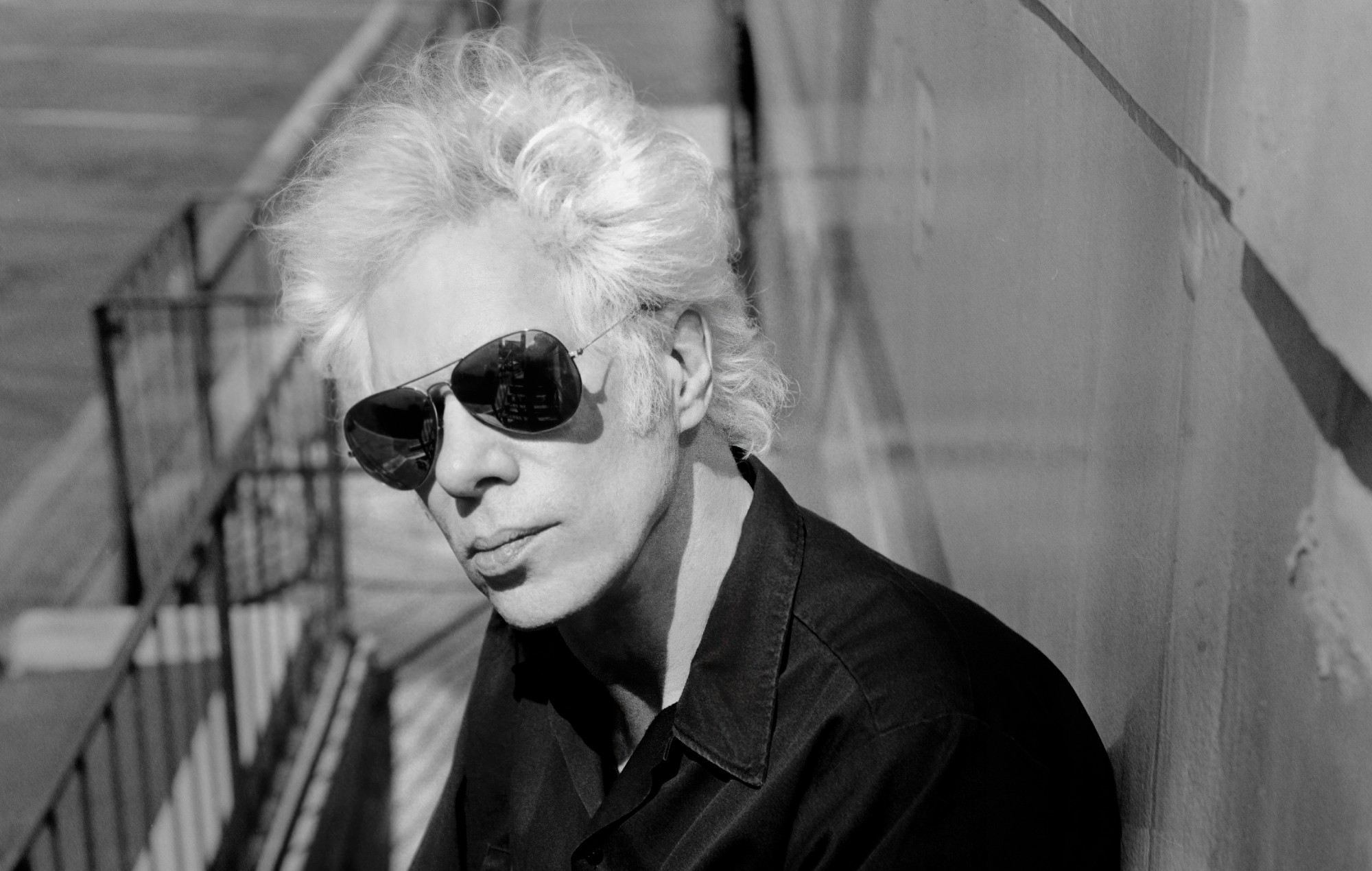
What we wouldn’t give to see inside Jim Jarmusch’s contacts book. “I have a lot of weird friends,” the white-haired filmmaker drawls, today dressed head to toe in Johnny Cash black. “I had several friends in the Hells Angels in New York City… I have friends who were made members of the Mafia. I’m close with the Wu-Tang Clan” – RZA did the score for his 1999 film Ghost Dog: Way Of The Samurai – “so don’t fuck with me!” Wouldn’t dream of it, Jim.
In terms of American independent cinema – which Jarmusch almost single-handedly kickstarted with 1984’s Stranger Than Paradise – he’s always done it his way. From offbeat Westerns (1995’s Dead Man), off-kilter vampire flicks (Only Lovers Left Alive), zombie films (The Dead Don’t Die) and stories about bus-driving poets (Paterson), it’s near impossible to categorise his work. At 73, he’s almost the last man standing when it comes to the US indie scene.
He remembers the day David Lynch died; he was doing an interview with Canadian horror maestro David Cronenberg on the phone. “We both found out 30 seconds before that we had lost David Lynch – and we were both really hit [by it],” he says, his voice tinged with sadness. “The thing that we both said was ‘David couldn’t get money for a feature film. He could not get a budget for a fucking feature.’ David Lynch! Cronenberg and I went, ‘Man, we’re fucked.’”
Well, not quite. When we meet, Jarmusch is soaking up rays on Venice’s Lido and still basking in the applause from yesterday’s premiere for his new slow-burn drama Father Mother Sister Brother, starring Cate Blanchett, Adam Driver, Charlotte Rampling and Tom Waits. “I was teasing Cate last night,” he recalls. “I said, ‘Don’t worry, Cate, my next film is going to be filled with sex, violence, nudity, action! Man, I’m going to throw it all in there!’ She’s like, ‘Good for you, Jim!’”
Father Mother… is “intentionally very slight”, he says, but the cumulative effect is powerful. “I like the small details and the nuances of interactions and relations,” he says. “I like the things that often aren’t said or, [are said] metaphorically. I like the notes in the music that aren’t played, because they resonate and make the ones that are have a different impact. There are certain expectations people want that I don’t satisfy. It’s not out of intention. It’s just the things I’m interested in… I really like those moments that are not dramatic.”
In a few days, the Venice Film Festival jury will award Jarmusch the Golden Lion – his first ever movie to take top prize at one of the big three festivals (Berlin, Cannes, Venice). A trio of thematically-connected shorts, Father, sees Driver and The Big Bang Theory’s Mayim Bialik as siblings visiting their old man (Waits) in rural America; the Dublin-set Mother follows, as Blanchett and Vicky Krieps call upon Rampling’s haughty matriarch; finally, Sister Brother sees Indya Moore and Luka Sabbat coming to terms with the loss of their parents, in Paris, after a plane crash.
Indya Moore and Luka Sabbat in ‘Father Mother Sister Brother’. CREDIT: Yorick Le Saux
“Honestly, I don’t know what I was thinking when I wrote this, because I’ve lost both my parents, but I was not obsessing on that,” Jarmusch explains. “I really don’t know where it came from. Just the fact that we all have these relationships, and they’re always complicated.” The son of a film/theatre reviewer and a businessman, Jarmusch was born in Cuyahoga Falls, Ohio, and left home when he was 17, moving to Chicago. Like most, he kept visits regular… but not too regular. “We would always have to go have a break from each other.”
He now lives in upstate New York with filmmaker Sara Driver, his partner of more than four decades. “My own family’s unconventional,” he says. “I can’t control everything [in] everyday life. I try to avoid drama, but it occurs a lot in my family. My personal family type is female, so there’s often a lot of a certain type of drama going on. Not to be sexist, but I love that.” Maybe that’s why he never got on so well with his dad, too much male energy? “We didn’t have a very good relationship, but I do respect him,” he nods.
“They’re badass, and they fucking say it. Long live Kneecap!”
In Jarmusch’s eyes, he’s in “the third story” that occurs in his film – finding more out about your parents once they pass away. “I learned some interesting things about my father after I lost him,” he reveals. “He went to Cuba as part of the OSS [Office Of Strategic Services, the second independent U.S. intelligence agency]. Some weird shit, I found out that I had no idea about… it changed my perception of my father in a way. Of secrecy or things that were not shared, and reasons why.”
His father, who worked for B.F. Goodrich, a manufacturing company, was in the First American Volunteer Group, or Flying Tigers – a unit set up to help oppose the Japanese invasion of China in WW2. “The Flying Tigers did not always have to wear uniforms,” he says. “They could have white t-shirts. They machined their own replacement parts for their aircraft. And actually, the Hells Angels grew out of the Flying Tigers. The first chapter in California were guys from the Flying Tigers.”
Jim Jarmusch
This is typical of Jarmusch, a man whose wide-ranging interests make any conversation illuminating. This “self-proclaimed dilettante” can tell you about all sorts. “I’m an amateur mycologist… mushroom identification. I’ve identified birds. I’ve studied the history of Italian motorcycle design. I know a lot about underground hip-hop. German symbolist poetry from the 19th century,” he says. “I am just interested in a lot of different things. It’s often the pop cultural things I don’t know, like the current TV shows. I have no clue.”
Given his new film’s part-setting in Ireland, and his interest in hip-hop, I wonder how he feels about those Irish provocateurs Kneecap. Is he a fan? “Of course. Are you kidding me?” he says, eyes glinting behind his Saint Laurent sunglasses. “I support them. I like their music. I like their spirit. I like their attitude. I like that they’re Irish and they’re badass, and they fucking say it. Long live Kneecap!”
Jarmusch has always enjoyed making films about music – from docs about The Stooges (Gimme Danger) and Neil Young (Year Of The Horse) to his 2005 movie Broken Flowers, with its score by Ethiopian jazz musician Mulatu Astatke. And then there’s the mighty, gravel-voiced Tom Waits, who Jarmusch has known ever since working together on his 1986 crime-comedy Down By Law. They’re reunited several times since, including Father Mother Sister Brother. “We’ve had a lot of weird adventures,” he says. “I don’t even know where to begin.”
On Down By Law, he and Waits had access to a brand new black Jaguar. “At night, Tom would come and say, ‘Jim, let’s go to the production office and get the keys to the Jag. So we would drive through New Orleans all night in this Jaguar. And we had one cassette tape in the car, which was Julie London singing ‘Cry Me A River’. After the third night of repeated ‘Cry Me A River’, I said to Tom, ‘Man, you know, we’ve only had this one tape the whole time. Our soundtrack to late-night New Orleans.’ And Tom said, ‘Come on, Jim, what more do we need?’ That was a beautiful moment.”
Jim Jarmusch on the set of ‘Father Mother Sister Brother’. CREDIT: Carole Bethuel
Recently, Waits rang him up, saying that he was penning a fictitious bio about Jarmusch, that includes him enduring a spell at Leavenworth Penitentiary in Kansas. “In the first sentence, he said, ‘I think Leavenworth was good for Jim. He learned how to take apart a radio and put it back together.’ He wrote this whole little imaginary biography of why my hair turned white!” And yet for all their good-natured ribbing, Jarmusch applauds Waits’ on-screen subtleties. “What I love is he’s very funny in the film without being comedic, and he’s very moving without being maudlin or sentimental.”
While Jarmusch will always have the support of A-list actors and musicians, he’s found other ways to fund his movies of late. Like his 2021 short French Water, Father Mother Sister Brother is backed by fashion house Yves Saint Laurent. “On the creative side, they were fantastic. No interference, total belief in my work as an artist. Anthony Vaccarello [creative director] is an amazing artist. I’m not a fashionista, but I am a dilettante. So certain designers have spoken to me: Alexander McQueen, Azzedine Alaïa. There are certain designers who are artists. And Anthony is one.”
Since making his 1980 debut with Permanent Vacation, Jarmusch has always remained far removed from the typical apparatus of Hollywood. He’s never been nominated for an Oscar, let alone won one – and studios, agencies and so on are just not his thing. “All they can promise you is fame and money. I don’t want those things. I don’t give a shit about them – so why would I go there then and give up my soul? Other people can do that. I don’t look down on commercial cinema. It’s produced some great films – but I’m not going to make them that way. I’m very stubborn.”
For his next film, which he plans to shoot in France this year, he approached two female actors – one of whom he’d never met – through mutual friends rather than the usual channels. “I totally avoided their agents,” he says. “I try to avoid all of that.” Once again, it’ll be a steep learning curve. “[Japanese director Akira] Kurosawa, when he was 90… they said, ‘Will you stop making films?’ And he said, ‘Respectfully, I will stop when I understand how to do it’ – and I feel this. I really have to learn each time.” To borrow his own comment… long live Jarmusch!
‘Father Mother Sister Brother’ is in UK cinemas from April 10
The post Jim Jarmusch: “If David Lynch couldn’t get budget for a film – we’re all fucked” appeared first on NME.