

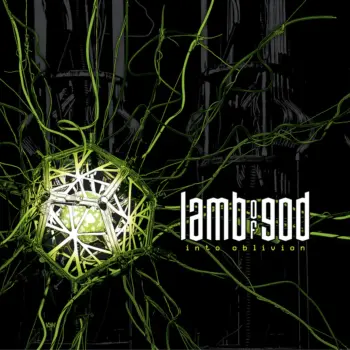
My appreciation for Lamb of God didn’t really take off until a very close friend of mine had me watch Killadelphia for the first time.1 Having survived more than a few metal battlefields of my own, I found the “Black Label” wall of death footage brutally fun.2 Additionally, watching LoG perform those songs live, I found the music clicked with me in a way it hadn’t before, which led me to return to those first three studio albums with renewed vigor and salivating over the upcoming release of Sacrament. Well, twenty years have passed since then,3 a span marked by no small amount of turbulence for the band, both inside and outside the recording studio, my own attention and interest in their work wavering as well. And since Saunders has so graciously ceded his seniority this Tyme around, you’re getting not just my crappy pun, but my two cents on Lamb of God’s tenth outing, Into Oblivion.
It’s not often that commercially thriving bands return from flights of progressive exploration to successfully tap back into their foundational roots. Yet, since the inconsistent VII: Sturm und Drang, Lamb of God seem focused on recapturing some of that lightning in the bottle from their earliest efforts—every step from 2020’s hopeful Lamb of God to 2022’s crunchy and visceral Omens,4 has led the Richmond ragers here, Into Oblivion. Operating musically in a space free from the confines of agendas or trends, LoG are writing songs for no one but themselves. Though lyrically no less acerbic, Into Oblivion serves as Blythe’s commentary on the continued erosion of the social contract here in the States. Mark Morton’s and Willie Adler’s signature guitar sound greets us at the door, the mix of chugs, spindly leads, and technical riffs of the opening title track a good launch point for the rest of the album. Which immediately transitions to “Parasocial Christ,” a thrashy barn burner that is one of the best songs Lamb of God have written in a decade and features one of Blythe’s most visceral performances, who recorded all his vocals at the legendary Total Access studio in Redondo Beach.5
It became increasingly evident that Lamb of God wrote Into Oblivion for the stage. While listening, I could vividly see the impending whiplash under seizure-inducing strobes that blister fests like “Parasocial Christ” and “St. Catherine’s Wheel” will cause just as clearly as I envisioned the swarms of boot-stomping brutality in pits across the country incited by the chugging, bruising grooves of “The Killing Floor” and “Blunt Force Blues.” Much of Into Oblivion should sate long-time fans yearning for days of yore, and settle the argument that the rhythm section anchored by Art Cruz would suffer from Chris Adler’s departure. Lamb of God has also found a way to inject a satisfying amount of experimentation into the strict confines of the album that works without turning things into an overwrought bloat-fest.
With a FAFO runtime of just over 39 minutes, Into Oblivion is the leanest a Lamb of God album has been since 2003’s As the Palaces Burn. Still, LoG managed to color some moments outside the lines. With an opening John Campbell bass line unexpectedly soaked in reverb, “Sepsis” is a monstrous sludgefest that trudges through verses where Blythe falls into a spoken but mostly shouted hybrid tone—an improvement over his mostly cringey straight spoken word—before dipping into a crushing riff that supports the chorus’s screams. This newfound bass-forward sludginess manifests again on “A Thousand Years,” before giving way to a sexy riff full of slithery Southern swagger. Here, Blythe layers some grungy cleans over spoken croaks that work within the song’s style. “El Vacìo” represents the largest departure, reaching near-ballad status as Blythe croons much-improved cleans over Morton and Adler’s moody guitar lines, then crawls into a dramatically tense chorus that gives me goosebumps every time I hear it.
Not everything about Into Oblivion works—for starters, the generic cover and new logo aren’t really hitting, and, while not terrible, I could live with or without the four-plus-minute “Bully.” Still, I wasn’t expecting to like Into Oblivion as much as I do. When I first popped its top, I joked in the AMG lunch room that it might threaten the safety counter. To which Steel immediately replied, ‘wut!’ While the safety counter is fine, Into Oblivion earned its score and might be the best thing Lamb of God has done since Wrath.
Rating: 3.5/5.0
DR: n/a | Format Reviewed: Farging Stream
Label: Epic Records
Websites: LambofGod.com | Bandcamp | Facebook
Releases Worldwide: March 13th, 2026
The post Lamb of God – Into Oblivion Review appeared first on Angry Metal Guy.