
A forever favorite, through and through, And Also the Trees have been a constant musical force throughout much of my later years, capturing my imagination with their enigmatic, elegant, and ever-evolving body of work. From their earliest demos in 1982 through their latest introspective albums, their discography remains in steady rotation for me and is never far from my heart at all times.
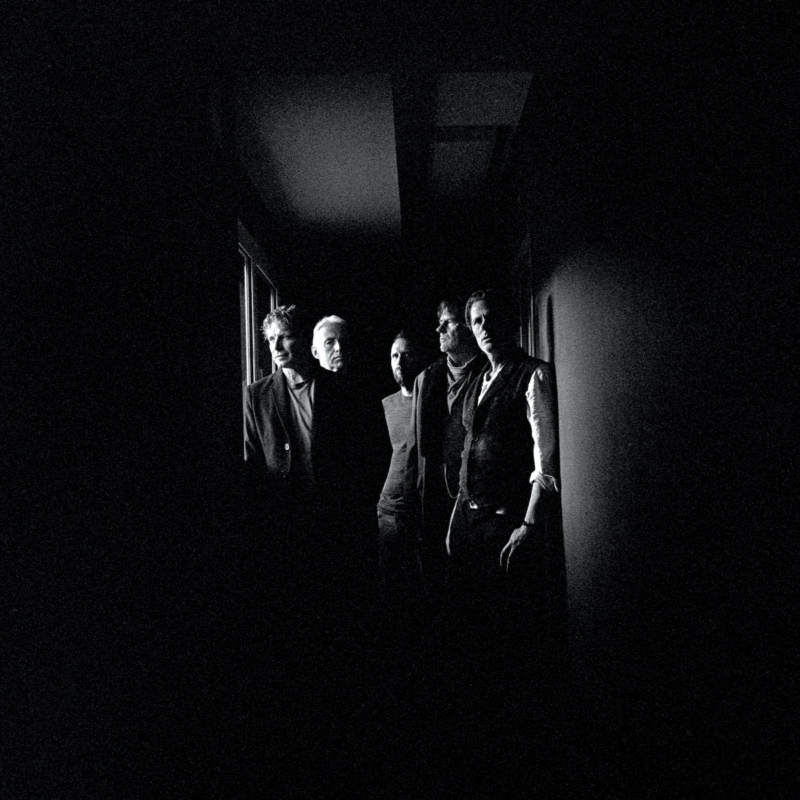
The band’s latest record, The Devil’s Door, was self-released last Friday and has been receiving rave reviews across the board. A triumph among triumphs, the record is a exemplary continuation of the band’s contemplative, yet powerful sound and showcases the immense talents of the band’s current lineup, consisting of brothers Simon Huw and Justin Jones. drummer Paul Hill, bassist Grant Gordon, and clarinetist and multi-instrumentalist Colin Ozanne. The album also features backing vocals and violin from Belgian musician, vocalist, and composer Catherine Graindorge, who worked with Simon Huw Jones on her most recent Songs From the Dead LP in 2024.
And Also the Trees are currently gearing up for their upcoming European tour dates, which kick off this weekend in Belgium and also include festival appearances with longtime champions and collaborators The Cure. As the band was hard at work preparing their set, I had the chance to catch up once more with vocalist Simon Huw Jones to discuss The Devil’s Door, the band’s connection to jazz and post-punk, and their upcoming tour dates. This time around, we are joined by guitarist Justin Jones, who was able to give us some insight on his masterful guitar work and the album’s evocative textures.
And Also the Trees remain one of the most consistent and engaging acts, and it seems you’re more active now than ever before. What is the secret to being so prolific?
Simon Huw Jones: We used to take around 4 or 5 years to write an album which is hardly prolific but we’ve been on roll, it’s true. The Covid period distorted time and when the world went quiet Justin, who is the creative source of the band, created a lot of guitar pieces which led to Mother-of-pearl Moon – this now feels to me like an album that came out of nowhere. Without a break, we went straight into the initial ideas for what became The Devil’s Door. It was almost as if we didn’t take a breath between any of them, they ran into each other very naturally. But that’s it for the moment, this chapter of our story is over now.
Tell us a bit about your recording process for The Devil’s Door, if you could. Are you still recording in different locations and piecing it all together afterward? If so, it’s wonderful to hear how coherent and cohesive the pieces are.
SHJ: Well, Paul and Grant recorded the drums and bass together in an old barn in Herefordshire where we’ve recorded before and Justin was there directing. We’re all reacting to the guitar pieces which Justin had written and recorded in London and I suppose at least some of the pieces they were playing to had a guide vocal. Colin played his parts at his place in London too. But it’s all very instinctive and follows no formula and this is what gives the songs that unpredictability and energy.
Your latest works strike me as very streamlined, lean, and intentional, from every note to the lyrics, to the track listing. Do you ever record more material than needed or is anything ever held back from the records? Do you ever revisit or rework older pieces along the way?
SHJ: There are usually a few pieces that don’t meet our expectations or more commonly don’t get finished. We occasionally revisit them and they become part of another album. On this project there were two songs that Justin and I worked and reworked to the point of insanity which didn’t make the album – they went through phases where we thought they were on the verge of becoming amazing hit singles and then dropped off inexplicably into pieces that we began to hate. The lyric for one song I had forming and dissolving in my head for almost the whole of my summer holiday in Greece. Christ!… I have to laugh thinking about it or I’d cry.
This album is the third in a trilogy with the band’s latest lineup – can you expand on that a bit? Are there thematic similarities between this record, The Bone Carver, and Mother-of-pearl Moon, or are the albums connected more on a sonic level?
SHJ: It’s more on a sonic level. It’s the same five musicians on all three albums and particularly the clarinet, for me at least, threads through all three albums and ties them together. Justin would probably have more to say about the musicality of them all though.
Justin Jones: Sometimes things happen in threes. In this case it’s mostly to do with perception, but if I can stand far enough back from this last record I can see that: Born Into the Waves was a transitional album and then The Bone Carver started this triptych, probably because the cast was now formed, these individuals were emerging as AATT in the 2020s. Strong and confident in where they were heading.
From here on, who knows? I suspect if there is more it will be a new chapter or a new transition.
I’m always enamored with your lyrics and how they often paint an evocative portrait or create such lush stories. I know we’ve touched on your process in the past, but I’d love to hear about the lyrics for this album. What inspired you for this particular set?
SHJ: Almost all my vocals come as an instinctive reaction to the music, usually there is some lyrical content which I can develop but not always. The song we called ‘As I Dive’ had nothing lyrically usable but a decent vocal line. Justin and I were listening to the music with the garbled words running and he said to me – “it’s like a river… the music.” I agreed and decide I’d lyrically and literally dive into it.
Sometimes a working title will inspire me, like with “Return of the Reapers” which Justin took from a painting he’d recently seen. I didn’t see the painting but I had the title in mind and the scene in my head when I reacted to the music and it came very easily. Those moments are quite rare and of course I treasure them. As a lyricist you want all songs to sound like they came effortlessly, like magic, but of course they don’t.
“The Crosshair” on the other hand was more complex and challenging for me. When I first heard and reacted to the music a main protagonist came to life – but then Justin thought the piece would be more interesting if he took most of the guitar parts out of it leaving this rather wonderful bass line as the prominent instrument… and Colin then added some clarinet that changed the atmosphere of the piece again… leaving my main protagonist in the wrong song. So I needed to find another one. Then once I’d found one the scenario only worked convincingly if it was played backwards.
Is that too much information? – I don’t like giving too much away about my lyrics… don’t like pinning them down – they should be free to mutate… hopefully they still will anyway.
And Also the Trees have always excelled at crafting such alluring soundscapes and textures – each album is a world I can live in for some time and quickly feels like a warm, cozy sweater. Having now seen the band live (finally!) it’s incredible to hear these sounds come to life on stage as well as on the records. I’m curious to hear more about how you get some of these otherworldly sounds out of an electric guitar…
JJ: That’s very kind of you.
I don’t think I hear things like other people do. I suppose we all hear things differently. But sometimes I feel I have a kind of hearing colour blindness. I watch videos of people reviewing amps and I can’t hear the difference they speak of when they turn a knob. It sounds the same to me.
But I have a fascination for the unknown. Sounds that aren’t really there. When you combine an instrument and a room something happens. You hear it more evidently in churches with voices. The sound waves ripple around the arches and sonically some magic happens. I suppose I am talking of harmonic distortions. If you are lucky a kind of alchemy happens and more voices appear that aren’t there.
That is where I like to be.
It’s rare but when it happens it’s god-like.
I’ve also loved how this incarnation of the band explores instrumentation that you don’t hear often in post-punk music. In addition to clarinet, which has been a regular feature for a bit now, I’m also loving the accordion in “The Trickster” – how do you land on the instrumentation for each record?
JJ: Well that’s not me that’s Colin. I take him ideas and he hears them and is interested in where the idea is going. Then he will imagine the path and off he goes, sometimes in mad Colin-ways. He has lots of instruments that he seems to play well. Sometimes it will be a Portuguese guitar or a piano or clarinet, or bass clarinet or accordion or Ondioline or something I’ve never seen or heard of. It’s a lovely creative chaos and fascinating understanding of AATT.
The devil’s door by And Also The Trees
Speaking of “post-punk,” do you feel aligned with the genre these days, or do you feel the band has moved past such simple categorization? I’ve always found genres to be a mild annoyance, at best, and of course, that genre itself can mean any number of things, especially these days…
SHJ: As teenagers we bought and made our equipment and instruments with the intention of forming a punk rock band but by the time we’d learnt even the basics of playing, or shouting in time in my case, punk had ‘died’ as a movement. The ‘oi punk’ scene didn’t interest us, we had a different kind of energy. We didn’t want to try and become a classic rock band either. In fact we didn’t want to belong to any genre, we wanted to sound like no one else. There were bands that we could relate to emerging like The Cure, Joy Division, The Bunnymen etc. We loved those bands but we didn’t want to sound like them.
We listened back to early Pink Floyd, discovered The Doors, Can, Scott Walker – we discovered we liked some jazz and hated some more of it, we listened to some classical music, film sound tracks… John Barry, Bernard Hermann and we tried to play together. To make songs. What came out was very rough and slow and a bit awkward but eventually it started coming together. We were a band that formed precisely after punk rock – so when the category ‘post-punk’ started being used it was good for us because it was exactly what we were… even if we realised we didn’t have that classic ’80s post-punk’ sound, and apart, maybe, from our first album, I don’t think we ever did. But we have to have a category, like we need references to other bands and artists – we’re happy to mention The Cure these days because we sound nothing like each other but a lot of people who like us also like them. When strangers ask me what kind of music we play I say we are more like The Cure than ACDC or Abba.
We’ve talked a bit about your love of classical in the past and how that’s manifested in the work, but I’m hearing quite a bit of darker jazz influences on this particular record as well. Was this intentional? Have you always been into jazz, personally?
SHJ: This is also more of a question for Justin… but from my side I started to appreciate some jazz when I was lucky enough to inherit my brother-in-law’s record collection when he immigrated to the US back in 1981. He had quite a few Miles Davis records, some Pharaoh Sanders, Alice Coltrane – and I haven’t found anything I like better.
JJ: Jazz is an art form I have a lot of respect for. However intellectually it’s a language I can’t grasp, I don’t pretend to – it’s beyond me. My only experiences ‘close to’ jazz are on the peripheries. Marc Ribot is someone I could listen to all day. Other than that I would point to elements of jazz in film music. Colin is quite experienced in that world and has a grounding that seems to be based in jazz, he’s clever like that. Paul comes at it from a different direction, I think his early influence were jazz drummers.
Something exciting happened when I ‘opened out’ a piece on the new album called “The Crosshair.” I took out all the dense guitar that the idea was based around and left a skeleton of a guitar part and Paul and Colin created this mood that is like a Lalo Schifrin soundtrack that hover above Grant’s ominous bass part.
The devil’s door by And Also The Trees
On a related note, it’s great to hear a few instrumental segues on The Devil’s Door, especially the penultimate track, which really is quite playful! I love that you included this just before the devastating “Shared Fate” which really swells and swings in the best way possible. I’d love to hear more about how these tracks came together, especially…
JJ: This started life as quite an open, incidental piece of music but as it gathered form it began to seem as though it was trying to tell me something. Requiem is too grandiose a word for it but it felt like this was a slow march toward the light. Then Colin added his piano and clarinets and yes, it was just that. When he played back what he had done I wanted to hug him, but I’m English and we don’t do that very well.
“Shared Fate” was always going to be at the end with that title and so these pieces found themselves a home.
It’s wonderful to hear Catherine Graindorge guesting on the album. Will she be joining you on tour?
SHJ: She will be our special guest on tour yes, playing her solo act… I might join her for a piece and then she might join us for a song too – we haven’t really discussed it yet. She is a fantastic musician and I really liked working with her a lot… I find the violin an extraordinarily emotional instrument and even in rehearsals I’d get totally blown away by what she was doing. It’d be quite cool to see what would happen if she and Justin worked together on some more pieces.
It’s also great to see that you’re playing with The Cure again this year, three festival dates in southern France no less! Have you played outdoor venues in recent years?
SHJ: I don’t think we have played outdoor for some time. But we’re very happy to be playing there… and the fact that our two bands are still together 45 years after we first played together, and after having such different paths through music and life is extraordinary and pretty wonderful I reckon.
Last, but not least, I always love that you often play non-traditional venues as well as beautiful theaters. Are you playing any exciting and/or off-kilter venues this time around?
SHJ: Well the tour is still being planned – so far we just have France and a show in this amazing church in Namur in Belgium. We played there before and it was a surprise… huge and very grand and dramatic. Then we’re playing in a pub in Angers in France a few days later. Then in July the ancient Roman arena in Nimes – so, typical AATT.
I think it’s great we can play in such a variety of venues and not feel out of place in any of them. Knowing me, my favourite will be the pub… §
And Also the Trees 2026 Tour Dates
March 7th — La Nef De L’Eglise Notre Dame D’Harscamp — Namur, BE
March 18th — Le Grand Mix — Tourcoing, FR
March 19th — Joker’s Pub — Angers, FR
March 20th — Hydrophone — Lorient, FR
March 21st — Espace Culturel Buisson — Cherbourg, FR
March 22nd — La Gaité Lyrique — Paris, FR
April 4th — Death Disco Indoor Festival 2026 — Athens, GR
July 24th — Festival de Nîmes — Nîmes, FR
July 25th — Festival de Nîmes — Nîmes, FR
July 26th — Festival de Nîmes — Nîmes, FR
Follow And Also the Trees
Website
Instagram
Facebook
Bandcamp
The post Return of the Reapers — An Interview with Justin Jones and Simon Huw Jones of And Also the Trees appeared first on Post-Punk.com.