
January often feels like a slow month for releases, but this January stood out for its variety, with both prominent debuts (Alpha Drive One, Lngshot) and comebacks (Apink, Exo). Rock had ample representation this month with the debuts of Latency and ChRockitkal and singles from CNBlue, Onewe, and several other bands. This month’s Unsung Artists encompass a range of genres, from rage to deep house to pop with traditional Korean influences. What these debuts and comebacks have in common are well-executed music videos that enhance the songs.
Dodree – “Just Like a Dream”
Dodree, a new duo under JYP Entertainment’s subsidiary Innit, features contestants from the musical audition show The Ddanddara. Respectively, members Lee Song-hyun and Na Yeong-joo were trained in traditional Korean dance and music (specifically pansori). Their backgrounds inform Dodree’s sound in their debut single “Just Like a Dream”, which blends pop beats with traditional instruments. The members have alto voices and primarily sing in their lower registers, which refreshingly differentiates them from most other Kpop girl groups. Their fluttering voices beautifully express the melancholy of the song, yet exhibit exceptional control.
Like Dodree’s musical style, the MV merges traditional and contemporary elements, from sets to costumes to choreography. “Just Like a Dream” conveys its dream concept through gauzy lighting and striking imagery, such as a field of white flowers against a dark background. Further, some of the MV’s imagery feels surreal, yet evocative. For example, in one scene, a white peacock appears in an abandoned modern building that is overtaken by moss. Butterflies, another symbol of transformation, recur as a motif throughout the MV. Visually and musically, “Just Like a Dream” has intriguing layers, making Dodree one of the most promising debuts of the past few months.
DK x Seungkwan – “Blue”
Another standout release from a duo came from Seventeen’s DK and Seungkwan, with their first title track as a subunit. As one might expect from the group’s main vocalists, Seungkwan and DK deliver powerful vocal performances in an emotional ballad. With sparse instrumentation, “Blue” showcases the singers’ falsettos and soaring notes (including a dramatic key change near the end of the song).
The cinematic music video for “Blue” does not feature Seungkwan or DK at all, but rather a couple played by Lee Yoo-mi and Noh Sang-hyun. The MV explores the effect of Noh’s grief and trauma after surviving a car accident that killed his friend. Told through Lee’s perspective, the MV depicts her panicked with worry about Noh’s mental well-being and safety. Both actors excel in their roles, with Lee conveying a range of emotions and Noh perfectly portraying the emptiness of living with depression.
The MV’s color grading and lighting reinforce the couple’s relationship dynamic, with blue hues suffusing their shared scenes. This color palette aptly reflects the lyrics, showing Lee “falling into [his] blue”. After Lee runs out on a job interview to check on Noh, they both seem to realize the heavy toll depression has taken on them both. In one of the final scenes, when Lee wakes up alone, her scenes are bathed in sunlight, out of Noh’s blue. The MV realistically, yet artfully depicts the heartbreaking reality that love alone cannot heal grief, trauma, and depression. Sometimes, separation is what is best to protect one’s own peace.
Enhypen – “Knife”
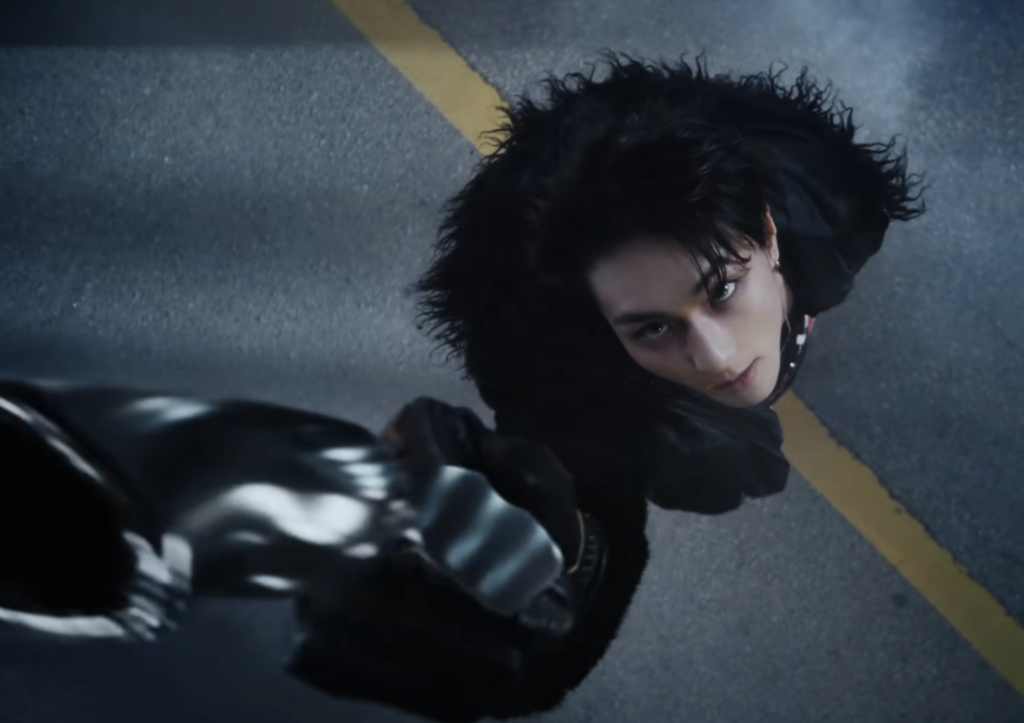
Enhypen also employ storytelling and cinematic aesthetics with the MV for “Knife,” the title track to a concept album, The Sin: Vanish. The story for “Knife” is a simple one that draws on the group’s vampire concept: the Enhypen members are hunted for “breaking a major taboo,” as stated on a news broadcast that opens the MV.
“Knife” feels like an action movie, particularly in the sequences in the point of view of a knife flying through the air. The dynamic camera movements, editing, and visual effects maintain this propulsive energy throughout the MV. However, it not only feels suspenseful but injects some referential humor, from the parody of news segments to the opening dialogue (“What’s behind your back?” “It’s a knife!”) that calls back to a 2017 Vine. “Knife” balances contrasting tones effectively to take viewers on a fun, wild ride.
Perhaps it would also be best not to take the song too seriously, considering that half of its lyrics consist of “It’s a knife.” Frankly, K-pop’s enthusiasm for the rage rap subgenre, specifically the repeated single-word chorus of Travis Scott’s “Fein,” has grown tiresome, especially because Hybe producers tend to adopt trends that have already peaked in Western markets. The MV definitely elevates the song, whose reliance on its repetitive hook might have been more glaring without the visuals.
Aside from the hook, other elements of “Knife” are quite effective at grabbing listeners’ attention. Its opening delivers a jolt of intensity and the trap beats and sharp synths sustain some tension. Without more variation in its melodies or song structure, though, “Knife” feels more like an introduction or interlude than a fully realized title track. Having a double title track with a song like “No Way Back” would have been fitting to flesh out the narrative that “Knife” begins.
Kiiikiii – “404 (New Era)”
Kiiikiii have switched up their sound often in their discography, not settling on one style or genre. However, the UK garage and house influences in their title track “404 (New Era)” suit them particularly well. Produced by LDN Noise, who are known for their energetic club tracks, the song features infectious beats and a catchy hook. The song is well-structured, with the pre-chorus and bridge bringing variety from the talk-singing of the chorus, showing off the members’ airy upper registers. The slowed down bridge also allows the final chorus to burst with energy in contrast.
Kiiikiii marketed their previous comeback “Dancing Alone” with a website referring to “anemoia”, the nostalgia for a time one has not directly experienced. That concept could also apply to “404 (New Era)”, which is full of visual nods to 2000s era music videos and commercials for brands like Apple and Gap. In addition to its Y2K aesthetics, the MV is full of interesting juxtapositions, opening with the members counting down to a “new era” in 2026 then cutting to home video footage of the members as children. This all suggests that in Kiiikiii’s view, there is freedom in embracing the simplicity of the past.
In its final scenes, the MV also calls back to its pre-debut single “I Do Me.” As in that earlier MV, Kiiikiii dance on top of a hill, filmed in hypersaturated colors. While the former single had a laid-back vibe, “404 (New Era)” is upbeat and joyful. Swooping drone footage matches the relentless energy of the dancing, conveying the momentum of Kiiikiii as they enter the new year.
I-dle, feat. Skaiwater – “Mono”
I-dle quietly dropped “Mono,” their first single in 8 months, but have managed to generate conversation. Primarily in English, and without credits from Soyeon or other members, “Mono” is a minimalistic dance pop song that presents a more easy listening, vibey style than other I-dle title tracks. While it lacks the edge of a typical I-dle track, the song takes advantage of softer facets of members’ voices, especially Miyeon’s.
Essentially, “Mono” stands out not for its musical choices, but for its message of self-acceptance and inclusivity, affirming the listener “whether East or West, whether straight or gay.” This message mostly works; however, its focus on unity risks flattening, rather than celebrating, diversity. On the other hand, I cannot think of another K-pop song that explicitly validates sexual orientation and gender identity, rather than relying on subtext and queer coding. That in itself makes “Mono” meaningful.
Fundamentally, though, the song emphasizes the importance of self-love. The first verse advocates taking a ‘monophonic’ approach, listening to only the sound of one’s inner voice:
What they play, that all don’t matter
You’re the beat that’s breaking through
It’s the meaning that hits louder
We’re ’bouta tune in to you
Don’t let the noise get in your way
You’re the rhythm they can’t replace
In other words, the song advises listeners to tune out the noise that keeps them from loving themselves as they are. Images in the MV evoking turntables and sound waves reinforce this message.
Seemingly simple but gorgeously shot, the MV illuminates both the members and diverse troupe of dancers. There are almost no shadows in the mostly monochromatic MV, clearly showing everyone’s features and thus bringing humanity that adds to the inclusive messaging. In the bridge, when Miyeon’s voice ascends with the line “You know you’re born to love,” the image turns from black-and-white to color. The color change is a common technique in visual media, but here it movingly reflects how a deep love for others stems from self-love. As a whole, “Mono” is not exactly musically or visually inventive, but realizes its ideas to have an emotional impact.
(YouTube [1][2][3][4][5][6]. Korea JoongAng Daily. Lyrics via Genius. Images via: Cube Entertainment, Belift Lab).