

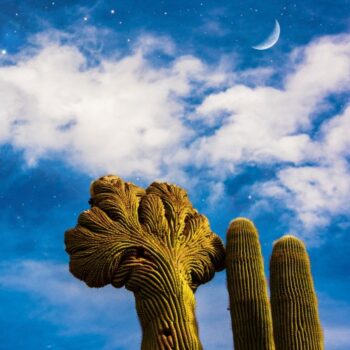
I swear I’ve seen that saguaro before, in Pima County, standing just off the side of the road, marked among the millions crowding the bajadas. At that size, the run rising over the Ajos has cast its strange shadow westward tens of thousands of times, yet it’s still young; a few generations removed from a pre-invasion Sonoran desert that thrived before the mountains had Spanish names, before the concept of the gringo, before the thousands of hung-over ones flattened every snake living within half a mile of Highway 85 driving back from “Rocky Point.” Maybe its great-great-grandmother’s seeds were carried by a coyote, lips stained sticky sanguine, slinking under the monsoon clouds when the only people around were O’Odham, themselves too distracted by the bounty to notice her stealing one more fruit from their baskets. Four generations later, a gray fox takes a pit stop under a creosote, setting a lucky propagule up for seventy years of extension, inch by inch, towards the noon summer sun, until a freak event smears its meristem into a radiate new form, ending this lineage forever.
Just after that point, someone takes its picture, and a couple of Italian guys slap it on a black metal album. A black metal album bent on re-orienting the genre away from a frostbitten North and towards an imaginary sun-bleached South, the saguaro being perhaps the most resilient (and, tellingly, clichéd) symbol thereof. Ambitions often crumble against this landscape; the schemes of miners fall through, the hopeful homesteads dry into rubble, at the bodies of desperate migrants collapse in the canyons. Beauty and hostility, available in such great measure here, produce the romance of the desert, the basis for Radici. Diespnea fail to capture either.
Diespnea practice oddball black metal in the Dødheimsgard idiom, attempting to reinvigorate a staid sound with odd and abrupt inclusions. At the end of “Radici,” they iron a bass groove flat onto gridded electronic beats, then gradually build vocals, drums, and guitars back into the matrix in what would be the record’s most memorable section if it didn’t feel almost identical to the ending of “Vultures.” When the tactic comes around yet again in “Mescalynia,” the effect is more of annoyance than interest. When the duo isn’t dabbling in dull electronica, they’re often whooping and cackling in what seems to be an awful pastiche of pre-Columbian musical traditions.
But the core failure of Radici isn’t in its lazy discursions but the soporific black metal that they depart from. Say what you will about 666 International, there’s no denying the intensity on display. Radici’s official kvlt tab book leads are usually played at three-quarters speed, and the spaces between them sag even more in tempo. Creative songwriting on cuts like “Radici” and “Mescalynia” is hard to appreciate when dragged out for six minutes, though tediously predictable guitar work, and the dull production and brickwalled master don’t do the record any favors. It’s a bit too on-the-nose for a band called Diespnea to sound this asthmatic.
Diespnea have the creativity to embark on something adventurous, but lack the curiosity to decide on a destination, instead floating around their “imaginary South” totally insulated from the confrontation with the real. It’s a painful missed opportunity; the places and traditions and feelings that the duo smudge at are truly profound, and Diespnea’s lazy Tintin “South” is at best an obfuscation and at worst a downright parody of the beauty that desert landscapes, their life, and their peoples hold.
The key to survival in the desert is specificity. In the Sonoran desert, oaks cling only to shady canyon bottoms; senitas populate only the hottest, sandiest washes; water scorpions flourish in ephemeral pools the size of bathtubs, and whole biotas erupt and disappear with the summer monsoons. The desert’s beauty comes from millions of years of coevolution, from novelty and extinction and cycles of glaciation that have stripped away that which does not belong again and again until everything that remains has its place and is fighting to keep it. Radici’s vagaries have nothing in common with places like this, and what Diespnea offer beyond those vagaries is just as unconvincing. And so, Radici comes nearly dead on arrival.
Rating: 2.0/5.0
DR: 4 | Format Reviewed: 320 kbps MP3
Label: Code 666 Records
Websites: facebook.com/diespnea | diespnea.com | diespnea.bandcamp.com
Releases Worldwide: February 13th, 2026
The post Diespnea – Radici Review appeared first on Angry Metal Guy.