
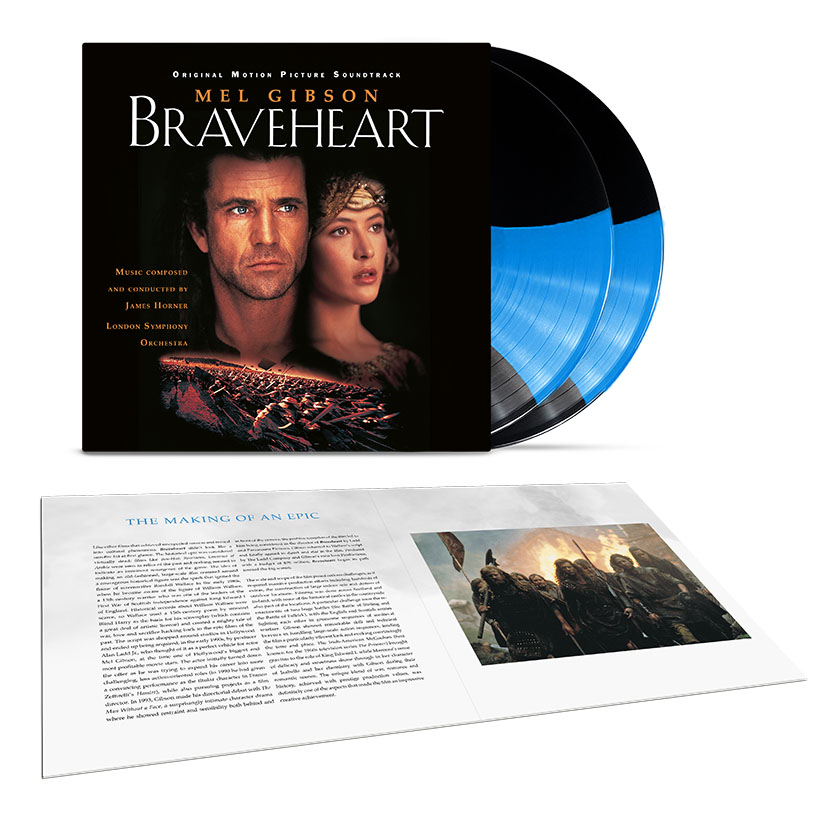
James Horner’s Braveheart soundtrack is coming back to vinyl.
Mel Gibson’s Oscar-winning 1995 epic about 13th century Scottish knight Sir William Wallace gained much of its grandeur from Horner’s original score, performed by the London Symphony Orchestra. The music was nominated for an Academy Award, a BAFTA, and a Golden Globe and is remembered as one of Horner’s crowning achievements.
Arriving just in time for the film’s 30th anniversary, the new soundtrack reissue will be available in a pair of 2LP variants, one on black vinyl, the other on blue streak vinyl, as well as in 2CD format. Each one comes with a booklet about the making of Braveheart and its soundtrack, featuring 4,000-word liner notes titled “The Making of an Epic” by Maurizio Caschetto, film score enthusiast and host of the podcast The Legacy of John Williams.
The composer drew extensively from Celtic and Scottish influences, deploying bagpipes, flutes, bodhran drums, and a boys’ choir to capture the essence of Wallace’s lifetime. “Gibson’s Braveheart features perhaps the most famous, instantly recognizable of Horner’s scores, a perfect marriage of his knack for the lushly romantic and the percussive ramping-up of pure adrenaline,” critic Harry Windsor wrote in a career retrospective following Horner’s death in 2015.
Horner first worked with Gibson on his directorial debut The Man Without a Face, an experience that left a positive impression on Gibson. When the time came to score Braveheart, Gibson “had an idea of what he wanted but not how to get there,” Horner told The Hollywood Reporter.
“We both wanted medieval music, but real medieval music is impossible to listen to for more than 10 minutes,” Horner continued. “So how do we do it? My job was to artistically do a 12th-century score, but one that was accessible to mainstream audiences. We decided to make certain things as primitive as we could. The film had to have scope and scale, so I mixed primitive South American (quena) flutes with Celtic instruments that are out of time with modern instruments. I used Uilleann Pipes, which are small bagpipes, and then sampled sounds digitally, using the synthesizer as a tool to get the right mix.”
According to film score reviewer Craig Lysy of Movie Music UK, Horner called Braveheart his personal favorite of all the scores in his canon. “It is easy to understand why,” Lysy wrote. “He masterfully captured the emotional core of the film, elevated its narrative and exceeded Gibson’s expectations.”