
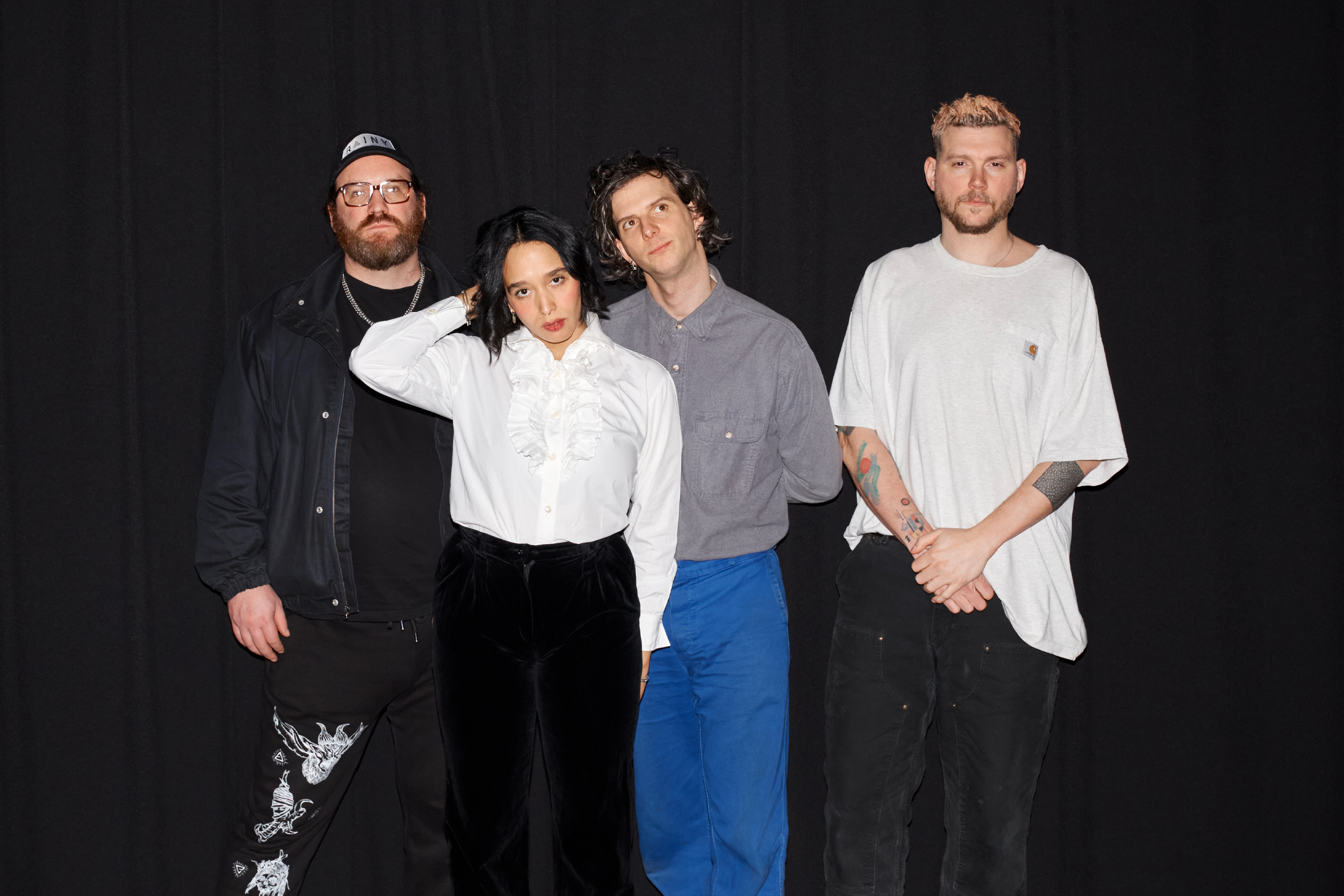
Between NME’s interview with Mandy, Indiana and the publication of this Cover story, something increasingly rare happened: a bit of hope in British politics, specifically in Manchester. Hannah Spencer, a Boltonian plumber representing the Green Party, won the by-election in the city’s Gorton and Denton constituency, beating Reform UK’s right-wing candidate Matt Goodwin. Two of Mandy, Indiana’s members – drummer Alex Macdougall and synth player Simon Catling – live in the constituency, while the other two, guitarist Scott Fair and frontwoman Valentine Caulfield, have been watching from further afield (West Yorkshire and Berlin, respectively). Regardless, when we speak via Zoom three days prior to the by-election, they all respond with a mix of nerves and cautious hope.
“You see something like this, where there’s the far-right who are horrible and the guy doesn’t even live in Manchester, and then you have fucking grassroots community organising where you get this woman who actually represents the people,” Caulfield, who moved from Manchester to Berlin a few years ago, says. (The address reportedly listed on Goodwin’s own ballot was in Hitchin, Hertfordshire.) “I’m not someone who has a lot of hope in politics – just ’cause I don’t have a lot of hope in general – but I think seeing [that] has been incredibly galvanising for me.”
Mandy, Indiana on The Cover of NME. Credit:Tom Oxley for NME
‘Galvanising’ is a word that keeps coming up throughout our interview – fitting, as it’s the intended effect of Mandy, Indiana’s music. On their new album, ‘Urgh’ (you have to pronounce it while throwing your head back and rolling your eyes, the band instruct), speaker-blowing sub synths and disorienting but powerful rhythms force you to imagine dancing your ass off in a foggy, anonymous club, even if you’re having an anxiety attack at the same time. Caulfield’s sprechgesang vocals, the majority of which are in her native French, are strikingly palpable in their urgency and directness, even if you don’t speak the language.
Once you’ve understood the lyrics, the direction of their urgency snaps into focus. “Our humanity is worth more than their lies and their bombs and their hatred,” Caulfield urges on the elastic, shapeshifting ‘Ist Halt So’, before proclaiming solidarity “de Paris à Gaza”. “Stand up and march,” she implores on ‘Dodecahedron’, a track built around a pounding, insistent tom beat. Elsewhere, there’s a caustic treatise on rape culture (‘I’ll Ask Her’), a darkly satisfying revenge fantasy (‘Magazine’, which Caulfield’s therapist encouraged her to write to process her rape), and a blast aimed at the healthcare industry (‘Sicko!’, on which US underground-rap firebrand Billy Woods takes the mic).
Valentine Caufield. Credit: Tom Oxley for NME
The suffocating evil in the world and the rage it makes us feel is at the core of the record, but the band resist despair when they can. “We’re not nihilists, I wouldn’t say,” Fair hazards. “I am,” Caulfield replies, somewhere between deadpan and serious. “Hope feels like a distant memory for me, frankly. But you have to keep your eye on something, because otherwise, you’ll just drown.”
Mandy, Indiana have been making disorienting, incendiary music since just before lockdown, after Caulfield and Fair met while sharing a bill with their previous bands. Fair, from North Wales, had been playing in DIY bands since he was a youngster; Caulfield, meanwhile, is from Paris, and grew up singing choral and opera music until she discovered “a lot of really horrible metal bands”.
“Our music is the equivalent of somebody grabbing you by the shoulders” – SCOTT FAIR
Initially naming themselves Gary, Indiana after a bleak city in the American midwest (they changed it when it started to cause confusion in the US), their combination of harsh industrial dance sounds and intriguing French vocals quickly spread across music blogs and publications, eventually leading to a spot on the NME 100 of 2022 and a deal with tastemaking indie label Fire Talk. Their first album, 2023’s ‘I’ve Seen A Way’, was one of the year’s best indie albums and took them on their first big tours across Europe and the US.
Making ‘Urgh’, then, came with the typical curse of a second album: what do we do now? They spent a weekend trying to figure it out at an isolated studio outside of Leeds that Caulfield insists “was a murder house”. They cracked it when they wrote the muscular, snarling ‘Magazine’, which intermittently swaps out dread-infused, intensifying racket for a pulsating dance beat.
“I think what we were noticing when we were touring and playing festivals was that we were attracted to unexpected rhythms. It’s something that you can dance to, but that you don’t normally dance to,” Fair recalls. “You can dance to some experimental noise artist hitting a snare drum at really weird intervals and throwing things around a room – that’s really exciting to dance to. I’m hopeful that people will be like, ‘Whoa, this is really weird, and I don’t know how to dance to it, but I’m gonna try.’”
Scott Fair. Credit: Tom Oxley for NME
If a Mandy, Indiana record is intense, then a Mandy, Indiana live show even more so. Where they can, the band play biblically loud; they want you to feel the force of the sound hitting you. “I think there would be zero point in listening to our music at low volumes,” Fair says. “It’s mixed loud, it’s written loud, it’s supposed to be moving air in such a way that it affects you physically. You can watch a really amazing, intimate kind of performance from another artist who’s very skilled at that, but when you come to see us, you’re being sort of thrown around. Our music is the equivalent of somebody, like, grabbing you by the shoulders.”
“If you’re someone who is keeping informed about what’s going on across the world,” Macdougall adds, “I don’t know how easy it would be to write calm or chilled [music]. That’s just kind of a disconnect for me.”
Alex MacDougall. Credit: Tom Oxley for NME
Those noble intentions don’t stop sound technicians from asking them to turn it down, and they have blown some speakers in their time. “Often the systems that we’re playing through don’t have the capacity, or the venue won’t allow us to play at that kinda volume,” Fair says. “I think you get more say in that kinda stuff the longer you’re around and the bigger your fanbase is. I can’t imagine My Bloody Valentine playing a show at really low levels – that’s kinda where we’re aiming to be.”
Despite those ambitions, and despite the fact that ‘Urgh’, released last month on Sacred Bones, has picked up even more critical acclaim than ‘I’ve Seen A Way’, the band are not quitting their day jobs, all of which are in solid, nine-to-five careers – partly because they don’t want to. “You hear about bands who go full-time, and where a normal person would go to the office, they go to write music – that doesn’t actually sound that great to me,” Fair says.
“You are losing such a big part of the tapestry if [only rich people] can afford to make art” – VALENTINE CAUFIELD
But it’s also because they can’t afford to, and they want to make that clear. “The music industry as it is currently set up is not designed for working-class people, or even middle-class people, to be able to make a living,” Caulfield says. “For us to go back to the US we would each need to get a three-grand visa, so that’s £12k for four people. We don’t have £12k. And then you need to pay for the flights, and the accommodation, and that’s even without factoring in paying ourselves.
“The music industry is a billion-dollar industry, but that money isn’t really going to the artist,” she continues. “Especially with streaming platforms like Spotify. It’s time to quit Spotify – please print that in bold. Unless we start taking the money out of these platforms, chances are that things are going to remain the way that they are, and it is just depleting the art that we get. I am very happy for rich people to be making music or art, but you are losing such a big part of the tapestry if these are the only people who can afford to make art.”
Simon Catling. Credit: Tom Oxley for NME
Mandy, Indiana’s music remains available to stream on Spotify, though they’ve “had several conversations about leaving the platform as a band”, they tell NME later over email. Their response highlights the situation many emerging and growing artists find themselves in: “Ultimately it’s still a huge way for us to reach new listeners, and the consensus amongst our team was that it was needed to help the album connect with as many people as possible. Hopefully that will change in future as there are better and more ethical platforms out there, although they all come with their own difficulties.”
The future is bleak and getting bleaker, and not just for the music industry. Mandy, Indiana know that; it’s deep in the bones of their clamorous drums, their panicked synths. But every now and then, to paraphrase the title of their first album, you see a way. That’s where their music lives. “I personally don’t think that anyone is coming to save us,” Caulfield says. “I don’t think Keir Starmer or Emmanuel Macron or god forbid Donald Trump are going to have some kind of realisation any time soon that the way that the world is functioning is not working.
“But I’m a strong believer in grassroots organising. I think deep down in most of us, there is a need for connection and for community. We all want to have a good life, we all want to see the people that we love do well, we all want to get our most basic needs met. And until I stop believing in that, I’m gonna keep fighting for it.” The fight goes on, even when you have to take a moment to heave a groan – urgh! – at the state of everything.
Mandy, Indiana’s ‘Urgh’ is out now via Sacred Bones.
Listen to Mandy, Indiana’s exclusive playlist to accompany The Cover below on Spotify or on Apple Music here.
Words: Spencer Hughes
Photography: Tom Oxley
Location: Sitcom Soldiers
The post Mandy, Indiana’s speaker-blowing noise-punk is here to galvanise appeared first on NME.