
Jimmy Eat World frontman Jim Adkins has spoken to NME about revisiting their classic breakthrough album ‘Bleed American’ for its 25th anniversary, as well as plans for the tour and new material.
The Arizona emo icons have a stacked summer of celebrations in honour of their huge 2001 LP, taking in a run of outdoor UK shows with a massive gig at London’s Gunnersbury Park, alongside newly-announced North American gigs, and their return to the legendary Vans Warped Tour.
‘Bleed American’ saw the band turn from struggling underground pioneers into a mainstream global success. Their now classic third album ‘Clarity’ from 1999 would go on to achieve cult status as one of the best emo records of all time, but it was then seen as a commercial failure and saw them dropped by their label, Capitol.
Signing to Dreamworks for the 2001 follow-up, the band didn’t know what was around the corner – let alone that they’d be here to take ‘Bleed American’ on the road again 25 years later.
“I have no idea why it’s been able to do that,” Adkins told NME of the album’s enduring legacy. “Questions like that are the last thing in the universe on your mind when you’re creating something, or even now. We just had this batch of ideas that we were excited about and decided to record them.”
Did they feel like ‘Bleed American’ was going to be their ‘make or break’ moment?
“I can see how from an outside perspective – especially these days – if you were looking at our story and reading that we were dropped by our record label and went on to finance our own album and it went on to be successful that it might look that way,” replied Adkins. “‘Hey guys, this is it, we’re putting it all on black!’
“It wasn’t like that at all from our perspective. The business and industry side of things was all just noise in the background.”
Jim Adkins, Rick Burch, Zac Lind, Tom Linton of Jimmy Eat World, 2001. (Photo by Martyn Goodacre/Getty Images)
Launched by the new century hardcore anthem title track before the singles ‘The Middle’ and ‘The Sweetness’ became radio-dominating hits that would shape emo for decades to come, ‘Bleed American’ saw the band finally able to keep their head above the parapet after nearly a decade of struggle. “Hey, don’t write yourself off yet,” sang Adkins fittingly on ‘The Middle’, echoed on the knowing question in ‘A Praise Chorus’: “Are you gonna to live your life standing in the back, looking around?”
Adkins explained how the album was unconsciously driven by “the seemingly disposable ways that we’re sold happiness or the thing that’s gonna do it for you and fill that black hole inside your spirit”.
“It is commerce, it is disposable, it might feel good for a minute for sure, but is that really it? Is that really going to do it? There’s a healthy place to put that kind of solution, but it doesn’t arrive without some work,” he told NME. “‘Bleed American’ the song is about self-medication, ‘The Middle’ is about the completely unsustainable fuel of validation to power your self worth, it runs throughout the record there.
“I was in my early ‘20s and not offering any solutions to this shit, but it was definitely being explored.”
Check out the rest of our interview with Adkins below, where the frontman told us about perseverance, legacy, what to expect from the anniversary shows, and the long-awaited follow-up to 2019’s ‘Surviving‘.
NME: Hello Jim. What was it like to step up to the plate again with ‘Bleed American’ after already being spat out by the music industry?
Jim Adkins: “We had no illusions about how little that system gave a fuck about bands like us. They can really drop a hammer with someone who’s selling 30,000 albums a week – but they have no idea what to do with a group like us who maybe sold 5,000 copies of everything leading up to that. We learned pretty quickly that the less you have to rely on outside assistance to do what you want to do, the better off you are.”
Has independence always been baked into the band’s DNA?
“When you start taking money from people, it changes things. It’s very rarely to your benefit, there’s very little true empowerment or development. That was our mindset going into make ‘Bleed American’. We had seen just from the work and touring that we were doing, that every time we came back to a city we had more people at the gigs or we were offered a bigger support slot.
“Things were moving up and up. We went and toured Europe for the first time, until we got dropped. We thought, ‘We really don’t need a label, we’re just doing this’. We’d proven to ourselves that we could do this, have fun and grow this project on our own.”
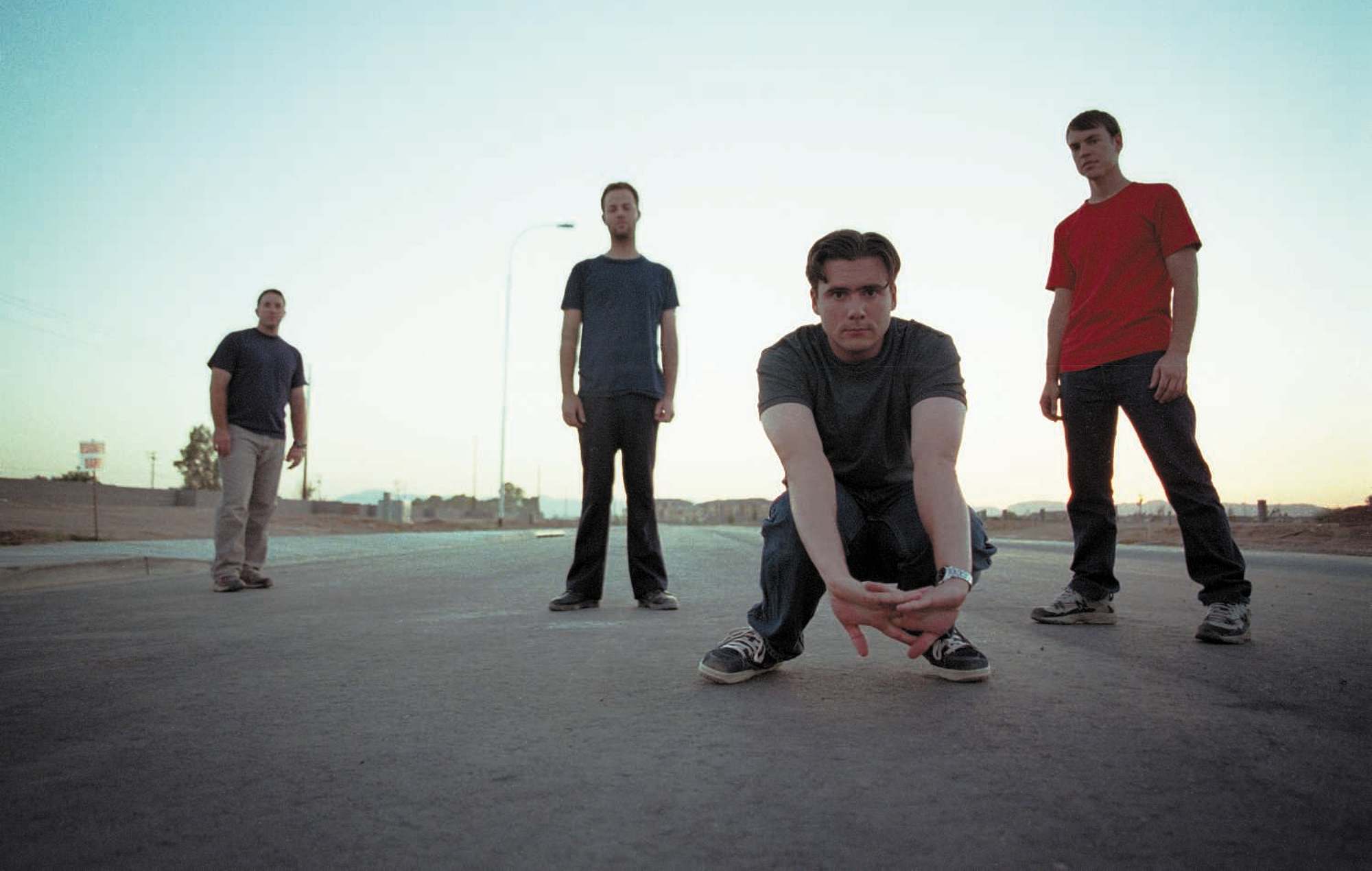
Jimmy Eat World today Credit: Christopher Wray-McCann
New generations of bands cite you as an influence and there always younger fans at the shows. What is it about ‘Bleed American’ that keeps regenerating that interest?
“It went through its ups and downs in a public way in the first five years. ‘The Middle’ was very successful in a commercial way where you didn’t have to seek it out because it was on the radio. ‘Sweetness’ too.
“The people that are finding the album now, or in the last 10 years, means its something they’ve sought out or have been able to absorb in a way that allows it to be theirs, on a personal level. Now you can really feel what it means to you as a listener. That’s powerful.”
You’re a big music fan and lover of the classics yourself. How do you feel about ‘Bleed American’ being part of the emo canon?
“I completely disassociate from it. The longer that we do this, it becomes easier to appreciate the smaller connections that people are making with what we’re doing, and how rare and special that is. Accepting compliments and praise has always been pretty difficult for me personally.”
So how did you cope with all the sudden praise and success back in 2001?
“When we made our first NME cover, it was still hard to accept. Where do you put that? You know: we’re playing Saturday Night Live, we’re on the cover of NME, we’re selling out Brixton Academy, where are you supposed to put that?
“Your whole being has prepared you to reject praise and accomplishment because it gets taken away. We internalised things the best we could, but we were in our early 20s, so we tried to be as present as possible and have fun with it, while not taking it seriously. We took our music deadly serious, but tried to keep everything else in the background.”
Jimmy Eat World fans tend to be quite religious about either ‘Clarity’ or ‘Bleed American’. Have you noticed that? How would you describe the split in personality traits between these psychos?
“Like the pre and post Matt Sharp [Weezer] kind of crowds? I mean, I get it. As a music fan, there’s something extra special about the record or song that you discover. I imagine the ‘Clarity’ vs ‘Bleed American’ people are probably like that because it was the first thing by us that really spoke to them.”
Jack Black with Jim Adkins of Jimmy Eat World backstage, 2001. (Photo by Martyn Goodacre/Getty Images)
For the anniversary shows, will you just be playing the album in full from front-to-back, or are you mixing it up for the setlist?
“First up, I can’t believe the response we’ve had from announcing this. Man, it’s pretty wild! We’re pretty stoked to do these gigs, especially the London one. It just blows my mind. We’re going back and forth on the set, whether we mix up the whole album into a live setlist. When you’ve got 10 albums of material, maybe you wouldn’t normally play those kinds of songs in that order. There’s a different arc to sequencing an album compared to a gig.
“For this, we’ll probably just play the album as a piece. We’ve been thinking about other material and we’re not just going to do that. I’m hoping to present a kind of arc of where we were before and a little bit after ‘Bleed American’, maybe some stuff we haven’t as much or ever. It’s about presenting a story and a little bit into the journal entry that was ‘Bleed American’ for our band.”
Will you be playing the best Jimmy Eat World single that never was, ‘No Sensitivity’?
“That’s highly likely. That split EP with Australia’s Jebediah led up to ‘Bleed American’, and we were in a frenzy of putting out singles and split records. We’ll probably dig into that for these shows.”
It’s been seven years since your last album ‘Surviving’. That’s the same amount of time in which The Beatles recorded their entire catalog. What’s going on?
“It’s been our longest break for sure! Between the plague and trying to catch up from that, it’s been a lot. We came out of the pandemic and we haven’t stopped playing; we’ve definitely been more on than off. We’re always working on new material and I do feel like that shift into a creative writing mode is underway, but I can’t yet say that we have anything that I’d feel confident releasing. It’s time to really focus and shift gears here.”
The last time we spoke in 2019 you told us how ‘Surviving’ was about killing the ego, dealing self-reckoning and doubt, sobriety and such. What’s been inspiring you recently and where are Jimmy Eat World going next?
“You’re never really done with that kind of work, are you? Unfortunately, once you’re self-aware of the effort of trying to rid yourself of self-delusion when it comes to coping mechanisms that may or may not be great for you anymore, it’s tough. You go deeper and deeper, like an upper level PHD course.
“I don’t really have enough material to say if there’s a specific theme, but not unlike ‘Surviving’ it’s about the personal quest to put the things you’ve learned into practice. It’s like with the ‘Bleed American’ thing coming up: when we were kids we were so in the moment that I don’t think any of it sunk in truly. If it did get past the first layer of, ‘I’m going to push you away before you can reject me’ then it was pretty shallow.
“It doesn’t happen on a dime. You sometimes realise, ‘Wow, I really do have a lot’. Maybe one time that protected or served me but I’m aware that isn’t helpful anymore. Now, you’re retraining your default reactions to be responses with agency. Given everything we’ve been through since then, we’re able to experience it in a much more rich way. I’m excited for that.”
Jimmy Eat World today. Credit: Christopher Wray-McCann
Jimmy Eat World’s ‘Bleed American’ 25th anniversary tour kicks off at Red Rocks Amphitheatre in the US on June 9 before rolling through North America – including the Vans Warped tour – and the UK, including Gunnersbury Park with Rise Against, The Get Up Kids and Jay Som. Visit here for tickets to North American shows and here for the UK.
The post Jimmy Eat World talk celebrating 25 years of ‘Bleed American’: “We were kids living in the moment” appeared first on NME.