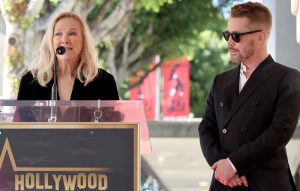

The great Catherine O’Hara – Delia Deetz, Lola Heatherton, Moira Rose, Sally, Cookie Fleck, and a procession of other indelible souls – has left us at seventy-one. She was born March 4, 1954, in Toronto, and died today in Los Angeles after a brief illness. She is survived by her husband, Bo Welch, and their sons, Matthew and Luke.
O’Hara arrived on the scene with a rare readiness. From Toronto’s Second City Theatre she stepped into SCTV, commanding scenes with mad talent such as Martin Short, John Candy, Joe Flaherty and Eugene Levy. She wrote with care, performed with bite, and found in ensemble work a lifelong faith. With SCTV she helped widen comedy’s field, teaching it to trust intelligence, timing, and restraint. Writing and performance braided early for her.
Her place in alternative culture arrived without announcement and stuck like glue. She gravitated to the margins where style speaks first and language follows. In her collaborations with Tim Burton, especially Beetlejuice and The Nightmare Before Christmas, she gave the strange a spine. In this, an unlikely fellowship formed with goth fashion. As Delia Deetz, O’Hara let black serve as thought: art-party severity, architectural dresses, a satirical pretentiousness. These figures offered a lesson: identity is performance; style is stance; laughter steadies the blade…..and an opera glove could double as a hat.
Burton’s worlds found in her a calibrator. She kept fantasy grounded by gesture and posture, by the angle of a chin or the patience of a pause. Even as she voiced Sally in The Nightmare Before Christmas, care and longing moved through the seams. She understood how darkness lives with laughter, how a joke steadies the hand.
Her later work extended that fashion influence across decades. Her screen life gathered quickly: Beetlejuice, After Hours, Home Alone, Waiting for Guffman, Best in Show, A Mighty Wind. In each, she carried an alertness to posture and pause, to the way a voice can tilt a room.
As Moira Rose on Schitt’s Creek, she swanned around rural Ontario in monochrome designer haute couture; her towering silhouettes and flurry of feathers announcing a regal distance from the ordinary. For alternative culture, where style is stance and stance is shelter, Moira became proof that gothic eccentricity ages well.
O’Hara’s reach through film deepened with Christopher Guest and Eugene Levy, where communities were mapped with affection and accuracy. In those rooms she let vanity breathe, let hope stumble, let kindness arrive sideways. O’Hara was showered with awards for her genius, including multiple Emmys and the Order of Canada, but they never defined her work. No one did unhinged and untethered as well as Catherine O’Hara, whether she was racing home to her forgotten kid in the back of a van with John Candy and a polka band, to crooning Midnight At The Oasis with Fred Willard. She threw herself into every role with an unmatched zeal.
She returned often, revisiting Delia in Beetlejuice Beetlejuice, stepping into new dramas, keeping her measure. Across roles, she honoured the outsider’s intelligence and the artist’s patience. She made comedy precise and drama generous. She taught alternative culture a quiet lesson: exaggeration can be honest; laughter can sharpen; style can think. Catherine O’Hara leaves behind a veritable city populated by her hilarious, endlessly quotable characters from the last 50 years…even the ones who don’t know how to ‘fold in the cheese.’
The post Catherine O’Hara Passes Away At 71 appeared first on Post-Punk.com.